
From ‘high conviction’ to patient impact: inside BIA’s UK Biotech Financing 2025 report – Part one

Interview with Dr Martin Turner, director of policy and external affairs, and Rosie Lindup, senior policy and public affairs manager, the UK BioIndustry Association (BIA)
Estimated reading time: 11 minutes
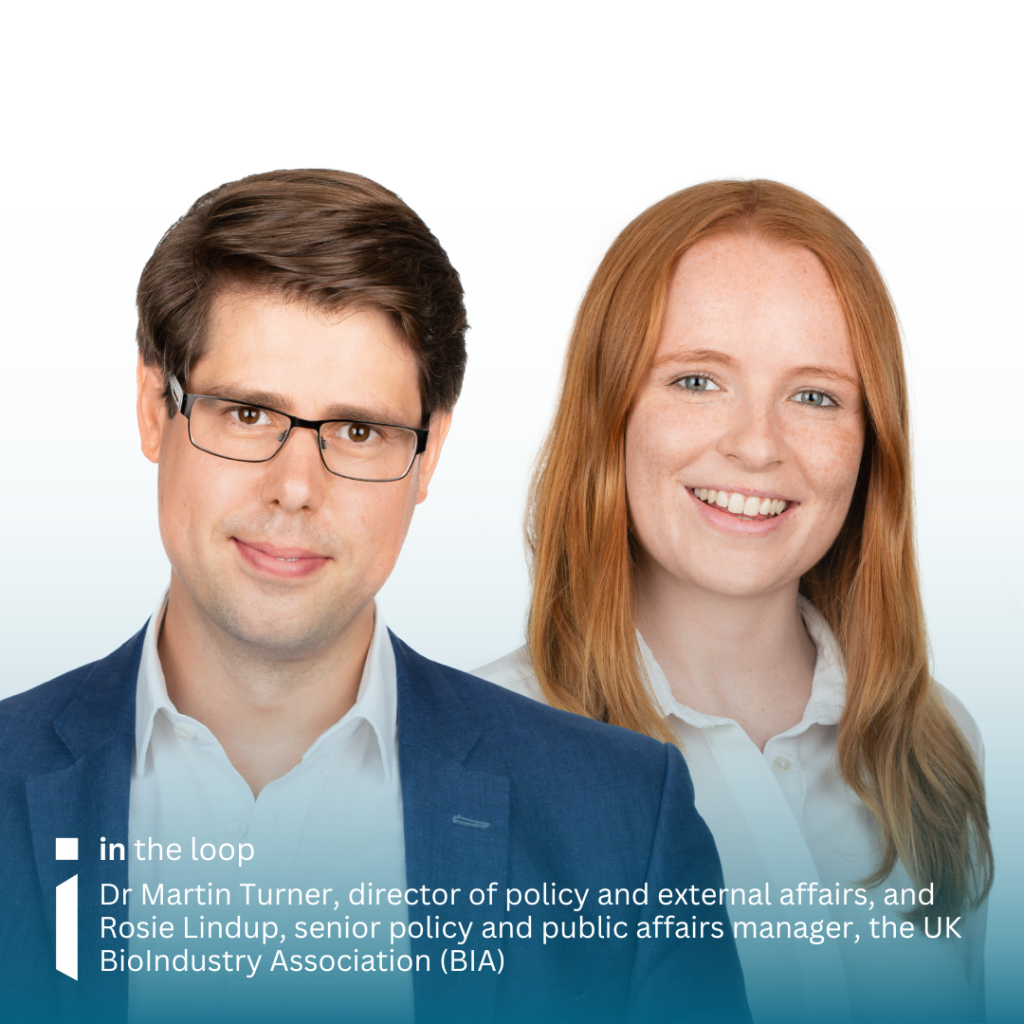

While the headlines focus on billions of pounds and venture capital deal counts, for the 1 in 17 people living with a rare disease in the UK, these numbers represent something more: a pipeline of hope. As the BioIndustry Association reports a ‘strong finish’ to 2025, we sat down with experts Dr Martin Turner, director of policy and external affairs, and Rosie Lindup, senior policy and public affairs manager at BIA, to ask: is the UK truly becoming the global launchpad for the next generation of orphan drugs?
Setting the scene: UK Biotech Financing 2025
BIA’s“UK Biotech Financing 2025”report acts as an annual health check on the strength and direction of the UK life sciences ecosystem. First established over a decade ago in 2012 its core purpose is to track how capital is flowing into UK-headquartered biotech companies, and what that means for the medicines of tomorrow, including those targeting rare and ultra-rare conditions.
As Dr Martin Turner, director of policy and external affairs at BIA explains, the logic is simple but powerful:
“Developing new medicines is an extremely expensive activity that takes many years and hundreds of millions, if not billions, of pounds. The amount of money going into the sector is a direct measure of the amount of science coming through, the promise of that science, and then ultimately, the number of products that convert, coming through the pipeline and getting approved to be given to patients.”
The report focuses primarily on equity fundraising for UK‑HQ’d companies, looking across, venture capital (VC) investment, public markets (IPOs and follow‑on financings) and mergers and acquisitions (M&A).
While the dataset within BIAs recent report spans the full breadth of UK life sciences, the themes—capital scarcity, scaleup risk, regulatory bottlenecks and the rise of AI enabled “TechBio”—are acutely relevant to rare disease innovators. As Rosie Lindup, senior policy and public affairs manager, BIA notes, the UK biotech base is uniquely intertwined with rare conditions: “BIA has had a longstanding focus on rare diseases—partly because a lot of innovation comes from rare disease research, and in part because of our focus on SMEs (small and medium sized enterprises) many of which operate in rare.”
The 2025 financing data is therefore not just a capital markets story; it is an early signal of which rare disease programmes will be born, survive, or stall in the next decade.
The investment landscape and economic drivers
High‑conviction investing: Making rare disease a “must back”, not a “nice to have”
The report describes a more selective, high‑conviction investment climate—fewer bets, but bigger tickets deals behind the strongest stories. For rare disease biotech, often working with tiny patient populations and fragmented natural history data, that raises an obvious question: how can they stand out as “investable”?
For Martin, the answer starts—and almost ends—with data quality and differentiation:
“I think it comes down to the quality of the data produced from a pre‑clinical point of view, if you can do the right type of experiments that are industry standard, using the right models, using the latest genomic techniques and the latest AI predictive models, all of that feeds into a data package that investors will find convincing.”
And in a crowded capital market, relative positioning matters as much as absolute science:
“You obviously want to be differentiated from other companies and products. If you’re speaking to a venture capital investor, they will probably have also been pitched by those other companies. It pays to know what else is in the pipeline and to know how your company or the actual science of your product, is differentiated from other companies vying for investment.”
Rosie adds that the UK’s deep specialist expertise gives rare disease biotech’s an inherent advantage when they can anchor their programmes here: “Part of what gives the UK strength in rare diseases is our strong scientific heritage. We have many of the world’s leading experts and centres here—in hospitals, academia and working in industry. The UK isn’t always the easiest or the cheapest place to do business, but it’s where you have the leading experts and that drives people to stay here, do their early research here and continue to grow here.”
For rare disease founders, the message from the 2025 landscape is clear: high‑conviction capital will follow high‑quality, standards‑aligned data, sharp competitive positioning and visible access to UK centres of excellence, even when patient numbers are small.

The “isomorphic” effect: TechBio and the 95% of rare diseases without treatments
The report highlights landmark deals for AI‑driven discovery platforms, including Isomorphic Labs, as emblematic of a broader TechBio surge. For rare conditions, where ~95% still lack an approved therapy—this shift could be pivotal.
Martin notes that many rare diseases are not singular entities but genetically splintered into ultra‑rare subtypes, making mechanistic understanding and classification essential: “Most rare diseases have genetic subsets. Understanding the core genetic basis of these diseases is absolutely critical, and TechBio is providing the analytical technology that is allowing companies to delve into that genetic basis and discover interconnections.” He points out that the UK has a dual strength in both advanced AI and life sciences: “Most people in the sector believe that AI will fundamentally change how we research and develop new medicines, and the UK particularly has great expertise in both life sciences and AI. There’s a reason why Google DeepMind chose to stay in London and create Isomorphic Labs—its drug discovery arm using AI.”
Rosie observes that many of the TechBio names now front and centre in financing tables are disease‑agnostic platforms whose impact on rare conditions may be under‑appreciated:
“A lot have a huge potential in the rare disease space, but they’re not limited to rare diseases, so these companies probably wouldn’t brand themselves as a rare disease company as such. But that doesn’t mean that there’s not enormous potential for rare.”
For the rare disease community, the “Isomorphic effect” is less about any single deal and more about a structural shift: capital is flowing into tools that can systematically interrogate small, genetically complex populations, which, if equitably deployed, could finally bend the curve for conditions long considered “too rare to research”.
Mansion House and domestic capital: Can the UK fund its own rare disease breakthroughs?
One of the stark findings behind the report is the relative absence of UK domestic institutional capital in late‑stage scale‑up rounds—particularly notable for rare disease and platform companies seeking long-term funding. The Mansion House Accord is designed to change that. Martin explains: “Mansion House Accord is an agreement by 17 pension funds in the UK, with the UK Government, committing them to invest 5% of their capital into the UK by 2030, and a further 5% into private markets. That includes VC which life sciences would fit within.”
For rare diseases, where capital scarcity—not scientific promise—is often the limiting factor, he is clear: “Many medicines will not be developed, not because the science isn’t promising, but because there’s just not enough money to fund every research programme, and with 95% of rare diseases still lacking a cure we really need the capital to be able to do that.”
The strategic prize, if UK pension capital is genuinely unlocked, is choice. Instead of being forced into early trade sales when cash runs out, rare disease companies could choose to stay independent longer: “Bringing more investment into the sector via Mansion House gives management teams the options of going it alone and trying to go all the way and build a company of their own, rather than being bought out by another company.”
Domestic capital is not about shutting out US or European pharma—Martin stresses that international capital is welcome and inevitable—but about rebalancing power so that UK rare disease innovators can decide whether to sell, partner, or scale in place.

The exit environment: IPO freeze, M&A heat, and the future of UK rare disease clusters
With global IPO windows largely closed, the report shows a financing cycle where mergers and acquisitions (M&A) have become the dominant exit route. Deals like the Verona Pharma acquisition by Merck are headline examples.
For Martin, M&A is not inherently a failure mode—it is a “tried and tested” model for the sector:
“Smaller companies develop medicines to a certain stage then get bought by a larger company with the finance and the global reach. There’s nothing wrong with it. That’s kind of how it typically works.”
However, Martin adds, “Rare diseases are structurally different. So that does create an opportunity for smaller companies to go all the way to market if they want to? Perhaps.” The tension is not between “good” or “bad” exits, but between an ecosystem where every success is exported via M&A and one where some companies can mature independently and anchor in the UK. Again, that loops back to domestic scale‑up capital: a vibrant M&A market plus a credible path to independent growth is what will determine whether future Veronas stay and build in the UK or exit abroad.
Rosie is keen that when we celebrate landmark deals, we don’t overlook their rare disease relevance, even if those companies don’t self‑badge as “rare”: Verona’s science, developed in the UK and bought by Merck for around $10bn, includes a pipeline “in lung disease, including cystic fibrosis another one of these examples where they probably wouldn’t brand themselves a rare disease company, but have interest in pipeline in rare disease.”
For rare disease communities, the key question is whether UK clusters can retain enough of this capability post‑deal to sustain jobs, expertise and new company formation locally. Mansion House‑enabled capital, combined with a joined‑up regulatory and access environment, will be critical to making “build here, stay here, grow here” a realistic option.
Global competitiveness and riding through global shocks
The report underlines that overseas institutions account for nearly 90% of Series B and later‑stage investors, raising concerns about exposure to global shocks. Martin doesn’t see the UK as uniquely vulnerable, but he is clear that we are operating in a fundamentally global market: “It is a global sector. The financing of it is global. Every country globally is impacted by what goes on in America. But as China and the Far East become more significant there is a shifting of influence and power there.”
International capital is not, in his view, the problem; over‑reliance without leveraging the UK’s own financial firepower is: “The UK is always going to need to attract international capital, and we definitely welcome that capital, but if we can unlock a few sources of our own capital as well that would be highly beneficial.”
That is why the Mansion House agenda, and broader efforts to shift a “risk‑averse” City of London towards innovation, matter for rare disease companies in particular: “The pension industry is seen as backing old industries, not necessarily innovative companies in life sciences and tech. There does need to be some pushing and maybe even some cajoling from industry with work from government to help them understand our sector and demonstrated the investment potential.”
A more domestically anchored source of capital could act as a buffer against international macro‑volatility—ensuring that promising programmes aren’t derailed simply because global risk appetite shifts or overseas investors rotate out of the sector.
Stay tuned for part two of this article which discusses the role of policy and regulatory bodies in driving investment to follow next week…
You can read BIA’s full analysis and report here:https://biotechfinance.org
To learn more about BIA please visit:https://www.bioindustry.org
Connect with Martin
Connect with Rosie
in the loop lets you stay informed with all the latest issues from the world of RARE. To access more in the loop articles click below.