
Genomics in the UK – progress made and priorities for the next phase

Estimated reading time: 10 minutes
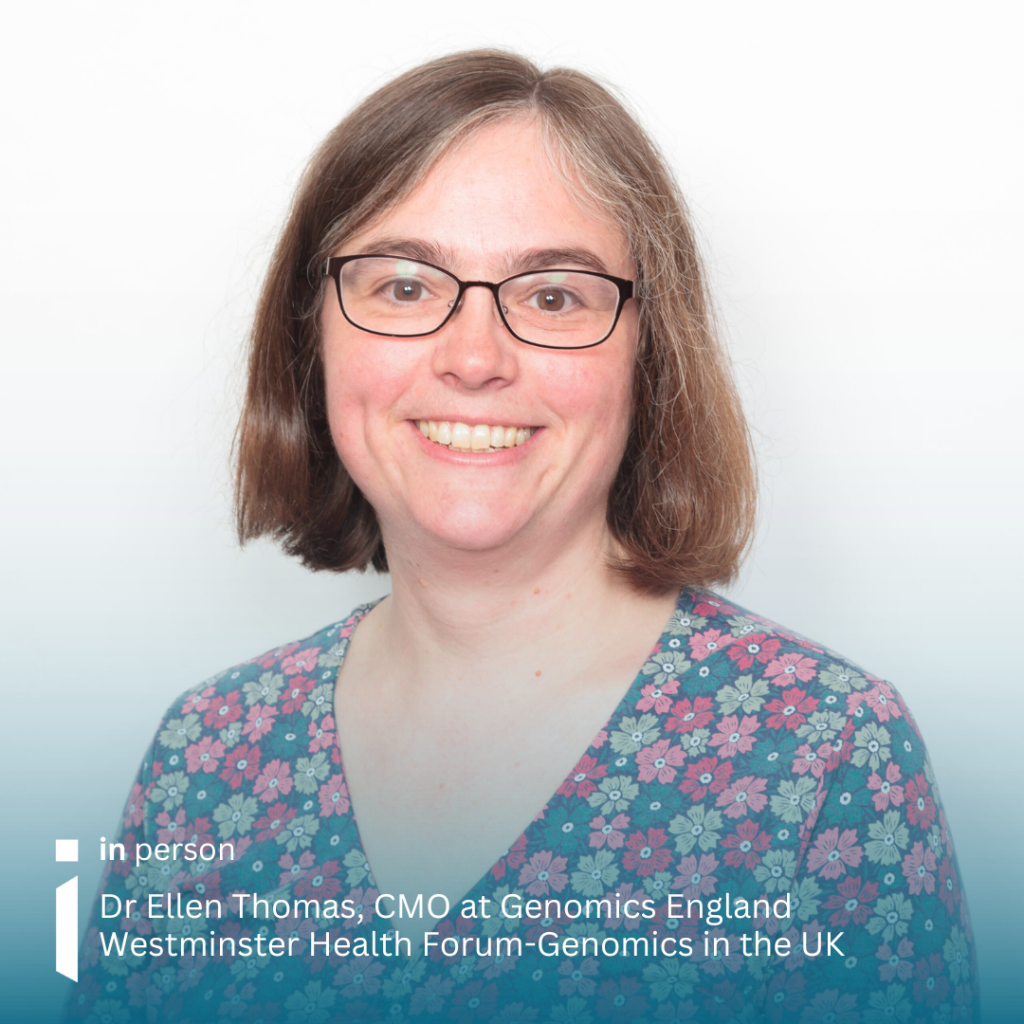
Dr Ellen Thomas, CMO at Genomics England, delivered a keynote speech at the recent Westminster Health Forum-Genomics in the UK, where she highlighted a transformative shift as whole genome sequencing moves directly into NHS laboratories. This evolution aims to make genomics part of routine, preventative care by 2035, accelerating definitive diagnoses and bespoke treatments for children with cancer and rare genetic disorders
As part of a firm commitment in theNHS Long Term Plan,the introduction of theNHS Genomic Medicine Servicewas designed to offer whole genome sequencing as routine care to improve the health of the UK population. For children with a likely genetic disorder or who are affected by paediatric cancers, improved access to a definitive diagnosis and bespoke treatments, could make a life-changing difference to their health.
At a recent conference to assess what’s next for genomics in the UK, Dr Ellen Thomas, chief medical officer at Genomics England, led a keynote session on progress made, learnings from the100,000 Genomes Projectand the ongoingGeneration Studyresearch programme, and next steps priorities.
“We share with the NHS a vision for a world where everyone benefits from genomic medicine, and that’s really what drives the thinking across the ecosystem about where we’re heading in what promises to be a very exciting next phase,” Dr Thomas told the conference. “We believe that by 2035, genomics could play a role in up to half of all healthcare encounters as part of a move for the healthcare system to be increasingly preventative.”
Whole genome sequencing coming inhouse
Early diagnosis and intervention for rare conditions is where genomics started to have its first healthcare impact, she advised the conference.
“We are very lucky in England, that we have this system which allows us to carry out whole genome sequencing as a first-line diagnostic test in a number of rare disease and cancer contexts,” Ellen said. “This accounts for around 8% of the testing that happens across the NHS Genetic Medicine Service in England, and it’s a novel pathway for diagnostics.”
Currently, whole genome sequencing and bioinformatics is fulfilled outside of the NHS and is run centrally in the Illumina laboratory in Cambridge, UK. But Ellen was excited to share that this will be changing soon.
“One of the innovations which is coming over the next year, is that the sequencing is going to move back into NHS laboratories, and that model is going to allow for a different set of priorities to be worked on in the next phase,” she explained. “There’s a big effort at the moment to make sure that this is all wired up seamlessly and lays the foundation for a greater proximity of the whole genome sequencing service to other technologies in the diagnostic context, so this is an exciting development that’s coming up.”
Patients who have their genome sequenced as part of the NHS Genomic Medicine Service (NHS GMS), have the opportunity to donate their clinical and genomic data to the National Genomic Research Library, and to date, this has provided a number of insights and outcomes, Ellen added.
“The benefits of having this system are that we have genomic and clinical data held in a centralised and standardised format, and this allows us to transfer insights from the research world back into healthcare. We can then transfer data in from the healthcare world, with appropriate consent, into the research library. By sharing their data with the research community, patients can really benefit more rapidly from the latest developments in genomic medicine.”
Paving the way for new discoveries
Diagnostic discovery is a process that has been jointly developed between the NHS and Genomics England. The full cohort of patients who have had their genomes sequenced, whether this has been as part of the 100,000 Genomes Project or as part of the NHS GMS, have their data regularly reviewed by researchers and an inhouse team at Genomics England.
Any findings are returned to NHS laboratories. Ellen shared that this includes new findings, as well as situations where a particular variant has proved technically difficult to find, could not be identified in the original analysis, or where new knowledge has occurred.
“So far, we have returned over 5,000 of these diagnoses, and more than 85% of those findings have been classified as being the likely answer in a rare condition,” Ellenexplained. “This is a very streamlined way of continuing to look back at genomic data and making the most of new discoveries. There are also circumstances where having the data together in that standardised format and available for research leads to really dramatic new discoveries.”
Ellen shared an example of how two different research groups discovered the significance of the small non-coding RNU4-2 gene. It led to the definition of a whole new genetic condition known as ReNU syndrome, she explained.
“We think that this might be one of the individually commonest causes of severe neurodevelopmental disorders. That section of the genome had previously not been particularly focused on. But by the time you have a big enough set of data, all in the same place, you can spot these signals. Thousands of children around the world have now received a diagnosis and an explanation. Drug companies are also working hard on looking at how you might develop treatments for ReNU syndrome.”
Improving diagnosis for all
While huge improvements have been made, there is still plenty to do, Ellen added. There are more diagnoses that can be found, and the first type of improvement needed is around being able to identify the full range of genomic variation. For example, through new technologies such as long-read sequencing, and methylation detection through bioinformatics developments.
This would improve understanding on the impact of variation, she said. “Very importantly, this needs to include global variant sharing and having more data available from all genomic ancestries to improve the equity of diagnostic outcomes,” Ellen explained. “We have new omic technologies, which we’re working on across the ecosystem, to work out their place in the diagnostic scheme of things. For example, RNA and protein-based tests, then multiplex assays of variant effect, which are effectively scaled up versions of functional tests and artificial intelligence. These will both play a role.”
The rare disease pathway needs to be extended so that diagnosis in more situations leads seamlessly to treatment, she added. “This involves scaling up genomically-informed therapy development and developing better databases of treatment and trial availability. But very importantly, it also involves having real-world data linkage, as many of these conditions are too rare to run traditional clinical trials.”
Ellen added that the MHRA’splanned reform of the UK rare therapies approachand having theHealth Data Research Service1 will help to ensure that rare patients can be treated effectively.
Continued progress in oncology
Genomics in cancer is making vast strides in understanding, Ellen told the conference. An example was shared of how whole genome sequencing in childhood onset leukaemia had led to improved definitions of the subtypes of leukaemia, leading to the possibility of better prognostication and therapy selection.
Having improved genomic data can help to identify cancer in children more precisely, and in many cases, it can lead to changes in cancer management, or enhance available information about the cancer, beyond what is known from the current standard of care tests.
Similarly, improved understanding of the different types of genomic variation seen in breast cancer tumours can improve treatment selection or provide access to clinical trials. This demonstrates the power of broader genomic tests to provide a greater degree of personalisation in cancer, Ellen shared.
But despite progress made, there are a number of areas where continued improvements in cancer care are needed, she explained. For example, the ability to detect the full range of somatic genomic variation, and long-read sequencing with methylation detection, particularly in brain tumours. This is an active area of exploration, she added, and improving the ability to understand the oncogenicity of variations that are detected, is also needed.
“It’s also crucial that we embed the pathway so that results lead more seamlessly to personalised treatments in more patients,” she concluded. “That’s partly about therapy development, but it’s also about signposting and having better databases of treatments and availability, and the Experimental Cancer Medicine Centre (ECMC) Network is one of the key players in that area.”

Genomics in newborn screening
Part of Ellen’s role at Genomics England is working alongside the NHS on the Generation Study research programme to investigate the role of genomics in newborn screening. As part of her keynote session, she provided an appraisal on current learnings, plus what’s ahead for this promising area of genomics research.
The Generation Study is part of a wider newborn genomes programme, and it has three aims. The first is to evaluate the utility and feasibility of screening newborns for a larger number of childhood onset rare conditions, and this is the main focus of the Generation Study, Ellen explained. The second aim is to understand how newborn infant genomic data could be used for discovery research, and the third aim is to explore risk, benefits, and potential implications of storing a newborn infant’s genome, and reanalysing this, when useful, across their lifetime.
“With the Generation Study, we are now recruiting babies from 66 hospitals around England,”Ellen advised. “We’re coming up to two years into our recruitment in March, and we are aiming to recruit 100,000 babies to the study. Currently, we have just over 35,000 infants recruited, with 25,000 results returned. We have also returned results in which we suspect that a rare condition, one of 200 rare conditions, is present in 93 babies in the NHS.”
Around 0.4% of babies recruited have received a condition-suspected result, which is roughly speaking, what was predicted at the start of the study, she added. “In terms of what we’ve been able to follow up so far, although it’s early days for these babies, 78% of our confirmed outcomes have been reported back to us by the NHS as being true positive results. This is very much what we expected in the context of screening tests.”
Ellen shared a story of an infant who took part in the Generation Study and was subsequently diagnosed with a change in his retinoblastoma gene. Following a referral to a specialist eye department, he was found to have retinoblastoma tumours in both eyes. These were treated quickly and at an early stage, and he has made a full recovery.
The use of genomics in a newborn context is complicated, she added, as there is a lot of evidence to develop, and there is more learning to do as they move towards the next phase.
“But we are beginning to see that using genomics in this preventative context is feasible. We have learned that we can do it, and our timeframe for results is now quite similar to the timeframe for results from the standard blood spot test. This demonstrates that genomics can really contribute to this area.”
Connect with Ellen
References:
[1] hdruk.ac.uk
in person keeps you up to date with RARE conference insights. To access more in person articles click below.