Genomics in the UK – streamlining adoption in the NHS

Estimated reading time: 9 minutes
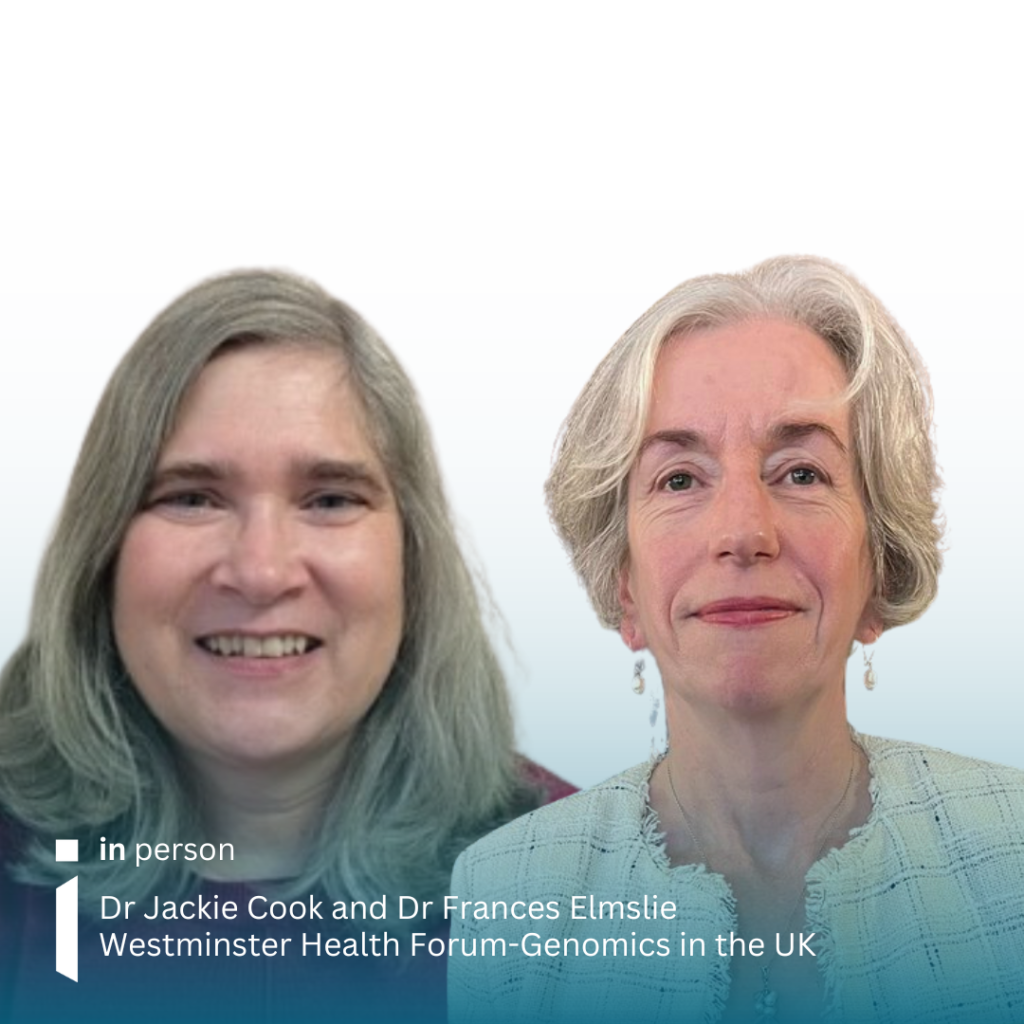
Dr Jackie Cook, a consultant clinical geneticist, and Dr Frances Elmslie, a clinical geneticist, spoke at the recent Westminster Health Forum Policy Conference on genomics in the UK, discussing the importance of genomics in rare disease and the growing need for greater understanding and training in this ever-evolving field
The10 Year Health Planidentified the need for a fundamental shift towards preventative care, and as part of this, genomics was outlined as being central to achieving this ambition. What is required to implement genomics in the NHS, and how it could impact rare disease care was the topic of the closing session of a recent Westminster Health Forum Policy Conference.
Dr Jackie Cook is a consultant clinical geneticist, and clinical director for rare disease at North East and Yorkshire Genomic Medicine Service. She began with a description of how genomics has already had an impact on healthcare.
“Rare disease is the most established element of genomics in the NHS at this current time,” she told the conference. “Our goal in the next 10 years is to make a positive impact on the diagnostic odyssey facing patients with rare genomic diseases. For a lot of children and individuals, it will be three to five years before a diagnosis is made, and that is just not good enough. We have got to speed that up.”
Improving rare disease awareness in the NHS
One of the issues at the moment is the clinical workforce is quite “genomically illiterate”, Jackie explained. “We have to train our clinicians in both primary and secondary care to first of all recognise when they have a patient in front of them with a rare disease. We need to make sure that although they may not be making a diagnosis, they recognise individuals that have a suspected rare disease will need to be seen by a specialist.”
Another change that would help is to ensure there is “equitable access” to specialists in particular fields and genomic testing, she added. “It’s important that those individuals get genetic testing where it is going to make a difference. We’re not doing genetic testing because it is interesting. Genetic testing contributes to the management of that patient’s rare condition.”
Improved NHS recognition of rare disease would lead to more rapid referrals to specialist centres, including clinical genetics services for very complex syndromic cases. But most of the time, primary care professionals such as doctors would do this via tertiary referral centres, where specialists will have seen these diseases before, Jackie advised.
“We do not want patients with a rare disease being seen by someone who has never had a case of it before,” she said. “They need to be in specialist centres that can arrange appropriate genetic testing, provide a diagnosis, and more importantly, where they may have access to clinical trials. We can then start to think about centres that are involved in theRare Disease Therapies Launch Padwho could offer treatments for ultra rare diseases where they may only be one person in the country being treated.”
Wider use of AI needed
In addition to the need to speed up the diagnostic odyssey that patients face, the timings around genetic testing could also be improved, Jackie told the conference.
“Once the blood is taken and is sent to the laboratory, we need a much faster turnaround time than we have at the moment. Key to this is automation so that we can use robotics to move the sample through the diagnostic pathway, and AI to aid variant interpretation.
“At the moment, interpretation of these genetic results is incredibly complex,” she explained. “We all have millions of variants within our genome that we have to wade through, and you cannot do that with one person sitting at a computer. We have to use AI more and more in order to help us come up with the causative variant.”
The introduction of new technologies is another requirement, Jackie advised. “There has been talk about looking outside the coding region, and we know that just looking in the coding region is not going to make all the diagnoses out there. We need to be looking outside of unity regulatory regions.”
Prevention considerations
Rare disease prevention was another component of change needed that Jackie highlighted during her session. “Once we have identified conditions that are inherited within families, we need to look at familiar predictive testing so that we can identify people who are potentially at risk, in order to inform screening and improve decision-making in terms of treatments. We also need to be thinking about how we can identify all those people that are potentially at risk, and whether this could work via newborn screening or theNHS health check(offered to patients aged 40 and over), for example.”
Currently ongoing, is theGeneration Study,a newborn screening programme that is run by Genomics England in partnership with the NHS. The study aims to identify rare and serious health conditions at the earliest opportunity. Asked about her views on the programme, Jackie said, “I think the first thing to say about the Generation Study is this is a research programme, and there is a danger in leaping ahead to conclusions about what it’s going to show,” she said. “One of the programme’s first aims is to identify babies with genetic conditions that are treatable as if we can treat them early, we may mitigate some of the long-term consequences of some of these diseases. I think that is a really important aspect. The study is multi-faceted, and I think it is going to be fascinating to see how it pans out and the information that comes back from it.”
Jackie added that the whole genome sequencing of newborns who participate in the study, could provide a wealth of information that could be useful in the future in terms of pharmacogenomics. She concluded with the message that it is a “very exciting time to be in genomics”.

Improving molecular diagnosis rates
Dr Frances Elmslie is a clinical geneticist, and chair of the board of trustees at the Tuberous Sclerosis Association. She began with an introduction to the condition.
“Tuberous sclerosis complex (TSC) is a rare disease that affects many different parts of the body,” she explained. “It causes benign tumours to grow, but in complicated, difficult to access places. TSC is often associated with both learning difficulties and epilepsy, and it affects around one in 6,000 people in the general population. For clinical geneticists, TSC is one of our bread and butter conditions.”
How TSC affects people varies hugely from individual to individual. Yet, around 15% of patients with TSC do not receive a molecular diagnosis on first-line genomic testing. Frances explained that deep sequencing, a technique where the genetic code is read multiple times, can provide these results for 5-10% of people affected by TSC, and this is enormously helpful.
“From a patient perspective, a rare disease diagnosis of TSC induces a lot of emotions,” she told the conference. “First of all, it very often just gives people uncertainty. We often have to say wait and see when we make a diagnosis, particularly in a young child, as we do not know what the future will hold and that makes it very difficult for families.”
Genetic testing and providing a confirmed clinical diagnosis matters as it guides treatment decisions. “The only reason we have treatments for tuberous sclerosis is because we understand the genetic background to this condition now, and that is amazing as we didn’t have treatments when I first got into medicine,” she advised. “Having access to treatments enables family planning and cascade testing, so we can identify other family members who may be at risk. It also enables access to clinical trials and precision medicine.”
Improvements to molecular diagnosis in rare disease must be made, she told the conference. The variability in access to genomic services, and particularly specialist TSC clinics, also needs to be addressed. “Partly this is geographical, but partly it’s because healthcare professionals don’t know about them,” she said. “Patients can also experience delays in testing, access to treatment and reproductive planning can also be affected.”
But not everyone with TSC will receive a molecular diagnosis and this can create a barrier to being placed on registries and accessing clinical trials.
Frances shared a comment from a patient who has TSC, but does not have a molecular diagnosis. “I know it sounds strange, but the negative result from the genetic testing was really upsetting,” the patient said. “I have all the symptoms of TSC, and my doctors tell me that I have TSC, but the genetic test could not find any proof.” The patient has a young son who is unaffected by the condition, and is currently expecting her second child.
“We have still not identified a genetic chain for her, but we know she has tuberous sclerosis,” Frances added.
Improving access to treatments
At the end of her session, Frances responded to a question on how improving access to treatments could potentially work.
“There has been quite a lot of focus on repurposing of current medications and this requires understanding genetic mechanisms before we consider whether there are drugs already out there that may be able to treat some of the rare conditions we see,” she explained. “But, it’s a really good place to start as we already understand those drugs and they could be provided to patients quickly.”
She also discussed theHuntington’s disease clinical trialand described it as “exciting”, but expressed caution about the road ahead. “It’s going to cost millions of pounds, and there’s a lot of due diligence to be done before it actually comes into clinical practice, including regulatory and financial hurdles. But undoubtedly, it is an exciting treatment prospect that is on the horizon.”
Connect with Jackie
Connect with Frances
in person keeps you up to date with RARE conference insights. To access more in person articles click below.