

Is it possible to predict and prevent seizures? The promise of a new algorithm

Interview with Petroula Laiou, co-founder and CEO of NeuralPulse
Estimated reading time: 7 minutes
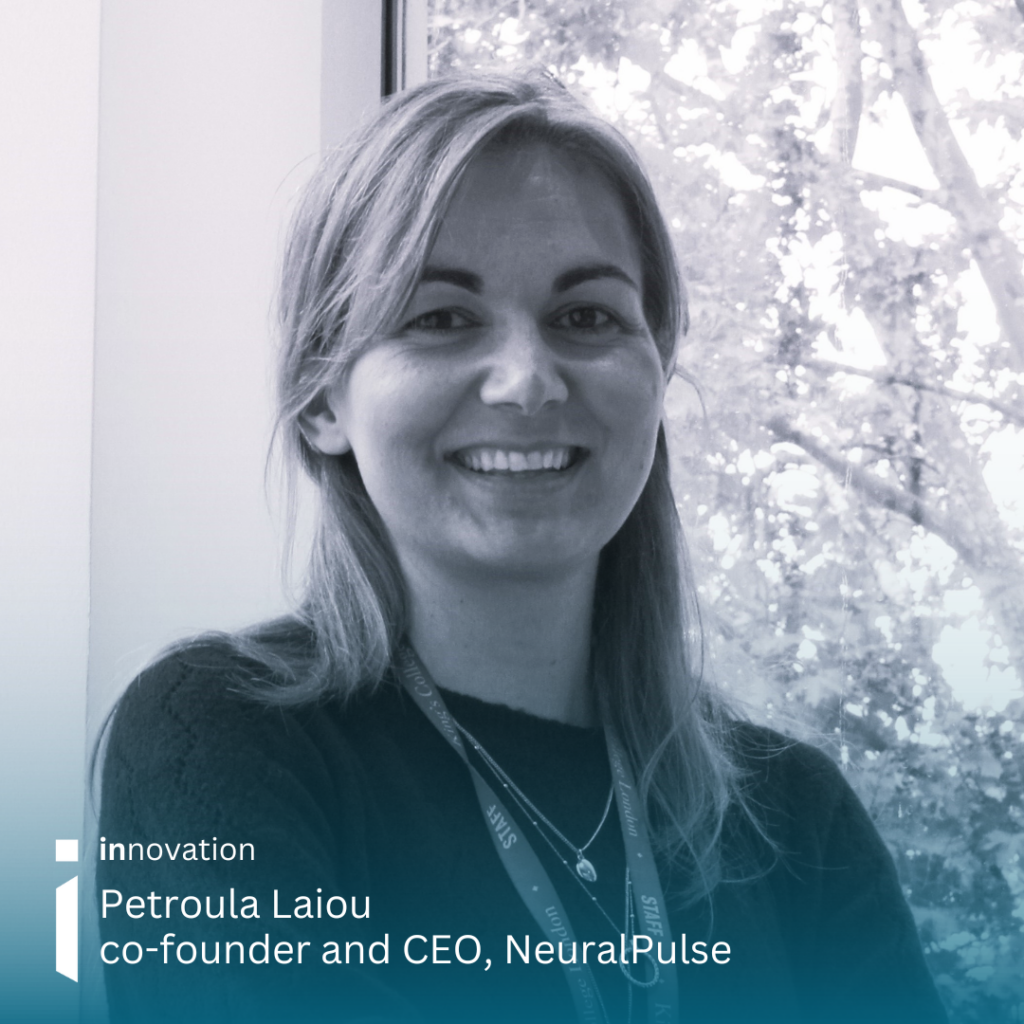

Petroula Laiou, Research Fellow at Kings College London and CEO of NeuralPulse, has developed a software that not only predicts seizures, but prevents them from happening altogether. Her algorithm aims to change the lives of the millions worldwide living with drug-resistant epilepsy, who currently have no way of reliably and effectively controlling their seizures
The need for better seizure care
Seizures are sudden bursts of electrical brain activity. They arise when brain cells communicate in an unusual, overly coordinated pattern, often causing loss of consciousness and muscle control. Around 50 million people across the globe are affected by epilepsy1. Out of these 50 million, it is estimated that approximately one third experience seizures which cannot be controlled by medication (drug-resistant or intractable epilepsy) .
Petroula explains that “for those with drug resistant epilepsy, their lives are often dominated by uncontrolled seizures—unpredictable events that can cause damage in the brain, cognitive and psychiatric decline, injuries, frequent hospitalisations and sometimes premature death.”
She states how aside from brain surgery, which carries many risks, there is “currently no effective treatment,” and that the mission of her research “is to change the lives of people who have drug-resistant epilepsy,” by creating an effective way to both forecast and manage seizures.
Answers in plain sight
Though Petroula’s research is cutting edge, it first came about when she was tasked with analysing data that had been collected many years prior. She explains, “teams had tried to analyse this dataset before, but weren’t able to find an insightful outcome.”
But with Petroula s mathematical skills, alongside neuroscientists Professor Mark Richardson and Doctor Joel Winston, the team were able to spot patterns in the data that had so far been missed. The team then translated these patterns into a predictive algorithm, allowing them to forecast seizures with a higher accuracy than any other method to date.
What sets this technology apart?
Petroula explains that her team has “not developed a brain implant device itself, because these already exist, but a software that can be used inside brain implants, to enhance their predictive and therapeutic capabilities.”
She also shares that other methods of seizure forecasting are in use already, but that her technology can make predictions with potentially life-changing accuracy.
“So far, all methods of seizure forecasting passively collect brain signals from the implantable devices and then use these to try and identify patterns that tend to appear before seizures. This can predict seizures better than random chance, but it still often underperforms, and is far from being clinically useful.”
The ‘passive monitoring’ Petroula mentions involves a constant collecting of data on brain activity. This differs from her new approach, which instead actively probes the brain with tiny electrical impulses, and measures its response from moment-to-moment.
She expands, “It’s like a radar for the brain. Imagine you’re walking in a forest, and you know that danger might be approaching. Instead of just listening for distant sounds, you send pulses and then measure the echo and the bounce, to know exactly where the danger is coming from. This is what we do. We predict seizure risk based on the brain’s response to electrical stimulation.”
Probe, predict, prevent
In addition to its predictive capabilities, the technology Petroula and her team are developing also aims to prevent seizures from occurring.
She explains how, “tiny electrical pulses estimate seizure risk from moment-to-moment. If the seizure risk exceeds the threshold, then the device would change the frequency of these pulses, administering therapeutic stimulation to prevent the seizure from starting. We call this ‘adaptive neuromodulation’.”
Petroula shares that this technology is the first of its kind and could be applied to any existing brain implant that has the capability to sense and stimulate. This means that people who have implants already, wouldn’t need further surgery to access the treatment.
Onwards and outwards: The next stage of development
So far, Petroula and her team have conducted their first in-human study, published in Epilepsia2, before founding a company called NeuralPulse, to file for an international patent for their technology.
She outlines, how, “At NeuralPulse, we are a multidisciplinary team. We have expert mathematicians, engineers, and clinicians and we work together to build all of the core technology. I’m responsible for data design and data analysis, working alongside Professor Mark Richardson, Head of the School of Neuroscience at Kings College London, and Doctor Joel Winston, who is a senior lecturer in clinical neurophysiology.”
Now, NeuralPulse aims to do a clinical study with a much larger group of participants, to test the technology in real-time.
Petroula explains “the company is currently fundraising to carry out this next stage of the research, which is a large clinical trial.
We need this trial to validate the robustness of the algorithm, as we want to show that it works in both adults and children, as well as identifying the minimal requirements that are needed to integrate it into actual brain implants. We also, of course, need to do real-time testing of the whole forecasting and therapeutic approach.”
Epilepsy and beyond
Petroula shares that her “day one mission” has always been to help those with drug resistant epilepsy, creating viable treatment options and giving them control over their seizures. However, she goes on to share how this method of actively stimulating the brain could also have positive impact for other conditions too.
“After this, we have a vision to expand to other neurological and psychiatric conditions. There are several brain disorders that manifest as these episodic events, where people are stable one moment, and then not the next.
This concept of probing the brain doesn’t just have potential in epilepsy, but also in conditions such as mood and anxiety disorders. It would be good to predict these episodes in advance, in order to prevent them from happening.”
The head and the heart, the science and the impact
With tens of millions worldwide living with drug-resistant epilepsy, the work of Petroula and NeuralPulse has the potential to be revolutionary. When speaking about what motivates her research, Petroula shares that:
“Working in epilepsy research covers both my brain and heart.
It covers my brain in the sense that I get to use complex mathematics, concepts from physics, machine learning, AI and biology. It’s a really nice interdisciplinary field, and I think having these crossovers with people from other areas is beautiful.”
“At the same time, I also do it for my heart, because I’m doing something to help others.
Seeing people in pain, suffering in the hospital, and knowing that your work can help them, is really fulfilling.”
To learn more about NeuralPulse, please visit:https://www.neural-pulse.com
Connect with Petroula
References:
[1] https://www.who.int/news-room/fact-sheets/detail/epilepsy
[2] https://onlinelibrary.wiley.com/doi/10.1111/epi.18518
innovation spotlights the future of RARE through a technological lens. To access more innovation articles click below.