

Programming the future of rare disease: ABYA Genomics’ AI revolution

Interview with Tim Szalay, founder and CEO of ABYA Genomics
Estimated reading time: 1 minute
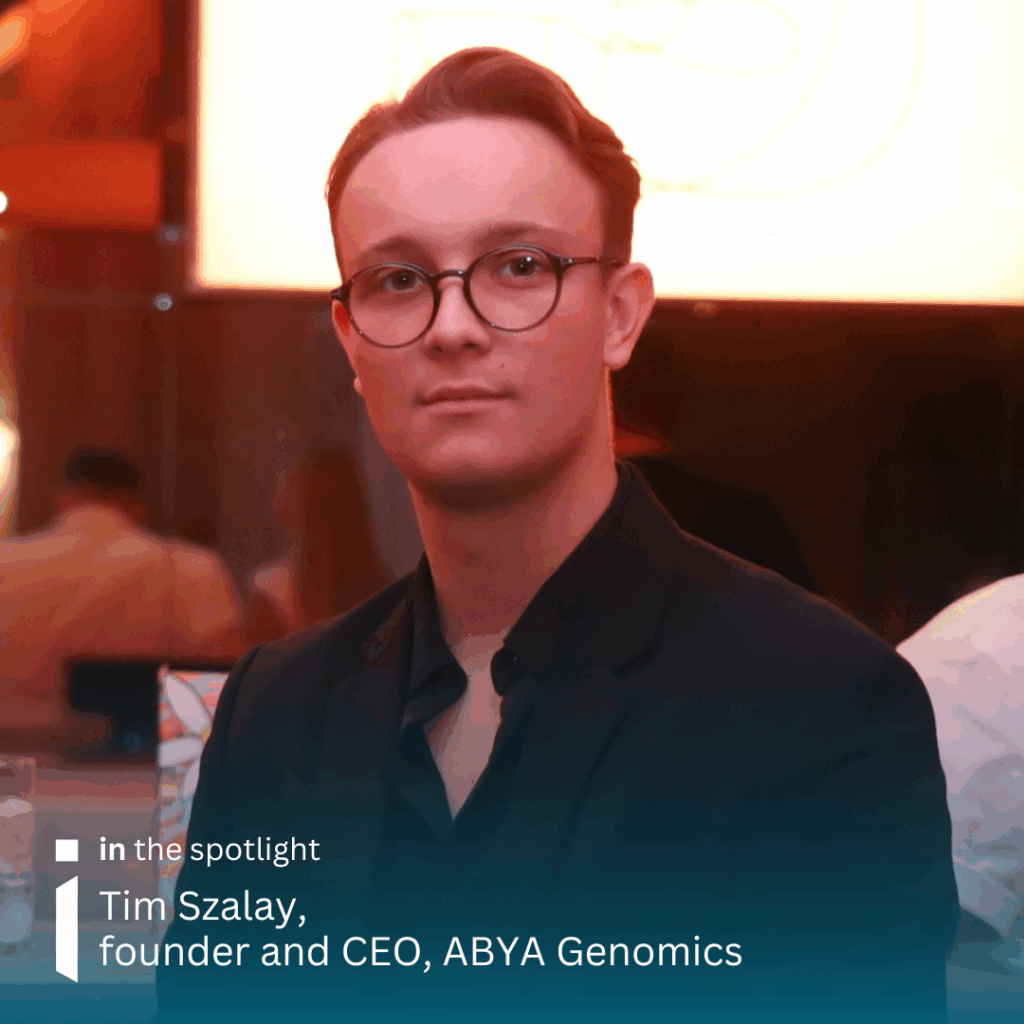
ABYA Genomics aims to revolutionise rare disease research by combining cutting-edge AI, intuitive bioinformatics tools and an unwavering commitment to accessibility. Founded by self-taught innovator Tim Szalay, whose own health journey inspired the company’s mission, ABYA Genomics is challenging the status quo. Recognised globally for its potential, the company’s transparent, patient-driven approach is paving the way for a more personalised future
Name:
CEO:
No of staff:
Company status: Head office: Sector:
Founded:
ABYA Genomics
Tim Szalay
Two
Private
Delaware, US
Biotechnology
2024
An unconventional path
ABYA Genomics is a company driven by the personal story and truly pioneering vision of its founder, Tim Szalay—a young scientist whose experience as both patient and data explorer led to a bold new approach in genomics and rare disease research.
From the start, Tim’s journey was defined by challenges that would ultimately shape his careers as Tim explains, “It all started very early, because I was born with one kidney, and then later, when I was 14 or 15, I was diagnosed with juvenile arthritis. And these two events really led me to think about medicine and my personal medicine, and how do we treat diseases in general?” These formative experiences inspired a relentless curiosity and a “prime example” approach: “I’ve basically been a clinical trial my whole life,” Tim reflects.
Instead of following a conventional academic path, Slovakia born Tim, became a self-taught data scientist and machine learning enthusiast, motivated in part by being turned away from academia. “I was rejected by four schools when I was applying for universities because I didn’t have a formal English language certificate,” Tim recalls. He responded by throwing himself into informatics and coding, sometimes even skipping regular school classes to “learn data science and models”. This unconventional route became a strategic advantage where his youth and lack of formal training became a strength, allowing him to explore, unconstrained by limitations.
The company’s name, “ABYA,” is even rooted in Tim’s lifelong fascination with science, specifically astronomy. “The name was born in high school. I was really interested in black holes and worm holes. I shortlisted the four most important black holes, largest ones, the most interesting ones, which are the closest ones to Earth. And those black holes’ initials start with A, B, Y, and A.” For Tim, the name is a symbol of cosmic exploration, discovery and curiosity: qualities that perfectly echo his future-focused vision for genomics.
Together, Tim’s personal journey, self-taught expertise, and imaginative spirit define the heart of ABYA Genomics: a company built alongside his co-founder Sree Chanumolu, to challenge tradition, expand access and accelerate the possibilities of rare disease research.

AI, genomics and the path to faster diagnoses
Rare disease patients know too well the agonising “diagnostic odyssey”: years spent searching for answers through trial, error and uncertainty. ABYA Genomics hope to rewrite that narrative with a technical leap: the fusion of AI-powered analytics and advanced genomics to transform those years into days.
Bridging the gap between raw genetic data and actionable insights, Tim emphasises what sets ABYA Genomics apart: “Many competitors focus on a specific set of computational tools. What we are doing is focusing on the most groundbreaking technologies that exist and combining them into one platform”—making the process significantly more streamlined and time efficient for researchers. Three major layers of AI are at work: guiding hypothesis generation, selecting the best analytical tools and running complex virtual cell simulations: each designed to make diagnosis and drug discovery faster, simpler and more effective.
A cornerstone of this innovation is the concept of the “virtual clinical trial.” For communities familiar with the slow pace of multi-phase trials, Tim envisions a future where “clinical trials are not going to be needed. Where everything is going to be done in silico, meaning computationally by the creation of “digital cell twins”, “simulating the entire drug development, research and development, and efficacy and safety on a digital basis rather than on real-life community participants.”
Already today, ABYA’s model allows researchers to run in silico predictions, dramatically improving the targeting of laboratory tests, and, as accuracy improves, moving ever closer to safe, regulator-accepted digital trials.
Technology meets patient advocacy
ABYA Genomics’ technology isn’t built in a vacuum—it’s designed with a clear purpose: to give practical hope, answers and agency to people living with rare conditions and their families.
For families facing diseases that are often unpredictable and poorly understood, ABYA’s predictive modelling aims to give clarity about the future. “Could we be in a position where we could tell parents if your child has this mutation of this disease, this is what they may look like in 5, 10, 15 years without intervention, and actually, then this is what they might look like with an intervention? Exactly, and also without any subjective arguments, but actual objective data behind it,” Tim affirms. “It’s not just a subjective argument but there’s actual digital twin data supporting that.” This modelling can provide families, and their clinicians, actionable, individualised projections based on comprehensive data, turning guesswork into evidence-backed planning.
Access to this technology isn’t limited to the privileged. Their “2002 Macintosh Experiment” demonstrated that ABYA’s tools can run on even decades-old computers: “That’s the exact point of this testing, to show that our platform is able to run on outdated infrastructure.” For families and clinics in low-resource settings, this democratises high-powered genetics research, breaking down geographic and financial barriers and advancing global health equity in rare disease.
Transparency is another pillar of ABYA Genomics’ approach. While biotech is often a world of closed doors and secretive development, ABYA’s “Behind the Science” work sessions on YouTube are a deliberate act of opening up the process—and the conversation. “We wanted to be as transparent as possible in the work we’re doing, for people to see our evolution from the first days, which were literally playing around with a bunch of tools, to seeing what we can do now to build something of great value,” Tim explains. This open, accessible narrative invites the rare disease community—and the world—to follow along, ask questions and become involved in this bioinformatics revolution in the making.
By prioritising predictive insight, radical accessibility and true transparency, ABYA Genomics is not just advancing technology—it is championing the needs and empowerment of the people behind the science.

The roadmap ahead: global recognition and a new hope for rare disease
ABYA Genomics’ journey, driven by vision and ingenuity, is gaining momentum on the world stage. Recently nominated for a Global Startup Award, the company is earning recognition far beyond its modest beginnings. In a competitive, investment-heavy landscape, this validation affirms that a mission-driven, technology-first approach can break through. Proving that startups and newcomers in the field can win respect by relentlessly focusing on real-world impact and a bold vision.
Looking ahead, one of ABYA Genomics’ boldest visions lies at the intersection of AI and gene-editing technology. By harnessing AI to model and simulate gene-editing tools like CRISPR-Cas9, ABYA aims to make tailor-made therapies safer, faster and vastly more predictable. As Tim explains, “We want to simulate what’s going to happen if you do an incision with CRISPR, for example, and how it’s going to affect over time. That’s where the digital twin comes in, simulating the actual physics environment behind it, the chemistry and how the timeline is affecting that incision.” Tim believes that in the next 3–5 years, this synthesis of deep computational insight and practical lab work could bridge the final gap between digital theory and life-saving therapies delivered directly to patients.
To the rare disease “insiders”—from researchers to advocates—Tim’s message is one of radical potential: “We’ve been stuck in the innovation phase when it comes to biotechnology and computational biology for a long time. One of the missions of our company is to change people’s perceptions and move beyond this phase.”
ABYA Genomics strives to open doors for ordinary patients, for everyday researchers, for anyone who dares to think differently and imagine new solutions.
So, what could the rare disease experience look like for a child born in 2030, in a world where biology can be programmed with the precision of software? If this, now just 21-year-old innovator/founder and his company ABYA Genomics succeed, it means a future where diagnosis is instant, treatments are tailored, hope is real—and the next generation’s rare disease journey is defined not by waiting, but by possibility.
To learn more please visit:https://www.ABYAgenomics.com
Connect with Tim
in the spotlight profiles innovative companies working in the RARE space. To access more in the spotlight articles click below.