
Rare Disease Day: after the dust settles

Estimated reading time: 4 minutes
As Rare Disease Day 2026 concludes, the global community transitions from a moment of high-profile advocacy to the quiet reality of daily life. While the collective movement celebrates significant impact, individuals often face a profound emotional aftermath. Now is the time to reach out and make your community feel seen and heard by acknowledging the unspoken personal collateral of RDD
Another Rare Disease Day has been and gone. And it’s been incredible to see the breadth of activity happening around the world. From local events to historic monuments shining like beacons of hope in hues identifiable as the colours of the day—and everything in-between. We have elevated our voices, shared our collective stories and embraced the missions to #Showyourstripes become #Rareaware, #LightUpForRare and strive to be #MoreThanYouCanImagaine and #StrongerTogether.
We, as one global community, stood up, spoke our truths and did everything we could to be seen, heard and honoured—all in the hope that this swell of attention helps us in our collective and individual quests to move the needle and turn the tide for rare diseases.
But of course, for the rare disease family community RDD this isn’t just one day. The efforts we see across the world on RDD are an accumulation of 365 days of advocacy, and in many cases 365 days of sheer grind. For those entrenched in the world of rare disease it means digging in and going the extra mile. For those not so entrenched, RDD may be a once-a-year snapshot of their personal lives that they lay bare to the world in the spirit of education and awareness raising, or for some it may be the first time they show themselves to the outside world to be rare.
For professionals RDD is a powerful opportunity to show your support which can manifest in many ways from lunch and learns, event attendance, pro-bono or sponsored support right down to donning your stripey socks.
In short, RDD is a powerful advocacy movement that can feel celebratory and joyous and can show through analytics, metrics and change to be highly impactful.
But there is something profound we cannot and should not lose sight of.
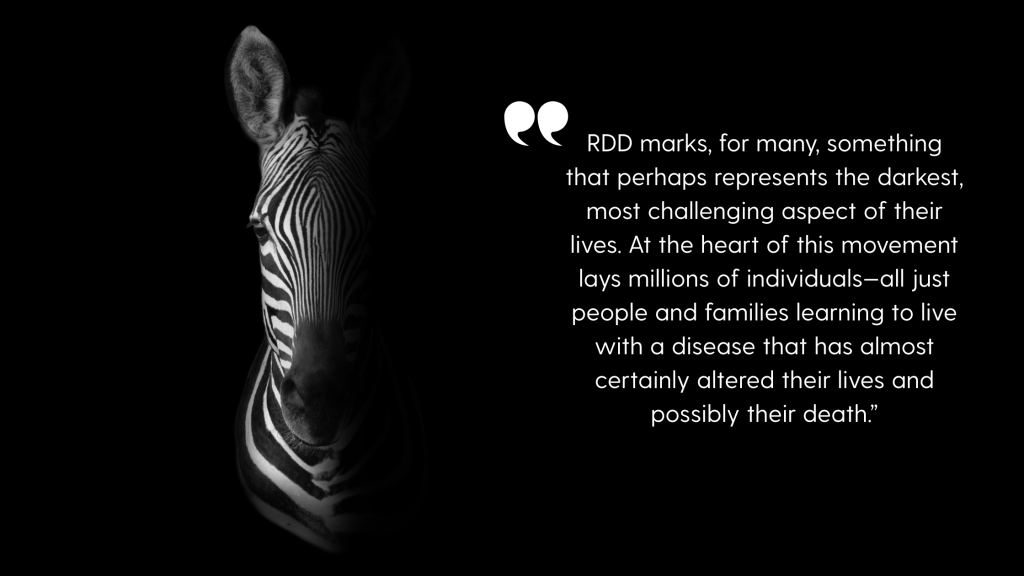
At an individual level, RDD marks, for many, something that perhaps represents the darkest, most challenging aspect of their lives. At the heart of this movement lays millions of individuals—all just people and families learning to live with a disease that has almost certainly altered their lives and possibly their death.
So, if I might ask a favour of your all it is this:
That as we edge away from the epicentre of RDD, reach out to your patient advocate contacts, reach out to the families who have shared their stories with you, and whom you have relationships with—reach out and check in.
Chances are, as the dust settles, they may be left feeling flat or traumas may be brought closer to the surface as they may be reminded of the fragility of their situation or the scale of their journey ahead. There can be no better way to show your community that you truly understand, than by acknowledging the other side of the RDD coin and giving space to that. No better time to send a thoughtful message to help them feel seen and the personal collateral of advocacy acknowledged.
For people living with rare disease, every day is RDD.
What can you do to help keep the momentum going in the following days and weeks, to show the rare disease community that their advocacy efforts are not in vain, that there is legacy in laying their truths bare.
Advocacy fatigue is very real, and never more so than after a big event like RDD—showing your support and understanding really can make all the difference—motivating the community to continue showing up day-after-day, sharing their stories, imparting their insights and fighting for much needed equity, awareness and change.
Connect with Nicola
in the know brings you the latest conversations from the RARE think tank. To access more in the know articles click below.