


Releasing the brake: how an oral therapy could transform life with achondroplasia

Interview with Dr Daniela Rogoff, chief medical officer, BridgeBio Skeletal Dysplasias, and Bubba Murarka, executive vice president, BridgeBio
Estimated reading time: 10 minutes
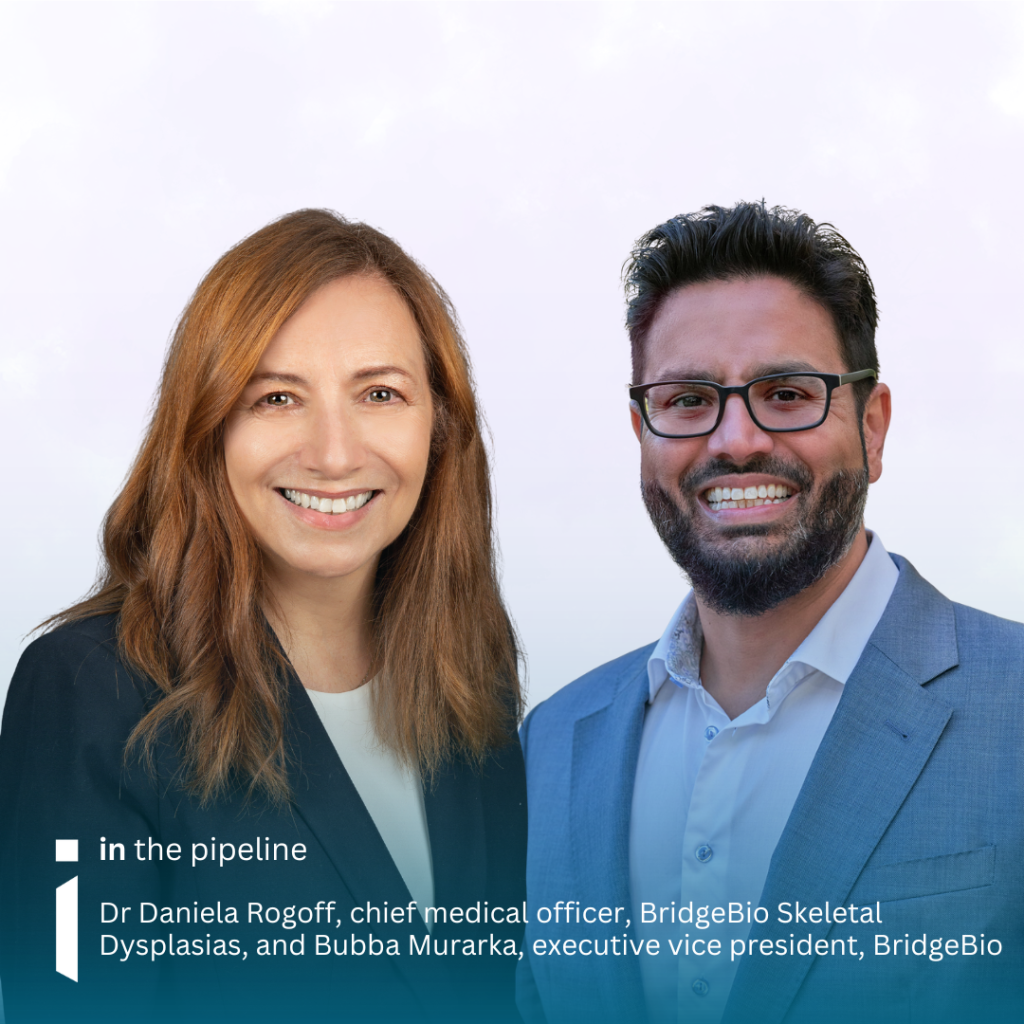

For children with achondroplasia, the only approved treatment has meant a daily injection. BridgeBio’s infigratinib, an oral therapy that targets the condition at its genetic source, has just delivered the first statistically significant improvement in body proportionality ever seen in a 52-week clinical trial. Dr Daniela Rogoff and Bubba Murarka explain what that means for families, and why proportionality matters more than height
Dr Daniela Rogoff is a paediatric endocrinologist by training, originally from Argentina. She built an academic career in the United States, working first at the National Institutes of Health and then at UT Southwestern, before a growing restlessness pushed her toward industry. After years of research, she wanted something closer to the people she was trying to help. “I wanted to do something more connected to individuals,” she says, “and to potentially bring some direct impact to their lives.” More than fifteen years in industry followed, but it was clinical development that gave her what she describes as her “place in the world”. In 2019, she joined QED Therapeutics, now part of BridgeBio, to lead the achondroplasia programme. She has been with it ever since.
Bubba Murarka arrived at BridgeBio in 2023 from an entirely different direction. His career had been spent in technology and investing; achondroplasia was not on his map. When BridgeBio’s founder and CEO, Neil Kumar, asked him to help build the company’s communications function ahead of a major product launch, he took on something he had never done before. What struck him was not the science alone, but the contrast with his previous world.
“There’s a lot of unintended consequences of technology,” he reflects. “Versus here, it’s about families and patients. It’s not just a trite line of making the world a better place.”
A brake that will not release
Achondroplasia is the most common form of skeletal dysplasia, affecting roughly one in every 25,000 births1. It is caused by a change in the fibroblast growth factor receptor 3 (FGFR3) gene, which normally acts as a negative regulator of bone growth. In achondroplasia, the receptor is permanently switched on, slowing growth significantly and causing bones to develop in an irregular manner. Daniela uses a simple analogy: “FGFR3 acts as a brake on bone growth. In achondroplasia, that brake is stuck.”
The visible hallmark is disproportionate short stature: limbs that are shorter relative to the torso, and a head that is larger in relation to the body. But the clinical picture reaches well beyond skeletal proportions. Complications can be severe and, in some cases, life-threatening. In infancy, foramen magnum stenosis—a narrowing at the base of the skull—can compress the structures connecting the brain to the spine, increasing the risk of sudden death. Children may undergo multiple surgeries throughout childhood and adolescence. In adulthood, spinal stenosis can become profoundly debilitating. The vast majority of children with achondroplasia are born to families with no prior experience of the condition, making the diagnosis itself a shock before the medical complexities even begin.
What makes achondroplasia particularly difficult to characterise is its variability. Although nearly all cases share the same single genetic substitution, the clinical presentation differs markedly between individuals. “Not every individual experiences the same complications, some may not even experiences complications at all,” Daniela explains. “Some may live without complications, or they experience the same type in a very different way.” This variability, she stresses, should not obscure the central point: achondroplasia is not about height. “It is a condition about health and how that impacts the overall quality of life and functionality of the individual.”
Four thousand injection versus, a daily capsule
The only previously approved treatment for children with achondroplasia is a daily injectable therapy. Bubba puts the cumulative burden into a single number: “The current burden for families may be 4,000 shots over the treatment of their child.” That figure captures not just the needle, but everything that surrounds it and the urgent need for other options: the supplies, the storage, the disposal, the injection site reactions, and the logistical weight of managing it all while travelling or simply getting through a school day.
Infigratinib, BridgeBio’s oral small-molecule FGFR3 inhibitor, was designed from the outset with children in mind. Developed as a small capsule containing granules that, depending on the child’s age and comfort, can be swallowed whole, opened and taken directly, or sprinkled onto food. “Being able to provide that oral option to families was always our top goal,” Daniela says. For Bubba, the significance goes beyond convenience. The oral route eliminates the injection site reactions that accompany the existing treatment and removes the practical burden of managing injectable supplies entirely. “In some ways, the oral option has the least side effects from the administration side of things,” he says, “and the ability to be given to very young children addressing a priority heard from families.”

The first proportionality result in any clinical trial
The PROPEL 3 Phase 3 study evaluated infigratinib against placebo in children aged three to under eighteen. Its primary endpoint, change from baseline in annualised height velocity, was met with high statistical significance (p<0.0001), showing a LS mean treatment difference of 1.74 cm per year compared to placebo, with an observed mean difference of 2.1cm/year. That result alone would have been significant. But for Daniela, the data that matter most came from a different measure altogether.
In children aged three to under eight, PROPEL 3 demonstrated a statistically significant improvement in the upper-to-lower body segment ratio, a marker of body proportionality. It was the first time a change in body proportions had been observed in any achondroplasia clinical trial, and it was achieved within a single year of treatment.
“Being able to observe these changes very early is really promising,” Daniela says. “It shows the potential of infigratinib to improve body proportions that can translate into an improvement in functionality.”
The link between proportionality and daily life is direct. When limbs grow proportionally closer to the length of the torso, tasks that many people take for granted become more achievable. “It relates to being able to comb your hair, to clean yourself, to put on socks and shoes,” Daniela explains. These are not minor conveniences. For many individuals with achondroplasia, they are activities that shape independence and self-sufficiency. “That proportionality relates to functionality, to being able to perform activities of daily living,” she says. “It ultimately impacts quality of life.”
The safety profile reinforced these findings. There were no treatment-related serious adverse events and no discontinuations due to treatment related adverse events. The trial recorded no signals of concern around hyperphosphataemia or retinal or corneal events. Daniela attributes this to the precision of infigratinib’s mechanism: it reduces the overactivity of FGFR3 without suppressing the receptor entirely. “The theory of approaching and targeting the condition directly at its source, at a dose that decreases the overactivity without suppressing the receptors,” she explains, “is how we are seeing the results that we are seeing.”
Measuring success by communities, not prescriptions
BridgeBio is preparing regulatory submissions to both the FDA and the European Medicines Agency in the second half of 2026. In the United States, infigratinib is the only achondroplasia programme to have received breakthrough therapy designation, which has enabled additional interactions with the FDA throughout development. The company has also partnered with Kyowa Kirin to advance the programme in Japan.
As a small molecule rather than a complex biological therapy, infigratinib carries practical advantages for global distribution. Bubba is direct about the company’s ambitions. BridgeBio has already demonstrated its approach with its previously launched product, Attruby (acoramidis), through what he describes as the most generous patient access programmes in the field: medication delivered within two days of prescription and free drug for life for clinical trial participants. He expects the same types of commitment to carry forward. “Neil, our founder, is focused on access and real patient impact,” he says.
For Bubba, BridgeBio’s identity rests on a metric that most pharmaceutical companies would not choose. “We’re going to measure ourselves by how many communities we get approvals for,” he says, “as opposed to how many individuals are taking our drugs.” That philosophy explains the company’s willingness to pursue conditions regardless of population size. Its first approved drug was for molybdenum cofactor deficiency type A (MoCD type A), a condition affecting only hundreds of children worldwide. A gene therapy programme for Canavan disease, another ultra-rare condition, is currently in the clinic.

Starting younger, reaching further
Infigratinib is currently developed for children with open growth plates and active growth potential. Through its PROPEL Infant & Toddler (I&T) study, BridgeBio is now evaluating the drug in children from birth to three years of age, a critical population because many of the skeletal changes associated with achondroplasia begin very early. “The younger you can start an intervention, the more potential for benefit you could see,” Daniela explains. In this youngest age group, the team is also assessing potential effects on foramen magnum dimensions, an outcome that cannot be meaningfully measured in older children because the structure has already closed.
Beyond achondroplasia, BridgeBio is advancing infigratinib into Phase 2 and 3 development for hypochondroplasia, a related skeletal dysplasia driven by the same FGFR3 pathway that is often underdiagnosed. The company is also exploring whether the drug could benefit young adults who have completed growth. The long-term extension study, PROPEL, in which children continue to receive infigratinib until growth is complete, will provide the fullest picture of infigratinib’s benefit across skeletal development, proportionality, and quality of life.
Built with the community, not just for it
From its earliest observational studies through to Phase 3, the infigratinib programme has been shaped by sustained collaboration with the achondroplasia community. Daniela describes a development process in which advocates and investigators helped to determine what outcomes mattered most, and in which the team continually sought to reduce the burden of trial participation without compromising data quality. “We continue to listen,” she says. “Not only getting here but getting here knowing that we did the best for the children and their families.”
The response from the community has been strongly positive. Investigators, healthcare providers beyond the trial and families have all expressed encouragement with the proportionality data generating particular hope. “This brings hope,” Daniela says. “It validates that the work we are doing every day is very meaningful and has the potential to impact individuals’ lives.”
For Daniela, a paediatric endocrinologist who left clinical practice because she wanted to do more for the patients she was seeing, the trajectory of infigratinib has closed a circle she once thought impossible.
“It’s a dream come true,” she reflects. “When I started, I don’t think I even imagined that this day could come.”
To learn more about their work please visit:bridgebio.com
Connect with Daniella
Connect with Bubba
References
[1] -Horton WA, Hall JG, Hecht JT. Achondroplasia. Lancet 2007; 370(9582): 162-172.
-Waller DK, Correa A, Vo TM, Wang Y, Hobbs C, Langlois PH, et al. The population-based prevalence of achondroplasia and thanatophoric dysplasia in selected regions of the US. Am J Med Genet A 2008; 146A(18): 2385-2389
in the pipeline brings you the latest developments from the RARE pipeline. To access more in the pipeline articles click below.