Rethinking consent: The unresolved challenge of genomic newborn screening

Estimated reading time: 9 minutes
Across the world, newborn screening (NBS) programmes operate under a patchwork of consent models shaped by history, culture and national policy. Some countries rely on long‑standing opt‑out frameworks embedded in public health law. Others require verbal parental consent at the bedside, while a growing number—particularly in North America—ask families to provide written authorisation for data storage, secondary use or research participation. For decades, these models have been deemed adequate for screening panels that are relatively finite, time‑sensitive and clinically straightforward.
But the potential integration of whole genomic sequencing (WGS) changes this equation.
As whole genome sequencing becomes technically feasible and economically realistic at population scale, the very nature of informed consent shifts from a one‑time decision to the potential need for an ongoing, multidimensional relationship between families, health systems and the organisations that support them. Sequencing introduces questions that traditional screening consent models were never designed to address: future reinterpretation of variants, cross‑border data sharing, long‑term storage of genomic information and the ethical implications for biological relatives who never entered the consent conversation.
In other words, we are moving from event‑based consent, one that essentially requires a simple “yes” or “no” to a defined panel, to the potential need for longitudinal, dynamic consent frameworks that must function across jurisdictions, cultures and regulatory environments.
For industry partners, this shift will require enhanced partnership. The transition to genomic NBS will require tools and infrastructures that make consent understandable, culturally responsive and operationally feasible at scale. It will require interoperable platforms that respect local standards while enabling global data sharing and integrity. And it will require a shared commitment to transparency and trust so that families feel confident participating in programmes that may shape their child’s health trajectory for decades.
As genomic sequencing enters the new frontier of newborn screening, the complexity of population‑level informed consent will only grow. Industry has a critical role to play in ensuring that this evolution strengthens, not breaks, the global promise of equitable, ethical, expansive and future‑ready NBS systems.

Current consent models and their limits
Today’s consent approaches tend to fall into three broad categories:
- Opt‑out public health models that treat screening as a standard preventive service, justified by the immediate and known clinical benefit to the newborn.
- Verbal consent models that rely on clinician explanation at the bedside, often with variable documentation.
- Written authorisation models that require explicit parental signatures for data storage, secondary use, research participation, and in some cases, screening itself.
Each model has its strengths: an opt‑out model maximises logistical considerations, coverage, and equity; verbal consent is potentially pragmatic at scale; written authorisation protects data rights. But each also has limits when applied to genomic data. Opt‑out struggles with the breadth of potential findings; verbal consent may fail to convey complexity and long‑term implications; and written forms can be too legalistic, expensive to administer and incomprehensible to many families. In essence, none were designed for a data type that is both persistent and generative of new knowledge over time.
How genomics might transform newborn screening consent
While some argue that whole‑genome sequencing is simply a more sensitive and comprehensive screening modality, akin to other technological upgrades in the long arc of newborn screening; others contend that it represents a fundamentally different class of public health screening altogether. They argue that WGS can surface a far broader spectrum of information: childhood‑onset disorders, adult‑onset disease risks, carrier status for recessive conditions and variants of uncertain significance (VUS). It also creates a dynamic data asset, enabling future reanalysis as scientific knowledge evolves.
This expanded informational reach brings new opportunities and new tensions. WGS could accelerate rare‑disease discovery, support longitudinal research and deepen understanding of population‑level genetic variation. Yet it also introduces risks—misuse of genomic data, breaches of privacy and the potential for therapeutic misconception as families conflate screening with diagnosis or research with clinical care. In this sense, the debate is not just about technology but about whether WGS stretches newborn screening beyond its traditional mandate and into an entirely new ethical and operational domain.
This reframing of what WGS in NBS is naturally leads to other, more tangible questions: how might public health systems operationalise consent in a landscape where the informational stakes are much higher, at a time when resource capacity is lower, and what are the opportunities for industry to assist?

Consent considerations
Once one views WGS as something larger than a traditional screening test, the operational questions that programmes will have to confront from day one become paramount:
Scope of disclosure
Most people agree on one thing: childhood‑onset, actionable findings should be returned. Beyond that, the consensus evaporates. Should adult‑onset risks be shared because they matter for parents’ health? Should carrier status be part of routine disclosure? What about VUS, which may confuse more than clarify? Any real‑world consent system will need to accommodate different disclosure philosophies while still honouring a spectrum of parental preferences.
Scaling informed consent
In research pilots, consent often happens through long, multi‑step conversations with trained staff. That’s simply not feasible when you’re talking about millions of births a year. So, the question becomes: how do we preserve meaningful consent at scale? Digital consent tools, tiered opt‑in/opt‑out models and AI‑supported triage are all on the table, but each comes with tradeoffs in comprehension, equity and perceived legitimacy.
Data stewardship and recontact
Genomic data doesn’t sit still. Variants get reclassified, new gene–disease links emerge and what was once uncertain can become actionable. But who is responsible for going back to families when that happens? The NBS programme, the sequencing provider, the child’s clinician? The answer shapes implications for liability, cost and continuity of care, and at present, no unified framework exists.
Privacy and secondary use
Public trust is fragile, especially in the post-pandemic era and after high‑profile controversies involving neonatal blood spots and law‑enforcement access. Families want the benefits of public health and research without the fear of their child’s data being used in ways they never agreed to. Technical solutions like federated data access, cryptographic consent records and auditable logs can help, but only if they’re paired with strong governance and real trustworthiness and transparency.
Therapeutic misconception
The rare‑disease community’s hope for genomics is powerful and understandable. But that optimism can blur the line between what sequencing can do and what families think it will do. Consent materials and communication strategies need to strike a careful balance: setting realistic expectations without discouraging participation in programmes that genuinely save lives.
Taken together, these dilemmas point both directly to the work ahead and to the places where industry partnership can meaningfully shift what is possible.
Six strategic opportunities for industry partners
1. Build scalable, adaptive consent technologies
We need to work towards development of interactive, multilingual digital platforms that combine short video modules, decision aids and comprehension checks. Platforms will need to be adaptive by delivering more detail when parents indicate interest and simplifying when they do not, all while logging consent preferences in a machine‑readable, auditable format. Integration of AI‑assisted Q&A to answer routine questions and triage families to appropriate staff when complexity or distress is detected should be considered.
2. Invest in the genetic counselling workforce
Population‑scale genomic newborn screening (gNBS) will very likely outstrip current counselling capacity. We need to better fund training pipelines, scholarships and continuing education focused on newborn genomics. Expansion of coverage, reimbursement and telehealth networks will be necessary to reach all communities.
3. Adopt layered, transparent communication
Consider how we implement tiered disclosure models that range from essential information (what every parent must know), to practical information (what happens if a variant is found), to technical information (methods, classification criteria, retention policies). Materials must be co-developed with patient advocates to ensure cultural resonance and to avoid paternalistic and biased language that undermines trust.
4. Establish best‑in‑class data governance
We need to examine going beyond regulatory minimums by offering granular data control options, ranging from limited result disclosure with raw data destruction to long‑term archives with periodic recontact. We need to consider immutable consent records that allow families to update preferences over time and look to publish transparency reports on data requests and disclosures to build public accountability while fostering trust and transparency.
5. Engage proactively in policy formation
We absolutely cannot wait for regulation to crystallise in order to keep pace with our technology. Together, we must contribute to model legislation with ethicists and advocates while promoting baseline protections that allow local flexibility. We must foster international standards efforts that seek to harmonise approaches across jurisdictions and reduce fragmentation that complicates multinational research and programme deployment.
6. Create long‑term family partnership programmes
Finally, we must treat consent as an ongoing relationship by implementing periodic reengagement to revisit preferences and offer updates on reclassifications. Family and community advisory boards should be engaged to help guide disclosure policies and research priorities. We need to consider how we can provide clear, voluntary pathways for families who want to contribute deidentified data to research, ensuring separation from clinical screening.
Conclusion
Genomic newborn screening is a generational opportunity for rare disease diagnosis and early intervention. But its promise depends on more than sequencing throughput or variant calling accuracy. It depends on the social and technical systems we build around consent, data stewardship, family partnership and public trust.
Industry’s role is not merely to supply technology or therapies; it is to codesign the ethical and operational frameworks that make genomic NBS sustainable and just. Companies that invest now in adaptive consent technologies, workforce capacity, layered communication, robust governance, policy engagement and long‑term family partnerships will not only capture market leadership, they will help preserve the social contract that underpins public health newborn screening.
The path forward will be iterative and uneven across jurisdictions. That is inevitable. What is not inevitable is failure. With deliberate investment, cross‑sector collaboration and a commitment to equity and transparency, industry can ensure that genomic NBS accelerates diagnosis and treatment while strengthening public trust in the systems that serve families worldwide.
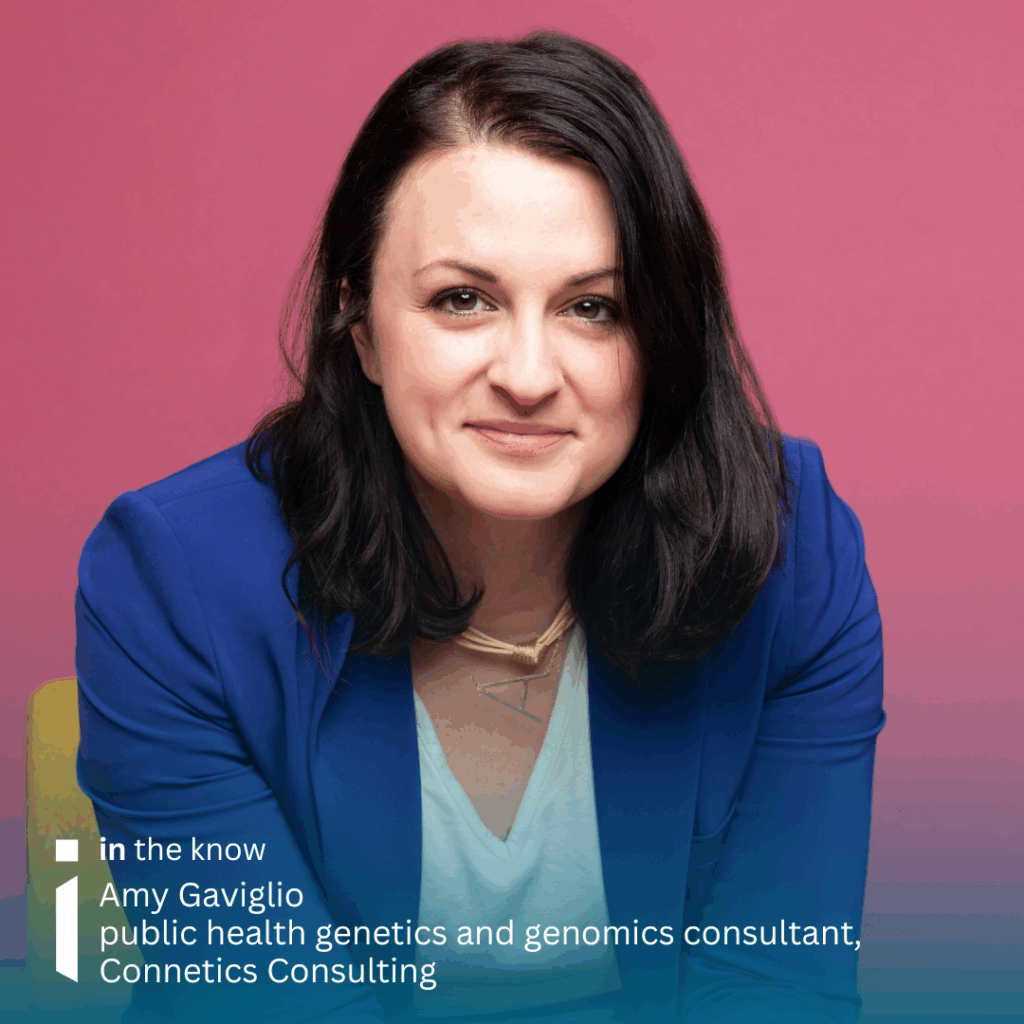
Connect with Amy
in the know brings you the latest conversations from the RARE think tank. To access more in the know articles click below.