RARE Revolution poll finds glaring gaps when patient advocacy organisations work with industry

Estimated reading time: 6 minutes

Without question, the relationship between patient advocacy groups and pharma companies is a vital one. Rare disease charities are uniquely placed to thoroughly understand the needs of their community, and to identify where industry research and drug therapy development is most needed. They are also ideally placed to support research including patient recruitment for clinical trial participation. But is this relationship being nurtured and valued as it should?
Patient groups and pharma companies work best when they are on the same page and are united in a shared aim that is driven by best intentions, and importantly, mutual benefits.
RARE Revolution wanted to look under the bonnet of this special relationship as part of our ongoing social media poll series. What we found was a mixed picture where good experiences contrast with quite concerning ones, including glaring issues with lack of communication, funding and adequate remuneration.
Complex and overly onerous MSAs
Views on this topic were sought from the rare disease community via social media platforms including Facebook, Instagram, LinkedIn and X.
We began by asking how the community found the process of entering into a master service agreement (MSA) with a pharma company or industry partner. Overwhelmingly with 66% of votes, many answered that it was a complex and overly onerous experience, but one that they had to navigate with inhouse knowledge alone.
For a further 11% of respondents, who also agreed that the process had been complex and overly onerous, they required external legal support to navigate it entering into an MSA. For financially strapped smaller rare disease charities this is an expense they could ill afford taking funds away from vital activities with direct patient benefit.
Just 23% of respondents considered their experience of entering into an MSA was easy to navigate and that in their view the process is ‘fit for purpose’.
Funding and remuneration challenges
Grant funding and what type is most beneficial to patient organisations was next put to the rare disease community. The answer was clear and unequivocal. 92% of respondents said unrestricted funds are most beneficial and of value to their organisation’s operation. The remaining 8% were happy with restricted funds if it was for core operational costs. Highlighting the difficulties of identifying such core funds, one respondent shared:
“It is an absolutely brutal landscape for fundraising for small, rarefied charities.”
Another gave further insight on the challenges of funding, saying: “Whilst unrestricted funds give you the freedom to spend where needed, core cost funding, even if restricted, can be invaluable—but difficult to secure.”
Perception is a key context to consider within the advocacy/pharma relationship. So we polled patient advocacy groups about whether they felt there is a perception within their community that partnering with pharma or industry impacts their organisation’s independence and autonomy. This question very much split the crowd with almost half (47%) saying yes, 30% saying no, and 23% sitting more on the fence, with maybe. This suggests that greater communication is needed around this dynamic so that transparent and effective partnerships can be formed.
With rare disease charities and advocacy groups having a fundamental role in working with pharma and industry companies on activities such as patient engagement, aiding recruitment for trials, and providing insights, grant giving shouldn’t be the only vehicle for support—adequate remuneration for activities carried out is also crucial.
But our poll found a concerning mixed picture on this topic. Almost a third of respondents (29%) said they had received NO remuneration for activities when partnering with pharma. When those who were paid, were asked if they felt what they were paid was a fair market value, only 18% said yes. 29% said no they did not consider they received a fair market rate of renumeration and 24% were unsure what the fair rate should have been. Again, highlighting gaps.
“I do not find working with industry easy”
A comment from one of our respondent’s highlights a further issue with some patient groups not even getting invited to collaborate with pharma and industry on research.
“As an individual, I’ve been paid the market rate sometimes (for example, when looking into trial design for people with rare conditions). But as an organisation, we haven’t been approached to do this kind of work, and I do not find working with industry easy, although I’d be more inclined to do it if we got paid appropriately.”
We also sought to gauge understanding of what co-design is in the context of advocacy and industry partnerships. While 40% of respondents said yes, they did understand what co-design meant, in equal measure 40% also noted that they did not know what it meant. The remaining respondents weren’t quite sure.
When drilling down to first hand experiences of co-design, either as individuals or when representing their advocacy organisation the question again showed a divided view. The split was even, 50/50, meaning that 50% of advocates working with pharma had not had the opportunity to engage in activities that they considered to be co-designed.
Lack of communication and project feedback
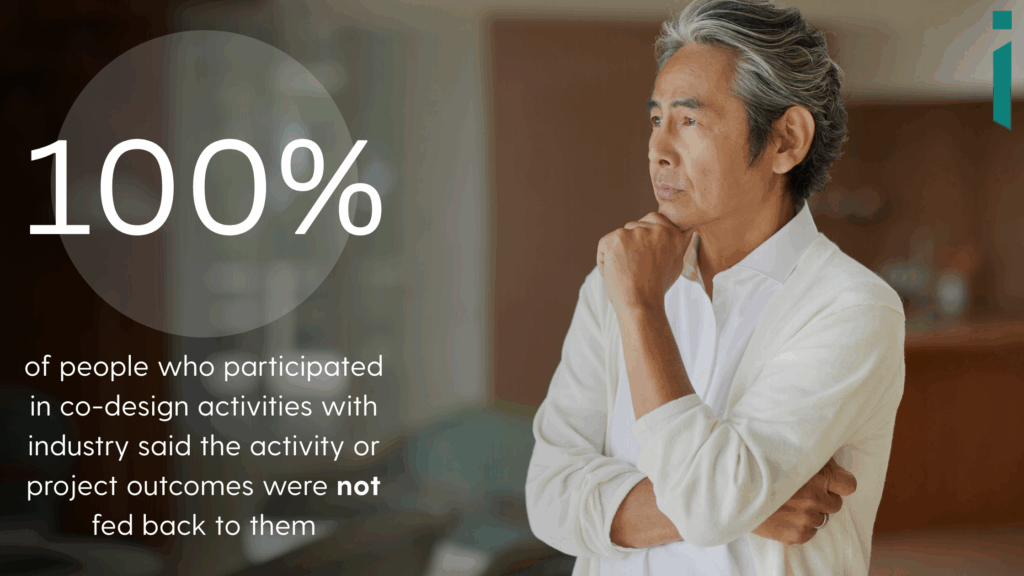
Incredibly concerning was the blanket response we got to the following question aimed at those who had participated in co-design activities with industry: were the activity or project outcomes fed back to you? All—100% of respondents said no. This underlines the critical issue with lack of communication. A clear area where industry must do better with.
Added to this, we asked those who had participated in co-design activities with industry whether they felt the outcomes reflected their community’s input to their satisfaction. This is another glaring area where improvement is needed—no respondents said yes. Not one. Instead, 50% said they were satisfied in part only, and 50% said a resounding no, they were not at all satisfied. Real cause for reflection.
But on a brighter note, we also asked those who co-designed activities with industry how they would rate their experience. Perhaps surprisingly given the above 57% of respondents said it had been extremely positive, and a further 14% said it had been somewhat positive. But with nearly one third (29%) describing their experience as being somewhat negative, it’s clear there is still room for considerable improvement.
This vitally important relationship between rare disease organisations and industry clearly needs work as feedback from a small cross-section of our community has revealed. When patients and advocacy groups have taken the time to contribute to industry activities, they deserve timely communications, improved updates, and easier access to unrestricted core funding and fair compensation for their insights. We also cannot let the dust settle on attempts to do better in ensuring co-creation activities with the community truly respect and reflect their valuable input. 100% of any number telling industry that the output was ‘not to the community satisfaction’ is a number that is, and should be, hard to ignore!
*Number of respondents varies (to a maximum of 45)
To view the insights from the diagnosis trial polls, click on the insights button below.
in the know brings you the latest conversations from the RARE think tank. To access more in the know articles click below.