

The evidence that trials leave behind: Vitaccess and the MGFA look to address this gap in myasthenia gravis

Interview with Mark Larkin, founder and CEO, Vitaccess
Estimated reading time: 8 minutes
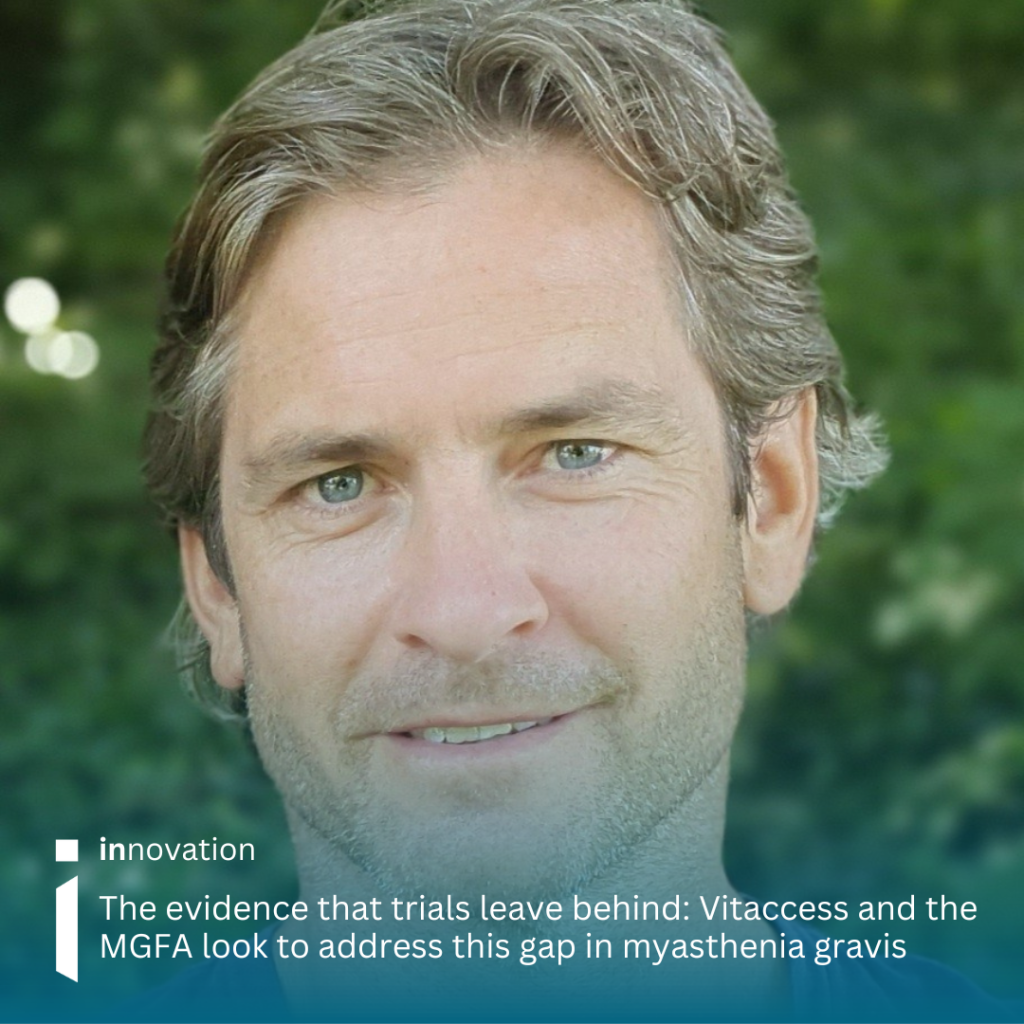

A clinical trial in myasthenia gravis might last 26 weeks. A patient lives with the disease for decades. In that gap lies a set of questions that matter to regulators, clinicians and patients alike, yet remain largely unanswered: why do patients switch treatments? How does the disease progress over years, not months? What does daily life actually look like? A new partnership between UK-based real-world evidence company Vitaccess and the Myasthenia Gravis Foundation of America (MGFA) is designed to find out
With an extensive career in healthcare—in pharmaceutical services, health economics and outcome research—Mark Larkin has spent the last few years focused on real-world research. He encountered a growing frustration with clinical trials in that they were answering the questions they were designed to answer, but clinicians, payers and health technology assessment bodies were asking different ones. “There’s a gap between what clinical trials can show and what decision-makers need to see,” he says. “And that’s particularly evident in a disease like myasthenia gravis.”
He founded Vitaccess to close that gap, and in February 2026, the company announced a partnership with theMyasthenia Gravis Foundation of America (MGFA) that represents the most ambitious step yet. The MGFA becomes the official collaborator for the Vitaccess Real MG (VRMG) registry, bringing its patient network and more than a decade of legacy registry data into a platform that combines electronic medical records, patient-reported outcomes and, more increasingly, biorepository samples. The aim is to create one of the most comprehensive patient-centred evidence platforms in myasthenia gravis (MG).
The limited window of a clinical trial
Myasthenia gravis is a rare, chronic neuromuscular autoimmune condition that causes fluctuating muscle weakness, often beginning in the eyes, face or throat. It can affect swallowing, speech, limb movement and breathing, and its presentation varies considerably between patients. The therapeutic landscape has been transformed in recent years, with five or six new treatments reaching the market after a long period with little innovation. Yet the clinical trials that brought those treatments to approval share a common limitation: they are, by design, brief.
“That’s not a criticism,” Mark says. “They’re designed to answer a question about efficacy and safety, which, if you can answer it in that period of time, that’s great. But in the real-world setting, patients aren’t being treated on a molecule for only 26 weeks. It’s far, far longer.” The VRMG registry is designed for a ten-year span and built to capture what happens after the trial protocol ends: how treatments perform across years, in broader patient populations, and through the unpredictable course of a chronic disease.
There is also a category of data that clinical trials rarely collect. In MG, understanding the patient’s daily experience is essential to measuring disease progression: how activities of daily living are affected, where functional challenges are emerging, and what that experience is actually like for the person living with it.
“Understanding from the patients themselves how the condition is affecting their activities of daily living is a crucial part of measuring impact,” Mark explains. “Other data sources don’t have that. We uniquely have really granular data on this—monthly and even weekly.”

Coalitions, not contracts
Vitaccess has been working in MG since 2019, and its relationship with the MGFA grew from an earlier study in which the foundation served as a research partner. The approach is deliberately collaborative. Mark describes his model as multi-stakeholder research coalitions: clinicians, key opinion leaders and patient advocacy groups, each contributing to study design, governance and dissemination of results. “We approached the MGFA a few years back, and they’ve been really great partners,” he says.
In rare disease, advocacy groups are frequently courted by organisations seeking access to patient communities. Mark acknowledges this and is direct about what sets a good partnership apart from a poor one: governance. The MGFA holds a seat on the VRMG Scientific Advisory Board, where subgroups oversee study design, data access and publication plans. A study charter defines how decisions are made. And the data access framework draws a clear line: industry researchers pay to use the data; academic researchers access it on a not-for-profit basis. “When we explain that to advocacy groups, they really buy into it,” he says. “They should be quite choosy about who they work with. And if you have a good governance framework, they’re very open to working with you.”
From protocol review to co-authorship
Mark is forthright about what patient centricity demands when practised thoroughly. “Plenty of research is not really patient-centric,” he says. “If you’re just asking patients for a review of a protocol that’s already been written, that’s not enough.” In the VRMG model, patients are present at every stage of the research lifecycle: shaping which outcomes to measure, contributing to implementation decisions and appearing as co-authors on published papers. “Many of them are extremely able, extremely well qualified in other fields,” he adds. “It’s really great having their input on the publications.”
There is a practical dimension too. In the United States, the VRMG registry supports decentralised recruitment, allowing anyone with MG to self-refer without visiting a clinical site. After completing informed consent through the Vitaccess platform, participants share their electronic medical records directly with Vitaccess. The MGFA has raised awareness of the registry across its network, and the results are tangible: Vitaccess reports 80 to 90% completion rates on standardised patient-reported outcome instruments. “That’s really high relative to people who do this sort of research,” Mark says. He attributes it to what he calls an informal contract between researchers and participants. “They’re giving their time and their data because they want to improve care. The part of your contract that you’re fulfilling is making sure it’s published.”

The questions that matter most
Among the research questions the registry is positioned to address, treatment switching stands out. With several new therapies now available, patients and clinicians are making decisions about when to move from one treatment to another. The reasons are varied: diminishing effectiveness, side effects or other clinical considerations. These patterns are invisible in trial data. “Clinical trials tell you nothing about that, because that’s not what their goal is,” Mark says. “But if we can understand what motivates a switch, maybe that can help us understand whether certain types of patient are better suited to a particular treatment.”
It’s the advocacy groups, he notes, that hear these stories first. Patients report anecdotally that they started on one treatment, then changed for reasons that are never captured in any dataset. The registry offers an opportunity to quantify those patterns, publish the findings and feed them back into clinical practice. “If we work well in that way, it could be a virtuous circle,” he says. “And of course, if you’re a pharmaceutical manufacturer, you’re quite interested in that as well.”
What to look for in a research partner
For patient organisations considering partnerships of their own, Mark’s advice is specific. Look at publications: has the partner published its data? Examine the governance framework: is there a scientific advisory board, and will the organisation have a meaningful seat? Ask about security credentials. Vitaccess holds ISO certifications for security and quality, alongside Cyber Essentials accreditation in the UK. “If people don’t have answers to those questions, that should ring a few alarm bells,” he says. “We’re talking about participants’ data. You don’t want to be in a situation where there’s a data breach because the partner hasn’t done this before. It’s serious stuff.”
Building what does not yet exist
The MGFA partnership is, in Mark’s words, “a flagship.” Beyond integrating legacy data and patient-reported outcomes, Vitaccess is now adding biorepository data to the VRMG registry: whole genotyping analysis and biomarkers that, linked with clinical and patient-reported data, will create a resource unlike anything currently available in MG. The ambition is to build a prognostic model of the disease. If successful, it could make clinical trials smaller, faster and less costly, accelerating the path from laboratory to patient.
The model is already being replicated in other rare disease indications, and in larger therapeutic areas too. But MG is where the approach is proving itself, and Mark is clear about why it works: because the foundations are right. Rigorous science. Transparent governance. A data access model that serves academic and industry researchers on fair terms. And, at the centre, patients who are giving their time and their data because they believe it will lead to better care.
“We’ve got the foundations so that we can do this in a proper, rigorous way,” Mark says. “And we’re very excited about the potential.”
To learn more about Vitaccess, please visit:vitaccess.com
Connect with Mark
innovation spotlights the future of RARE through a technological lens. To access more innovation articles click below.