

Turning point: FORTIFY phase 3 study for limb-girdle muscular dystrophy

Interview with Doug Sproule, chief medical officer, ML solutions, a BridgeBio company
Estimated reading time: 9 minutes
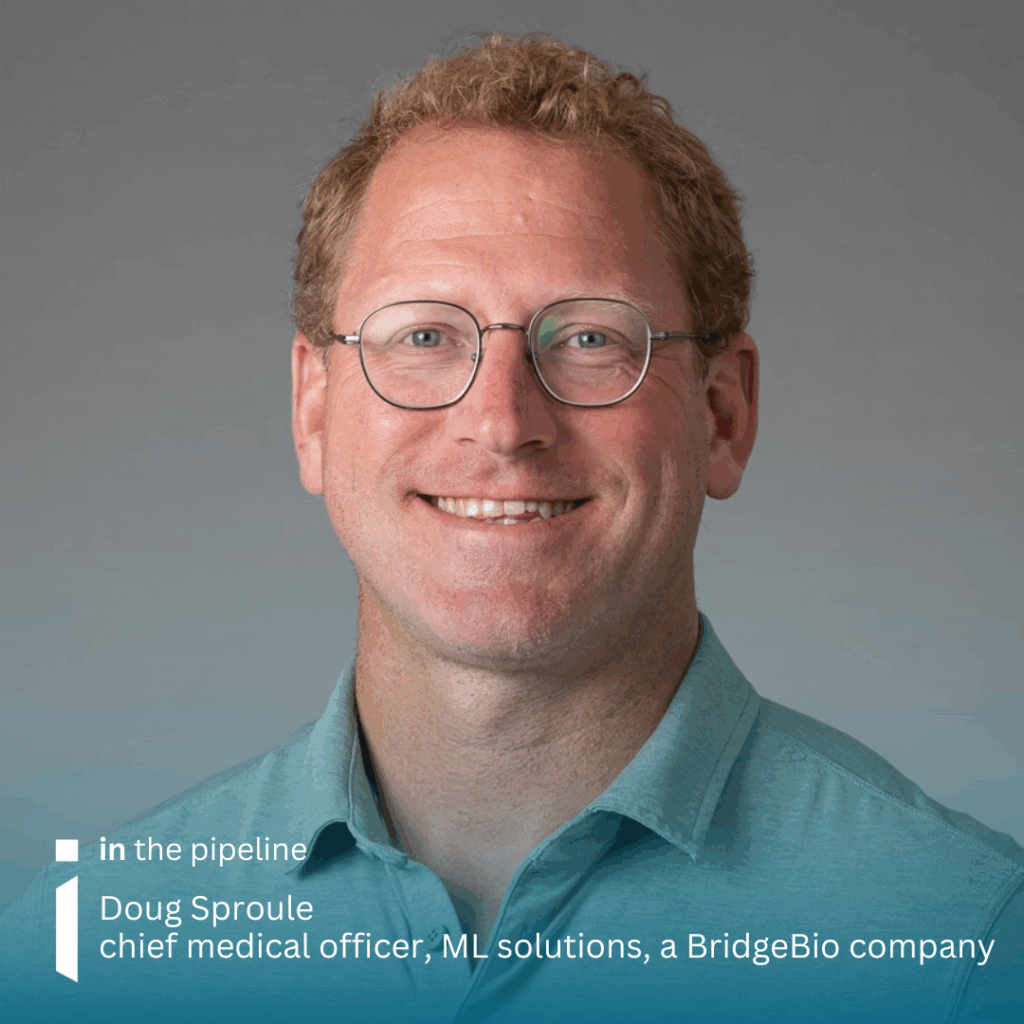
Chief medical officer Dr. Doug Sproule has spent his career striving to change the outlook for patients with rare neuromuscular diseases (NMDs). Now, as BridgeBio’s FORTIFY study delivers promising results in limb-girdle muscular dystrophy (LGMD), Doug reflects on the journey from clinic to cutting-edge biotech. With potential new therapies offering hope to families once given few options, he and BridgeBio are setting their sights on even broader horizons for rare disease innovation and patient care
Dr Doug Sproule brings a wealth of experience and a sense of mission to his role as chief medical officer (CMO) at ML Bio Solutions, a BridgeBio company. With early roots at Columbia University, where he trained in paediatric neurology, he went on to complete a sub-specialty fellowship in neuromuscular medicine. Doug gravitated toward the complex challenges of paediatric NMDs spending these years as a clinician and researcher, managing care for children with Duchenne muscular dystrophy, spinal muscular atrophy, and related disorders. During this time, Doug has authored dozens of publications and built a reputation for compassionate, expert care.
A building sense of personal and professional frustration ultimately propelled Doug from his role as a clinician into the biotech industry, as he explains, “I prescribed hundreds of wheelchairs and arranged support services for these patients, doing what I would consider God’s work, ensuring everything was as good as possible. But effective treatments were lacking.” Despite rigorous diagnostics and established supportive care pathways, there were few—if any—effective therapies available to his patients. Doug had grown increasingly frustrated that the families under his clinical care were left without meaningful treatment options—he felt compelled to change that landscape.
Now, as CMO, Doug channels his drive and expertise into the development of innovative therapies for NMDs—his previous clinical experiences provide the guiding force behind his work at BridgeBio. Today, their work in limb-girdle muscular dystrophy (LGMD) is bringing Doug real hope for a future where clinicians can be empowered with more ways to support their patients.
An unmet treatment need: limb-girdle muscular dystrophy
Limb-girdle muscular dystrophy (LGMD) is a group of rare genetic disorders characterised by progressive muscle weakness that primarily affects the shoulders and hips—the so-called “limb-girdle” muscles. LGMD results from inherited variations in genes that are crucial for muscle health and stability. One common form, for example, results from errors in the FKRP gene, leading to a fault in a process called glycosylation of alpha-dystroglycan. This defect disrupts the connections between muscle cells and their surrounding structures, causing cell membranes to weaken. Over time, muscle use leads to injury, degeneration and scarring which lead to muscle weakness and loss of function. As the condition advances, mobility becomes increasingly limited: many patients eventually require wheelchairs, or other assistive devices. Beyond muscle weakness, LGMD can have serious effects on the heart and lungs. Doug highlights that, for many patients, problems with heart function or breathing represent major health risks and are a leading cause of mortality.
Yet the true impact of LGMD extends far beyond its physical symptoms. Everyday tasks—like using the bathroom independently, combing hair or feeding oneself—can gradually become major challenges. This erosion of independence deeply affects quality of life for patients and their families. As Doug emphasises, maintaining the ability to perform “seemingly little things” is a central—and often overlooked goal.

Reconciling endpoints fit for patients and regulators
Designing clinical trials for LGMD requires a thoughtful balance between scientific rigor and real-world patient priorities. In the FORTIFY study, particular care was taken to select primary and secondary endpoints that not only satisfied regulatory standards, but also aligned closely with the goals, fears, and daily experiences of patients.
For many living with LGMD, as Doug discusses, the most pressing concern is not necessarily to regain lost abilities (albeit this was favourable), but to prevent further decline. “What patients are most scared about is not where they’re at, but where they’re going,” he explains. This anxiety regarding stability—maintaining independence and retaining the ability to manage life’s “little things”—emerged as a central theme during study design. While regulatory agencies traditionally favour precise, quantifiable measures such as motor function tests and cardiopulmonary outcomes, the FORTIFY team recognised that endpoints reflecting disease stabilisation would carry most impact from the patient perspective.
Crucial to reconciling these priorities was the foundational work of the GRASP-LGMD Consortium (Genetic Resolution and Assessments Solving Phenotypes in LGMD). By organising robust natural history studies—often run in “trial-like” formats—the GRASP Consortium gathered longitudinal data detailing how LGMD patients progress in the absence of treatment. “Having that commitment from the patient community to participate in natural history studies was key—they’re not getting anything for it, other than the hope that this data will ultimately move the field forward,” Doug says. These datasets made it possible to model practical, evidence-based endpoints: measuring not just whether a therapy could bring about improvement, but whether it could achieve real, meaningful disease stability. Outcomes incorporated into the study included functional metrics like the North Star Assessment for limb-girdle muscular dystrophy, the 100-meter time test, ventilatory function measurements, and biochemical markers from muscle biopsies. Patient-reported outcomes and tools such as wearables further enriched the picture, offering nuanced insights into daily living and disease trajectory.
Through this integration of natural history data, clinical expertise, and most importantly, the lived experiences of patients and families, the FORTIFY study established endpoints that are both scientifically robust and personally relevant. Such an approach is not only essential for regulatory acceptance but, as Doug emphases, is also “a matter of deep ethical responsibility to the LGMD community”.
FORTIFY for today and tomorrow
The FORTIFY study has delivered some promising results in the treatment of limb-girdle muscular dystrophy, marking a potential turning point for patients and families.
In its top-line interim analysis, the therapy demonstrated substantial biological and clinical impact: muscle biopsy results revealed a nearly doubling (1.8-fold increase) of glycosylated alpha-dystroglycan—a key marker of the underlying disease mechanism—in treated patients compared to placebo. Rates of muscle breakdown, measured by creatine kinase (CK), were reduced by 82% among those receiving active treatment.
Importantly, these biological gains translated into functional improvements. On the 100-meter time test, patients receiving therapy showed a 30% improvement over the expected decline seen in the placebo group, marking not just stabilisation but notable enhancement of mobility. Ventilatory function, a critical determinant of progression and quality of life, also shifted positively: treated individuals experienced a 3% improvement, while those on placebo declined by 2%.
Yet for Doug, these successes are matched by a responsibility to approach the future with careful optimism. “Our results really were on the upside of what we were expecting,” Doug notes. “I’m trying not to be too enthusiastic, until we have a chance to speak with the regulatory authorities.” To ensure the findings translate into real-world benefit, the team is taking deliberate, thoughtful next steps: “We are engaging our regulatory partners in the United States, European Union, UK and elsewhere, to understand what the appropriate next steps are.”
An open-label extension is anticipated, allowing participants from the phase 3 study, ongoing access to the therapy while gathering long-term data.
Transparent communication with patients and the wider LGMD community remains paramount. Doug emphasises, “We communicate really carefully. The goal is to see an effective therapy go forward.” With many eager for hope—but acutely aware of the challenges—the message to families is clear: “On bended knee, we ask patients and the community at large, to stay the course. We need this study to continue until we have the opportunity to understand the best pathway to an effective therapy, available globally.”
Forthright dialogue, shared resolve, and a commitment to rigorous science are guiding FORTIFY through its next phase—nurturing hope, while keeping both feet firmly planted in evidence and community partnership.
The success of the FORTIFY study extends beyond its immediate impact on this subtype of LGMD—it holds important implications for the wider NMD community. As Doug reflects, “scientific advances in a single rare disorder help to illuminate the path for therapy development across a spectrum of related conditions. I can’t understate how one victory begets the next and so on. The advances, learning and experiences can benefit other physician scientists, investigators, pharmaceutical and biotech companies who will be able to emulate. This is instrumental in progress.”
Perhaps most importantly, FORTIFY’s positive results energise the broader community, building confidence and optimism among patients, families, clinicians, and advocates. Victories in ultra-rare diseases can demonstrate what’s possible, inspire policy and industry interest and foster cooperative efforts across the field. As Doug emphasises, “The most satisfying thing for a patient would be—in my disease, now, there is a therapy. But seeing things advance in other forms drives forward a belief and that creates the ability for companies to engage in a very effective way.”

Looking ahead for BridgeBio
BridgeBio remains firmly committed to its core mission: delivering science-driven solutions for patients with rare genetic diseases. Building on the momentum of recent breakthroughs, the company is especially focused on expanding its footprint in the NMD arena.
For the immediate future, BridgeBio is prioritising the evaluation of its current therapeutic strategy in additional forms of limb-girdle muscular dystrophy—a logical extension of the success seen in the FORTIFY study. “There’s a couple other forms of muscular dystrophy that are potentially treatable with this therapeutic strategy, and that’s also going to be one of the immediate next steps for us,” Doug notes.
Beyond this, the company aims to accelerate research and multiply its efforts in the NMD field, and continuing to invest in collaborative, patient-centred research. As Doug puts it, “there’s a lot of work to do and hopefully that work will accelerate and grow and multiply—that’s my personal hope and I know that’s the BridgeBio aspiration too.”
For Doug, the journey from clinician to developer of a promising new therapy for limb-girdle muscular dystrophy is not just a professional milestone, but a deeply personal triumph. “It is such an immense privilege,” he reflects, speaking of the years of hard work, obstacles, and setbacks along the way. “I can’t understate the personal feeling of pride and satisfaction of being at the point of potentially having a really important impact on people’s lives. What a privilege.”
Connect with Doug

To learn more please visit:bridgebio.com
in the pipeline brings you the latest developments from the RARE pipeline. To access more in the pipeline articles click below.