
Next steps for rare diseases in England: assessing progress and priorities for policy beyond the current framework

Estimated reading time: 8 minutes
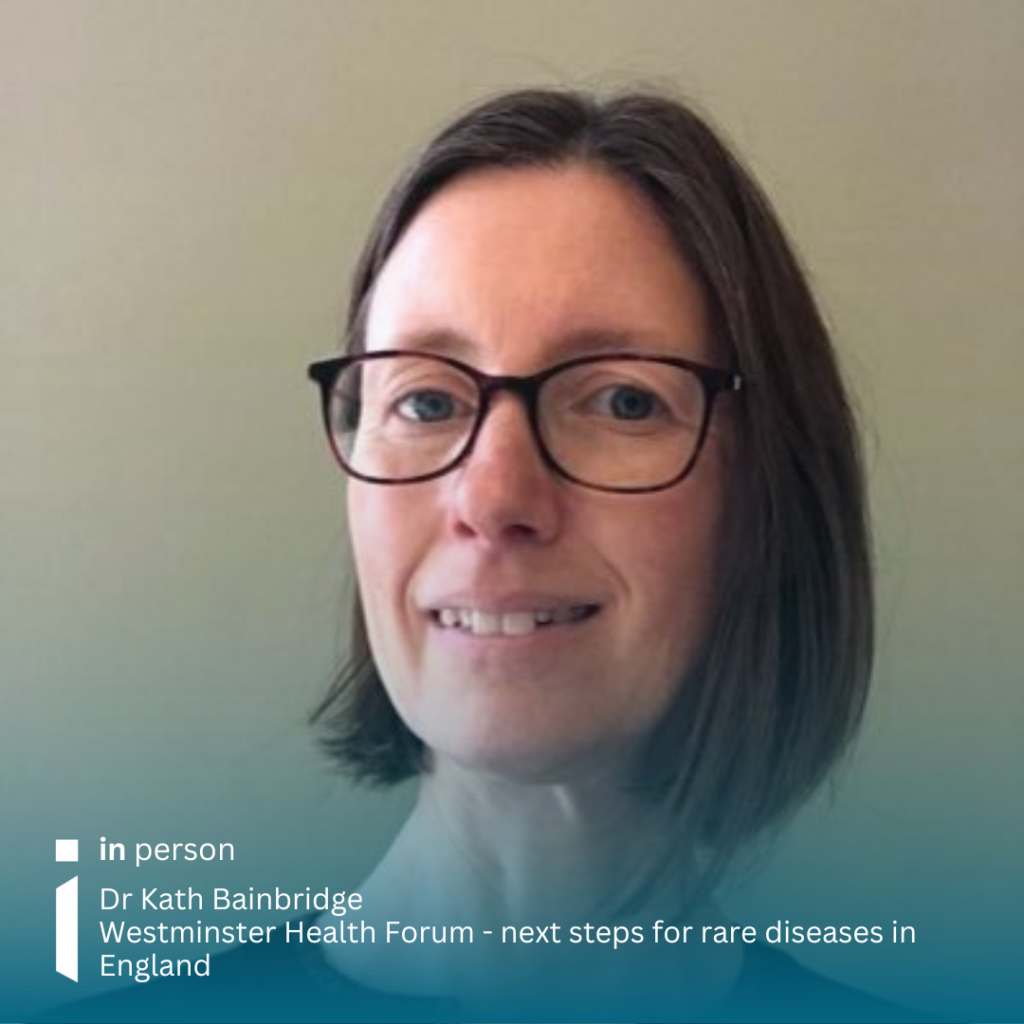
As the UK’s Rare Diseases Framework enters its final year, Dr Kath Bainbridge highlights the outcomes and impact achieved so far, and outlines new priorities to take forward, with a focus on addressing inequalities in the rare community
Now, in its previously announced final year, the UK’s five-year Rare Diseases Framework was in the spotlight at a recent Westminster Health Forum Policy Conference on what’s ahead for rare diseases in England.
Dr Kath Bainbridge began her keynote session by underlining why the development of the existing framework was such a priority for her team.
“One in 17 people will be affected by rare disease at some stage in their lives. In the UK, this adds up to 3.5m people,” she explained. Kath is head of rare diseases and emerging therapies policy team at the Department of Health and Social Care (DHSC).
“While 80% of rare conditions have a known genetic origin, importantly, there’s also 20% that don’t. We need to make sure that policy helps to deliver change for both of those groups.”
The framework included a commitment to publish annual action plans and regular updates across all four nations. “In autumn, ministers from all four nations agreed to extend the current framework to January 2027,” she told the conference.
In England, the latest action plan was published in February, just ahead of Rare Disease Day1. Through the five action plans, a total of 40 actions have been introduced. These have covered the four framework priorities (such as increasing awareness of rare diseases among healthcare professionals, improving diagnosis and access to specialist care and treatment), and six cross-cutting themes. There are 19 actions that still remain active, Kath said.
Each action plan is developed in partnership with NHS England, Medicines and Healthcare Products Regulatory Agency (MHRA), National Institute for Health and Care Excellence (NICE), Genomics England, National Institute for Health and Care Research (NIHR), Medical Research Council, and with input from the rare disease community.
Progress made on rare diseases
Real progress has been made in the last 12 months, Kath told the conference.
“Firstly, MHRA has taken impressive steps to rewrite the rulebook on rare disease therapies,” she explained. “In November, the MHRA published their position paper outlining their plans2, and they are now working on a framework which will be open for public feedback soon. In February, NICE published their quality standard for better care3. This will be instrumental in improving quality of care across the board. NHS England are currently developing an individualised therapies operational framework, which will enable therapies that are designed to be delivered within the NHS.”
Kath also shared an exclusive at the conference.
“We’re really pleased to be able to announce that we’ve secured funding to proceed with opening two centres for people with undiagnosed, rare conditions,” she revealed. “NHS England is currently working to get those set up. In addition, we will also cover the re-procurement of the Genomic Medicine Service4 with a focus on reducing the diagnostic odyssey.”
She also provided an overview of other successes in numbers. The Generation Study now has 36,056 participants across 72 hospitals5, and the Genomic Medicine Service carried out 340,000 tests for rare diseases in 2025. GeNotes has expanded to 12 specialties and now has almost 600 resources and covers more than 150 rare diseases6. In addition, NHS England has opened a further three rare disease collaborative networks, taking the total number to 28.

Introduction of “new and important” action
This year’s rare diseases action plan will focus on delivering against existing actions that are outstanding, but will also add a new one.
“We recognise that people living with rare diseases experience inequalities in their access to healthcare services,” she said. “By introducing this new and very important action, it is a commitment to ensure that addressing health inequalities for rare diseases is included under NHS England’s CORE20PLUS5 framework7.”
This new action was introduced following a scoping review carried out by the University of Exeter Medical School to look at the extent and nature of health inequalities experienced in the rare disease community. They found there were 11 distinct types of health inequity. These included delayed diagnosis, lack of knowledge among clinicians, lack of information provision, lack of care coordination and lack of services for people with rare syndromes without a name.
Kath then spoke about two examples that underline what a life-changing difference faster diagnosis and access to rare therapies can make. The first was a baby boy named Freddie who took part in the Generation Study to have his genome sequenced. He was subsequently diagnosed with a rare and aggressive form of eye cancer, hereditary retinoblastoma. Very shortly after his diagnosis, he was able to start treatment at Birmingham Children’s Hospital, one of two specialist centres that treat retinoblastoma in the UK.
“The second is a teenager with the devastating rare condition Niemann-Pick type C who was treated at Great Ormond Street Hospital, and was the first person to receive an antisense oligonucleotide gene therapy under a ‘master approval’ by the MHRA,” Kath explained. “This therapy was specifically designed for the change in their DNA. It is hopefully the start of wider progress on this, and the Rare Therapies Launch Pad has an important role in supporting that to take place8.”
As they consider the future beyond the current framework, Kath said the government will be engaging with the rare disease community to shape the next steps. As part of this, they have a current invitation for feedback and “ambitious” proposals.
She also highlighted the Future for Rare campaign that is led by Genetic Alliance9. They are seeking input from a range of stakeholders including industry, researchers, healthcare professionals and patients. The feedback that is gathered will be shared with Kath’s team, she added.
A question from the audience asked which elements of the current framework and previous action plans have delivered the most measurable progress. Kath said an evaluation has been commissioned and a report will follow later in the year.
“The most striking is, of course, the really big pieces of work such as outcomes from the Generation Study, the number of children screened and the direct impact of this,” she responded. “But, I think the building blocks that we’ve put in place have driven change across the system, and those changes are not always as easy to measure. The effects can be indirect and can take years sometimes to pull through.”
She gave an example of adding a definition of care coordination into the specifications for highly specialised services. “The specifications are still being revised and it will take time for that change to come through. But, I think the building blocks and the evidence base that we’ve gathered is shifting the dial across the system.”

A halt to progress?
Following Kath’s keynote speech, the conference heard from Henry Poust, secretariat at the Specialised Healthcare Alliance (SHCA). SHCA is a coalition of more than 140 charities, patient groups and corporate supporters who advocate for better services and better care for rare patients.
“Feedback from our members has found they have fears around what would happen to the rare conditions community if we don’t have a new UK Rare Diseases Framework,” he told the conference. “There are concerns about how it could get overlooked given the focus on other areas in government and the population health agenda mirrored by the 10 Year Health Plan10. Members also felt that after a really strong start with the framework and annual action plans, progress has started to stall.”
The SHCA has attributed this to contributing factors including lack of specific funding to support delivery, and ambition being limited by a lack of capacity and accountability.
“As a result, actions that have previously been committed to have sometimes been scaled back or delayed,” he said. “While rare conditions teams in all of the four nations have worked tirelessly to deliver these action plans, they haven’t always had sufficient resources and support to enable progress at the scale that our members would like to see. In addition, 8 out of 12 SCHA members said they felt the framework has not delivered on its potential.”
A new framework for rare diseases must deliver the conditions for success, he added. The SCHA wants to see this being accompanied by a specific funding envelope that is attached to delivery, and continued engagement with the community through UK rare diseases forum meetings.
Connect with Kath
References
[1] https://www.gov.uk/government/publications/england-rare-diseases-action-plan-2026
[2] https://rarerevolutionmagazine.com/rare-insider/mhra-on-their-reform-plans-to-transform-regulatory-approaches-for-rare-diseases/
[3] https://www.nice.org.uk/guidance/qs214
[4] https://www.england.nhs.uk/genomics/nhs-genomic-med-service/
[5] https://www.generationstudy.co.uk/
[6] https://www.genomicseducation.hee.nhs.uk/genotes/
[7 https://www.england.nhs.uk/about/equality/equality-hub/national-healthcare-inequalities-improvement-programme/core20plus5/
[8] https://www.raretherapieslaunchpad.com/
[9] https://geneticalliance.org.uk/future-for-rare/
[10] https://www.gov.uk/government/publications/10-year-health-plan-for-england-fit-for-the-future
in person keeps you up to date with RARE conference insights. To access more in person articles click below.