
Next steps for rare diseases in England: embedding genetic medicine in the NHS plus opportunities for diagnosis and treatment

Estimated reading time: 10 minutes
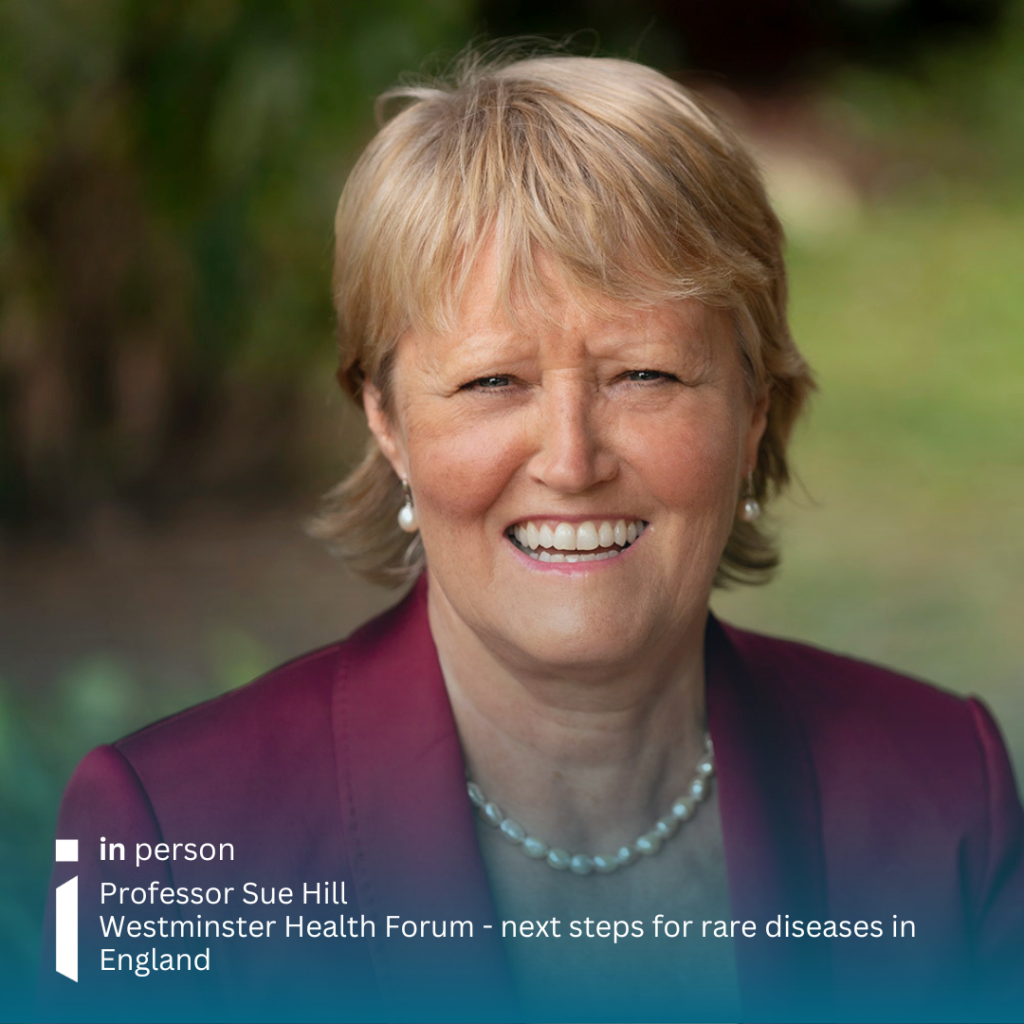
Professor Sue Hill, chief scientific officer for NHS England, spoke at the Westminster Health Forum about the evolution and integration of genomic medicine into the NHS to shorten the diagnostic odyssey for those with a rare disease and improve their long-term health outcomes
At a recent Westminster Health Forum Policy Conference on next steps for rare diseases in England, the conference heard from NHS England’s chief scientific officer, Professor Sue Hill.
She began by explaining that NHS England has plans in place to evolve the Genomic Medicine Service (GMS)1 to “where it needs to be over the next 10 years”, as this will support the delivery of the 10 Year Health Plan2.
The plan for the NHS also has a commitment that by 2035, 50% of all healthcare interventions would be genomically informed. To assist with this, there will be an NHS genomic laboratory function and three supporting clinical functions: cancer, population health and rare disease.
“This service will remain commissioned by a national NHS genomics unit with contracts being put in place for a 10 year period,” Sue told the conference.
“The service delivery model will remain across seven GMS geographies, and these will be delivered and led by a lead provider in each of those areas. But, in addition, there will be a requirement to deliver genomic testing, interpretation analysis and for services to be supported in enabling end to end clinical pathways across the entirety of providers. This will include primary care, community care and neighbourhood health teams.”
Each GMS will establish a rare disease clinical function and this will have several requirements, she explained. Services must be delivered by a multidisciplinary team with expertise in clinical genetics to enable the testing offer to be brought to eligible patients within the care continuum.
Services must also raise awareness of rare disease, and what this can mean for patients in their end to end journey. They must also understand and address any unmet needs and variation in equity of access. “In addition, there is a requirement to streamline those pathways and ensure that they can link to treatments or access to clinical trials,” she said.
New service specification
Sue advised that NHS England is working with clinical genetics to deliver a new clinical genetics service specification. This will be a new governance model that will be supported by an NHS Genomic Medicine Service board. The board will feed into a genomics ecosystem group that will bring together all of the research bodies working within the genomics field. This work will be carried out together withGenomics England.
A delivery board will have national oversight for both the clinical and laboratory functions. “For rare disease, this will include subgroups on prenatal testing and care, and the diagnostic odyssey, to tackle that variation in equity,” she explained. “These groups will be populated, but not exclusively by those seven GMS governance arrangements with other experts as relevant. This will ensure it fits together as a total system and links with the new operating model for the NHS.”
Another commitment in the 10 Year Health Plan was the creation of a genomics population health service which would be in place in its totality by the end of the decade. Sue told the conference more about this.
“Key features of the service will include identifying high risk populations for genomic testing. For example, those with conditions such as familiar hypercholesterolemia, a predisposition to cancer through BRCA1 and BRCA2 gene testing, as well as for certain cardiovascular diseases such as monogenic diabetes, where we know we still have an unmet need in the population.
“When other conditions are identified through the rare disease group as areas where we need to work with communities to increase the number of people coming forward for testing, this will be linked to familial and cascade testing,” she added. “This will help us to work towards reducing diagnostic odyssey and identifying rare disease earlier.”
The use of polygenic risk scores will also be explored, particularly around more common diseases through evidence-based studies, either in targeted cohorts or in conjunction withOur Future Health.Pharmacogenomic testing will also be introduced, Sue confirmed.
“This testing will include four more commonly used agents in the population. Some of those will be accessed by rare disease patients. But, linked to this will be the further analysis of short-read whole genomes. Both in terms of producing pharmacogenomic profiles, and also identifying other findings that might lead to, for example, the potential to develop rare diseases, perhaps in the parents of patients with a rare disease,” she explained.
NHS England has recognised it has to develop the NHS workforce further to work in the community, the conference heard. They are currently consulting with community leaders to learn what that might look like. Sue said they are already aware of the need to develop digital solutions to ensure that primary and community care can access results, for example.

Updating the National Genomic Test Directory
The nationally commissioned rare disease testing offer that is set out in the National Genomic Test Directory3, which sets out eligibility on who can order and requirements for testing, will be updated.
“We will be looking quite carefully at expanding the people who can order testing so that we can really fulfil those requirements around reducing the diagnostic odyssey,” she explained. “A range of test methods will be employed as we move forward. This will include more targeted testing, but also RNA sequencing, whole genome sequencing and then moving into the adoption of multi omics and DNA methylation.”
She added that NHS England wants to take a “multi-modal testing approach” to improve rare disease diagnosis. Currently, 50% of the testing that is carried out is in core testing such as in neurology, in certain paediatric disorders and cystic fibrosis. Moving forward, research and innovation will drive commissioning services.
The current commission testing offer includes a rapid prenatal exome sequencing service, Sue explained, and this will move to a whole genome sequence service. “In the last year, 1,620 of these tests were delivered with a diagnostic yield of 30%,” she said. “For our rapid whole genome sequencing testing for acutely unwell children with a likely monogenic disorder service, 3,294 tests were delivered in 2025/26, with a diagnostic yield of 40%.
“In our rare disease whole genome sequence service, just over 42,461 tests were delivered in 2025/26, with an average diagnostic yield of 28%, but up to 60% for some clinical indications. For example, in kidney disease and in some metabolic diseases.”
Research commitments are undertaken by Genomics England, in conjunction with the NHS, and this helps to build the evidence base that suggests what services should be commissioned. “We already are in a position to understand what is required to be commissioned and to adopt the outcome fairly rapidly,” she added.
Evolution of precision treatments
As technologies evolve in rare disease along with an evolution of precision treatments, these all require genomic stratification. Sue shared insight on some of the work that is currently going on in this space.
“We are working closely with theRare Therapies Launch Padwho are looking at some of the n-of-1 therapies, and across all of those therapies that may be delivered to small groups of patients, but that still needs to be done in a consistent and coherent way. They are also looking at driving the potential for manufacturing in the UK to reduce the price.”
Sue shared an example of this work in Alport syndrome. “Nonsense mutations can lead to Alport syndrome and result in childhood kidney failure,” she explained. “But what this research found was that if you identify patients via the RaDaR registry4 that uses NHS genomic lab data and get the testing done, the rare therapy Exaluren is an effective treatment in Alport syndrome. It allows cells to read through these mutations and create missing proteins.”
Cystic kidney disease is another area where the NHS gets very good diagnostic outcomes for whole genome sequencing, she added. “We can start to address the unmet need to protect the kidneys in rare disease by bringing together the research, the clinical data, and an understanding of the types of therapies that are available within the system.”
Sue also spoke about the importance of continuing to populate the National Genomic Research Library with whole genome sequences. The research library is curated by Genomics England, and a number of diagnostic discoveries have been made possible through this.
“The discovery of the RNU4-2 gene and its link to a monogenic neurodevelopmental disorder was a really good example of this,” she told the conference. “It led to really rapid adoption onto the test directory shortly after publication of the evidence. We need to continue to do that and the library will remain an important resource for rare disease patients.”
Work will continue with Genomics England to expand and populate the library with all genomic data that is generated. This will include panels and whole exomes, and will ensure the library reflects any reference genomes or any interpretation arrangement related to patients with diverse ancestry, for example. “This will ensure the library reflects our populations,” explained Sue.
The library currently has more than 170,000 data sets and ongoing data from the100,000 Genomes Project,the NHS GMS and from theNewborn Generation Study.As Genomics England makes progress on and establishes the adult population study, this data will also be added to the library.
What is important with all of this data is that there is a diagnostic discovery route back into the NHS, she added. Currently, more than 5,000 different diagnostic discoveries have been made. “Over 85% of those have been determined to be pathogenic by the GMS, and have been fed back to NHS clinicians and their patients with rare disease and with cancer.”

Networks of Excellence
Within the Genomic Medicine Services, Professor Hill added that more NHS Genomic Networks of Excellence5 will be introduced. These will be partnerships between NHS academia and the life sciences sector. This will enable the NHS to leverage the amount of money it puts into these networks, she explained. As they will be commissioned for a two-year period, the NHS can look towards adopting the outcome within that timeframe.
The priority area for 2026/28 includes the continuation of the Rare and Inherited Disease Network of Excellence6, and the link with functional genomics and clinical trials.
“This will give us an understanding of how we adopt new technologies including omics and how we create the right pathway to ensure we can identify patients for the emerging treatments in rare disease, but particularly clinical trials,” she added.
A unified genomic record will be introduced for every patient that has a genomic test by 2028, Sue confirmed. This is currently in various stages of testing.
“We in the genomics ecosystem, have a vision where everyone benefits from genomic healthcare,” she added. “In the Genomic Medicine Service, we want to remain world-leading in implementing genomic medicine to ensure that patients have access to the most effective treatments.”
Connect with Sue
References
[1] https://www.england.nhs.uk/genomics/nhs-genomic-med-service/
[2] https://www.gov.uk/government/publications/10-year-health-plan-for-england-fit-for-the-future
[3] https://www.england.nhs.uk/publication/national-genomic-test-directories/
[4] https://www.hra.nhs.uk/planning-and-improving-research/application-summaries/research-summaries/national-registry-of-rare-kidney-diseases/
[5] https://www.nw-gmsa.nhs.uk/about-us/our-projects/genomic-networks-excellence
[6] https://www.nw-gmsa.nhs.uk/about-us/our-projects/genomic-networks-excellence/rare-disease-genomic-network-excellence
in person keeps you up to date with RARE conference insights. To access more in person articles click below.