
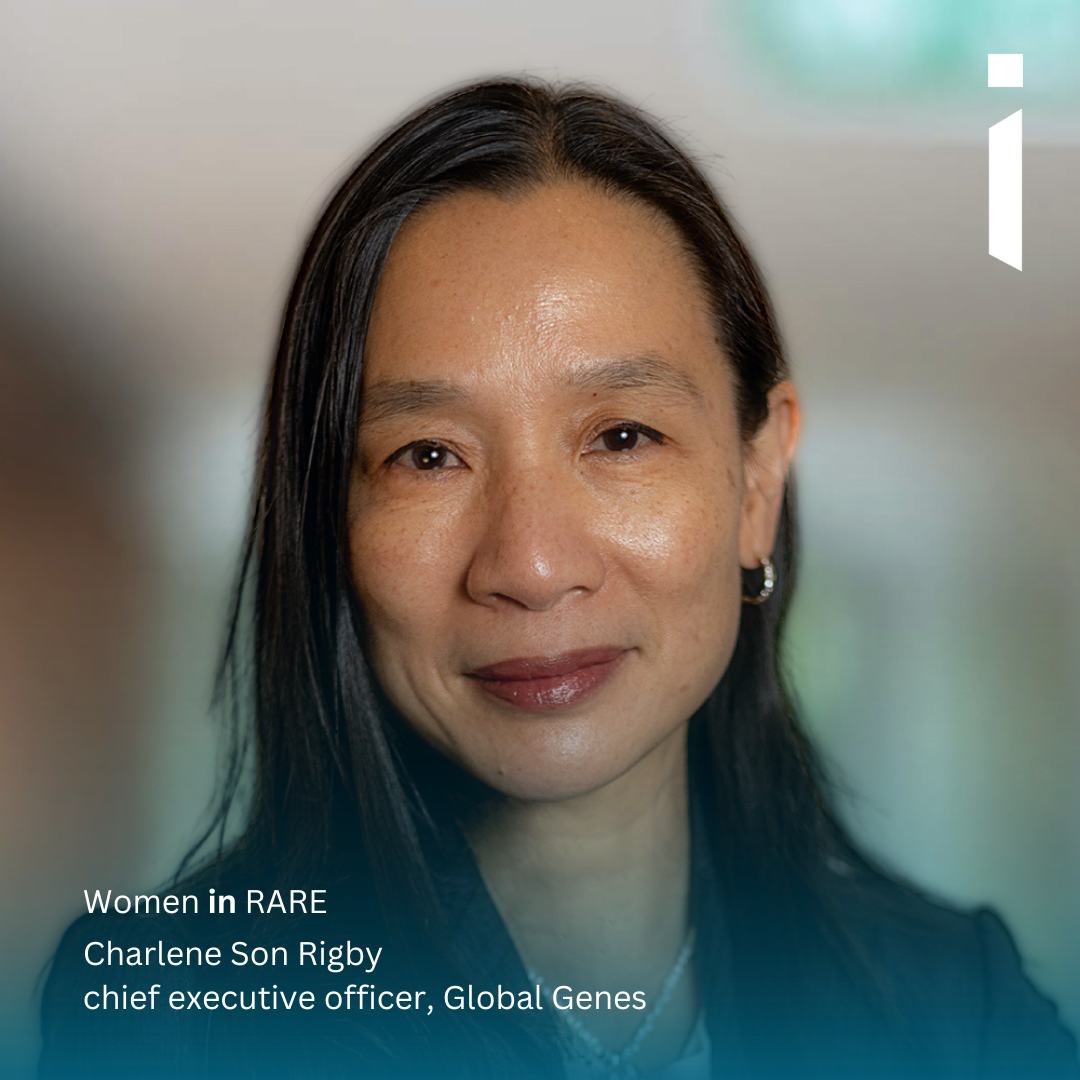
Charlene Son Rigby, chief executive officer, Global Genes

Estimated reading time: 7 minutes
“What drives me now is the belief that the rare disease community has more leverage than it realises. Patient advocates are not peripheral to drug development; they are central to it.”
I started my career in neuroscience research and early-stage bioinformatics startups, which grounded me early in how science actually moves: slowly, systematically, with a lot of uncertainty. From there I moved into commercial and executive roles at enterprise software and genomics companies, including Oracle and Fabric Genomics, where I developed commercial accountability and learned to build for scale.
What motivated you into your chosen career path?
I have always been drawn to data and to building solutions for hard problems. That thread runs through everything I’ve done. What I didn’t expect was that the most defining problem would be personal for me.
When my daughter was diagnosed with STXBP1, that became very clear. Experiencing what it takes to move a rare disease from scientific obscurity to a real therapeutic pipeline—the years of building from nothing, the constant negotiation between urgency and scientific rigor, the families holding everything together while waiting for answers—reoriented what I thought my career was for.
What drives me now is the belief that the rare disease community has more leverage than it realises. Patient advocates are not peripheral to drug development; they are central to it. The opportunity to help build the infrastructure that makes that true, across hundreds of communities at scale, motivates me and keeps me focused.
What do you see as some of the opportunities as a woman in your field?
The rare disease patient advocacy world is largely led by women, and that’s not a coincidence. Women are disproportionately the primary caregivers when a child or family member is diagnosed with a rare disease. They are often the ones who reduce hours or leave careers to manage care, navigate systems and become the family’s de facto medical expert. That circumstance, as difficult as it is, also produces something exceptional: deep expertise, relentless focus and a community of leaders who understand this space from the inside in a way no professional credential replicates. That community already exists. The opportunity is to take it seriously as a leadership pipeline.
I see real momentum here. Women in rare disease advocacy are increasingly at the table in clinical trial design, regulatory engagement and data strategy. The days of patient input being a checkbox are fading. Advocates are now structuring data consortia, negotiating research agreements and presenting at FDA advisory committees. They bring a relentless, community-grounded perspective that is genuinely differentiated.
The other opportunity is at the intersection of advocacy and industry. Women who have navigated rare disease from the patient side have a systems-level understanding of what patients actually need, beyond what a clinical endpoint captures to what a family’s day actually looks like. That knowledge is valuable, and biopharma and tech executives are increasingly recognising it.
There is a real opening for women who can operate credibly across both worlds: fluent in the science, trusted by communities and clear-eyed about what drives drug development decisions. That intersection is where critical work is happening.
What are some of the barriers to success as a woman in your field?
The most persistent barrier I encounter is the credibility tax. It is real, and it is tiring. When I walk into a room with tech or biopharma executives or research scientists, there is often an unspoken assumption that I need to establish my legitimacy before I can get to the substance. That tax is higher as a woman, and higher still when your title is ‘patient advocate’ rather than “chief medical officer”.
You learn to front-load your credentials, to be twice as precise in your language, to never let a technical error slide because it will cost you more than it costs the man next to you.
The second barrier is structural. The nonprofit sector, where much of patient advocacy lives, is chronically underfunded and undervalued, and it disproportionately employs women. The result is that the people doing some of the most consequential work in rare disease are operating without competitive compensation, without investment in their own leadership development and without the institutional backing their commercial counterparts take for granted.
There is also a subtler challenge around authority and style. Women in advocacy leadership are often expected to lead with empathy and humility, which are genuine strengths, but when those qualities are expected rather than chosen, they become constraints. Directness gets read as aggression. Strategic ambition gets read as overreach. The leaders who navigate this most effectively stop trying to calibrate to others’ expectations and commit to their own approach. Most women figure that out later than they should.
What is one piece of advice you would give your 10-year-old self?
Stop trying to get everything perfect. The version of you that takes the risk, makes the mistake and figures out what went wrong will learn more than the version that waits or only tries things you know you are good at.
People will still respect you—actually, they’ll respect you more—when they see you try something hard and recover from it. Failure is not evidence that you aren’t good enough. It’s evidence that you’re attempting things worth attempting. The pursuit of perfection is often just fear with better branding. Let it go earlier than I did.
Can you tell us about your current work priorities and focus or a particular project you are working on?
The work I am most focused on right now starts with a fundamental belief: patient advocacy leadership is not a nice to have in rare disease progress. It is the driver of it.
In 2025, Global Genes launched a new strategic plan built on that conviction. Global Genes was founded in 2008 to help build and connect the rare disease community. Over the last two decades, the landscape has changed significantly. Advances in therapy development, precision medicine and social media are creating real openings for patient advocates to engage and lead in ways that were not possible even ten years ago.
At the same time, the role of umbrella organisations like Global Genes needs to evolve to meet that moment. Our strategic planning process pushed us to get specific about our unique role in the ecosystem, and the answer was clear: our mission is to grow the ranks of patient advocacy leaders who will drive the next generation of rare disease breakthroughs. We are equipping advocates with the tools, training and trust to lead, to activate their communities, advance research and widen the drug development pipeline—while expanding and strengthening the rare disease ecosystem.
Our programmes are designed to accelerate that. RARE-X, our patient-owned data platform, now has over 9,000 patients enrolled across more than 95 rare diseases, generating patient-reported data insights that researchers and biopharma are using. Our Global Advocacy Alliance connects over 860 patient advocacy organisations, creating a network with real reach across the rare disease landscape. RARE Concierge provides direct navigation support to patients and families navigating diagnosis, resources and clinical trials.
The advocates we serve are doing extraordinary work. Our job is to make sure they have what they need to do it at the highest level, and that the ecosystem around them embraces and integrates their leadership.
Connect with Charlene
Women in RARE is a celebration of women working in the RARE space in science, research, industry and advocacy. To access more Women in RARE articles click below.