
Clinical trials in the UK: Assessing current issues in clinical research design and delivery, and opportunities for growth

Estimated reading time: 9 minutes
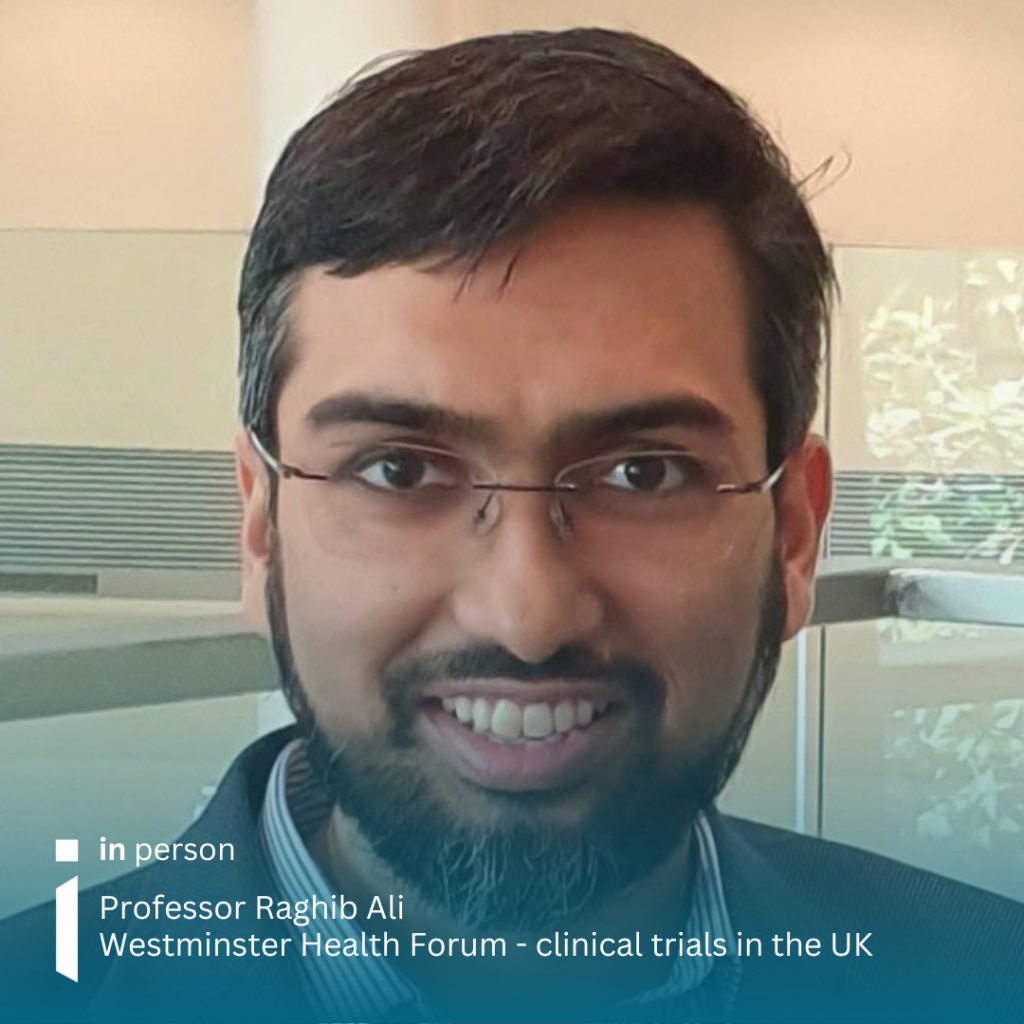
In recent years, UK clinical trail participant numbers have decreased, with the UK dropping down the global rankings for Phase III trails. Despite this, professor Raghib Ali, a medical doctor, clinical epidemiologist and chief executive and chief medical officer of Our Future Health, is optimistic about the UK’s opportunities for improvement and outlines key initiatives to help drive its future progression
As part of its10 Year Health Planthe government outlined its ambitious aims to transform clinical trials, speed up trial set-up processes and improve patient care in the UK.
In recent years, the UK has fallen behind on the global stage as the time taken to set up a trial hasrisen to around 250 days in the NHS.In contrast, clinical trials in Spain can be set up in around 100 days. To combat this, the government has set a target for commercial clinical trial set-up times to fall to 150 days or less by the end of March 2026. This has been described as the most ambitious reduction in trial set-up times in British history.
As the UK moves closer to this key target, a timely Westminster Health Forum Policy Conference considered the next steps for clinical trials in the UK. The conference first heard from keynote speaker, Professor Raghib Ali; a medical doctor, clinical epidemiologist and also chief executive and chief medical officer of Our Future Health
Current picture
Raghib began by discussing the current trials status, along with why he is optimistic that the future is bright.
“The last few years have been quite challenging for clinical trials in the UK, though there has been some improvement over the last year,” he told the conference. “When you look at what’s been happening, there has been a deterioration in the number of participants joining clinical trials. In 2024/25, for example, numbers fell for the fourth year running. The UK is also less competitive and has fallen from 4th to 10th globally for Phase III trial initiations.
“Concerningly, most of our trials have not been from industry,” he continued. “Over the last year, unfortunately, a number of companies have either withdrawn or decreased their investment in the UK. Although this sounds like I have a pessimistic view, I actually think the future is very bright, in terms of how we are going to go forward.”
One of his primary reasons for optimism was the publication of two important plans last year, he told the conference. The government’s10 Year Health Planand itsLife Sciences Sector Planincluded key initiatives and targets for clinical research and trials. “In terms of the target to improve the speed of trial set-up times to within 150 days, we’re not far away from that now,” he explained.
Reducing friction caused by unnecessary bureaucracy and tackling some of the contracting issues that particularly affect clinical research in the NHS will also be important, he added.
“As an NHS doctor myself, it’s not always easy to prioritise clinical research when you’re so busy treating emergencies and urgent cases.”
Increasing opportunities to use “our very significant data assets”, including the Health Data Research Service (HDRS), National Institute for Health and Care Research (NIHR) and Our Future Health (OFH), will be vital to improving the UK’s approach to clinical research, he advised.
“HDRS will be a very important initiative in the coming years and decades,” he said, “as it will bring together huge amounts of data on population health.Be Part of Researchis an important NIHR initiative that recruits participants through the NHS app, which tens of millions of people use regularly.”
Our Future Health aims to become the world’s largest longitudinal health research cohort and clinical trials recruitment resource by 2030. As part of this, it aims to have five million consented participants, with access to linked primary and secondary care health data, genomics data and biomedical samples.

Role of Our Future Health
“Our Future Health really is a unique resource, both because of the size of the data that we have, the types of data that we have but also the opportunities to use that data to identify population health insights and evidence-based prevention health policies,” Raghib explained. “Our current number of commercially advertised participants is 20,000, but we have made a commitment to increase this to 50,000 per year by 2030, just from OFH participants.”
It is a non-profit charity that is a unique public-private partnership working with government, industry and health charities. When patients are invited to join Our Future Health digitally, often via an invite from the NHS, they complete a questionnaire online, physical measurements are taken at a clinical appointment and they may also have a blood sample taken. When a blood sample is taken, this is stored and genotyped using custom array, he explained.
“We then ask participants to provide permission to link to their health-related data sets, including primary care, secondary care, cancer and death, for example. And crucially, they provide permission to be recontacted for further surveys, assessments and to take part in clinical trials,” he told the conference.
“We’re also very cognisant of the fact that many studies like this have not had good representation from many groups who tend to have worse healthcare outcomes. For example, deprived populations, younger adults and some ethnic minority populations. We wanted to ensure that Our Future Health has good representation from all of those underrepresented groups, so our research will benefit every part of the UK population, and thereby reduce health inequalities.”
Single healthcare system
The UK has a real advantage over many other countries in having a single healthcare system, and a unique advantage in relation to research, in particular, he added. “Having a single system means we can link all of our participants to both retrospective data and emerging data as we can follow them up going forward. We can link to genomics data, physical measurements data and questionnaire findings that we collect to offer a globally unique and leading resource in this area.”
Participant recruitment to the OFH programme began in October 2022 and people from across all four UK nations can participate. More than 2.5 million (almost 2.6m) people have joined the programme and have consented to provide their linked NHS data and be recontacted for further research and clinical trials. In addition to this, two million people have completed their questionnaire, and more than 1.5 million have provided a blood sample, as well as completed their questionnaire.
When asked why there is a difference in the two figures, Raghib advised that not all participants have the option yet of providing a blood sample locally. As OFH moves towards the goal of the programme having five million participants, more clinics across the country will be made available in community locations such as pharmacies and mobile units.
“Over the next couple of years, we will give all participants the opportunity to provide a blood sample, so the gap will decrease,” he responded. “Although this will be dependent on funding as there is significant cost in taking blood samples, and not everyone will want to provide one, so it might not be possible to get blood from everyone. But what we will ensure is that of our three million full participants that we are currently funded for, they will be representative of the UK population by age, gender, ethnicity and deprivation.”
In terms of demographics of the 2.5 million consented participants, Raghib said they still have work to do to improve the diversity of the cohort. But they are making progress with the number of ethnic minority participants and those from the first quintile (most deprived) who are participating in the programme gradually improving.

Clinical research opportunities
“We want to make it as easy as possible for participants to join studies,” he said, and this was a key driver towards the recent launch of theirClinical Research Recruitment Service.
“We have shown that we can get people into Our Future Health much faster and at a lower cost, compared to previous studies,” Raghib explained. “We have this cohort of 2.5 million people who have consented, provided a lot of health information and they are engaged and motivated to take part in clinical research, who are also searchable by genotype.”
As the service is still relatively new, Raghib said Our Future Health wants to hear from researchers.
“We will need researchers, whether they are from the NHS, academia or industry, to approach us with clinical trial ideas,” he highlighted. “In the near future, particularly working alongside NIHR and HDRS, we hope that it will be easier for all researchers to have a single front door to run their clinical trials across the various complimentary resources in the UK.
“Going forward, we will enhance the phenotyping of the cohort further with additional linkages such as maternity, disease registries and census, Raghib continued. “We can also collect data through, for example, wearables, additional questionnaires and by expanding the range of omics checks we can do via the blood samples taken.”
Our Future Health offers many unique research opportunities, he advised. “In terms of etiology, we can understand disease biomarkers better, and we can combine the information that we have to identify novel drug targets. The data we capture can also be used for pharmacogenomics, which is very important to ensure the medicines that we use are effective and safe for our patients. In addition, the use of AI and machine learning will enable the discoveries from this huge data set to emerge much faster.”
The UK can be a global leader in prevention studies, Raghib added. “But also in much more complex study research, using genetic data and identifying people at high risk of disease or with particular mutations that can increase their risk of disease. This has been well established in oncology, but we need to have these approaches in terms of precision health and precision medicine, available across all areas of healthcare.”
To find out more about Our Future Health, please visit:ourfuturehealth.org.uk
Connect with Raghib
in person keeps you up to date with RARE conference insights. To access more in person articles click below.