
Clinical trials in the UK: Strategies for increasing patient engagement, and the need for trial design flexibility in rare diseases

Estimated reading time: 1 minute
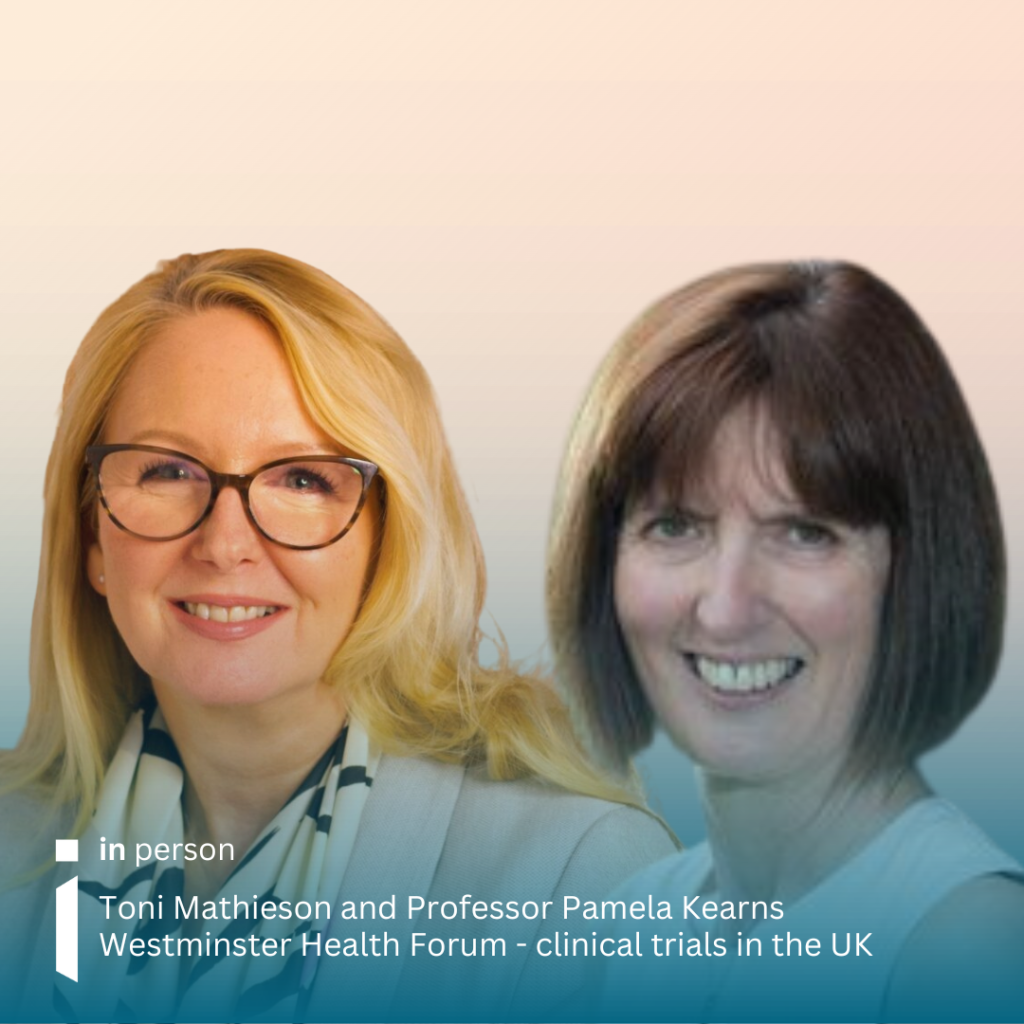
In the last in our three-part series looking at clinical trials in the UK from sessions at the Westminster Health Forum Policy Conference, Toni Mathieson, Niemann-Pick UK and Professor Pamela Kearns, University of Birmingham, discuss the need to involve patients in clinical trials from the earliest stages and outline the current R&D barriers faced by the NHS
As the Westminster Health Forum Policy Conference on clinical trials in the UK drew to a close, the final session explored how patient engagement could be improved, and also looked at wider clinical trial barriers that still need to be overcome.
“From a patient and family perspective, particularly in rare and ultra rare conditions, clinical trials are integral to care,” Toni Mathieson, chief executive of Neimann-Pick UK, told the conference. “They are often the primary route to innovation, access and progress, and this means patients and families are deeply invested in the success of the UK’s research system.
“When embedding the patient voice at the heart of clinical trials is done well, patient involvement can support the outcomes that policy makers and sponsors are seeking,” she added. “For example, faster set-up, better recruitment, improved retention and more meaningful data that reflects patient priorities.”
Valuable part of the research ecosystem
The first clear priority is early involvement of the patient voice, the charity’s chief executive advised.
“Patient and carer input is most valuable before protocols are finalised, and when decisions are made about eligibility criteria, visit schedules, endpoints and use of data,” she explained. “This can help to minimise avoidable barriers and downstream amendments, particularly in rare diseases, where seemingly minor design decisions can have huge impacts on feasibility and participation.”
The second priority is to capture patient and family experience throughout the lifecycle of a study, not just at enrolment or completion. This is because experience evolves over time, she advised, and ongoing structured feedback can identify practical issues early, before they impact on recruitment, retention or data quality.
Thirdly, carers and families must be recognised as part of the research ecosystem. “In many rare and neurodegenerative conditions, carers are central to treatment, administration, symptom monitoring and decision-making,” Toni told the conference. “Trial designs that underestimate this role risk placing unsustainable burdens on families, and this, in turn, could affect participation and completion.”
For many rare conditions, using animal models in clinical research is not optional, it is essential, she told the conference. “For understanding disease mechanisms, identifying therapeutic targets and generating the evidence needed to move safely into first in human studies,” Toni explained.
“The UK government has recently announced a national strategy aimed at expediting the transition to alternative methods where they are scientifically and ethically appropriate,” she added. “However, it must be noted that animal research remains necessary in contexts such as rare, progressive neurological diseases, where validated alternatives do not yet exist.”

Public trust and confidence is key
From a patient perspective, Toni advised that there is often a strong recognition that without robust translational research, there would be no clinical trials at all. But what matters most is that this type of research is well governed, scientifically justified and transparently communicated. This would help patients and the general public to better understand how and why this research contributes to the development of safe and effective therapies.
Data is central to the NHS’s ambitions, and this connects directly to patient trust and confidence, she said.
“Patients consistently tell us that they support the use of their data for NHS research, but only when there is transparency, clarity of purpose and effective safeguards,” Toni explained. “If data initiatives are to succeed, we need meaningful patient engagement and visible public benefit, as well as clear communication on how data is used, how privacy is protected and how insights are returned to participants and the general public. This is currently something that seldom happens and it is a source of great frustration to the patient community. So, it is great to hear that this will be addressed in the updated clinical trials regulations.”
Rare disease patients want not only to take part in trials, but to understand what has been learned, how decisions have been reached and to be informed of what happens next, she highlighted.
“The patient voice should be reflected across the research ecosystem, in regulatory dialogue, and in ethics reviews, workforce development and post-trial communication,” she explained. “Recognising the value of this important tool, can help the UK to deliver on its ambition to become a world-leading, trusted and effective research environment.”
“You cannot offer a trial to a patient if it is not open”
Delegates also heard from Professor Pamela Kearns, chair of the initiative for multi-stakeholder partnership to accelerate children’s cancer trials (IMPACCT), and emeritus professor of clinical paediatric oncology at University of Birmingham.
Pamela is a paediatric oncologist who has been involved in clinical trials for more than 30 years.
“I work in a specialty where offering a clinical trial to our patients is intrinsic to the patient pathway,” she explained. There is also the involvement of patient advocates in clinical trials in terms of trial design, and in trial management groups, oversight committees and delay summaries. “This is all very much part of our DNA,” she commented.
In paediatric oncology, trial recruitment is not the issue, she said, as patients and families that give consent for their children to go into clinical trials are very willing to advance research in the specialty.
“Our problem is that you cannot offer a trial to a patient if it is not open,” Pamela explained. “It is a big problem at the moment and I became involved in IMPACCT because rather disappointingly, after 30 years, the position of being able to open clinical trials in the NHS has deteriorated to a point of really quite catastrophic potential.”
The reason for bringing together IMPACCT’s multi-stakeholder partnership was to unite clinicians, trialists, patient advocates, funders and representatives from the Health Research Authority (HRA), Department of Health and Social Care (DHSC) and National Institute for Health and Care Research (NIHR), to find pragmatic solutions to overcome the barriers that are happening in R&D departments within the NHS. These are stopping clinical trials from opening, she told the conference.
IMPACCT’s work to date has focused on three main areas. “The first is the electronic prescribing system for chemotherapy, and this has added enormous amounts of barriers to the ability to practically open a clinical trial,” Pamela explained. “We’ve also been looking at the challenges around research workforce and the bureaucracy in R&D as there are real problems in R&D departments in terms of duplication of effort and overly complex systems for capacity and capability approval of trials.”
The partnership has made good progress in working together with its network of hospitals that treat children with cancer, working in alignment with HRA and DHSC. But there are specific problems with getting trials approved through the MHRA that the partnership’s patient advocates are frustrated by, Pamela advised.
“In the world of paediatric oncology and in many rare diseases, most of our trials are non-commercial,” she explained. “They are often sponsored by an academic institution, and they are pragmatic, and based around treatment optimisation using drugs that are used in day-to-day standard care. We’re just asking questions about how we can optimise their use.
“These trials would be considered low risk, and in fact, would come under the low intervention definition of theEU Clinical Trials Regulation,”she continued. “But they are specifically excluded from the notification scheme, which would accelerate their approval, because they involve children. Yet, this is in spite of the fact that the drugs are just being used as standard, so we have decades of experience of their safety profile.”
The situation is leading to non-commercial trials being deprioritised in R&D departments in the NHS, Pamela added. This is due to these trials not bringing in the funding of a commercial trial, and having smaller patient numbers, and it is leading to them being viewed as “unattractive” in the NHS, so they get deprioritised and delayed, she told the conference.

Impact of Brexit
The second challenge is in rare diseases, Pamela explained. “We have 2,000 children diagnosed with cancer in the UK, and that encompasses around 100 different diagnoses, so each individual trial only has a small number of eligible patients.”
This makes it imperative to collaborate internationally, she added. “But since we left the EU, we have very much become an outlier when it comes to participating in clinical trials that are initiated in the EU, whether they are commercial or non-commercial.
“When trials are assessed by the European competent authorities, they are now subject to combined approval through the clinical trials information system (CTIS), and they then come to the MHRA,” she explained. “But there is no practical, mutual approval, though I’m sure my MHRA colleagues would say that’s not true.”
This situation leads to trials either being rejected or additional conditions are applied because of what she describes as a “perceived additional risk” that is not typically seen in the competent authorities on the mainland. “This means we either don’t open these trials in the UK or they are extremely delayed, because we go backwards and forwards with the debate about why this particular additional condition is not required,” she told the conference.
Additional cost is another issue. Prior to leaving the EU, Pamela explained that they could participate in a European clinical trial, and the drugs could be imported to the UK on a mutual agreement basis via an import license, known as a qualified person (QP) release. That is no longer the case and it means there is no longer a reciprocal arrangement in place.
“We have very good examples of this where we have exponentially increased the cost of delivering a CAR-T trial in the UK because of these additional regulatory steps,” she highlighted. “It has reached the point where it can be two to three years before a particular arm of a clinical trial, and one that is offering innovation for children with cancer, can be approved in the UK. This is in spite of the fact that it is available in Europe.”
In addition, more innovation is needed for rare diseases. Pamela added that there is a big shift in paediatric oncology and rare diseases towards platform and adaptive trial designs. It is also where the UK’s regulatory authorities have been innovative and led the way in their approval of these studies.
“If they could accelerate the way we can adapt these designs and align with some of the work that’s going on in other countries, I think we could be a leader in rare diseases and rare cancer clinical trials in the UK,” Pamela added.
“My plea to the regulator in the UK is, while we have to safeguard and protect young people, it’s important that we don’t put the bar so high that we’re actually protecting them from the ability to participate in clinical trials and to access innovation.”
Connect with Toni
Connect with Pamela
in person keeps you up to date with RARE conference insights. To access more in person articles click below.