
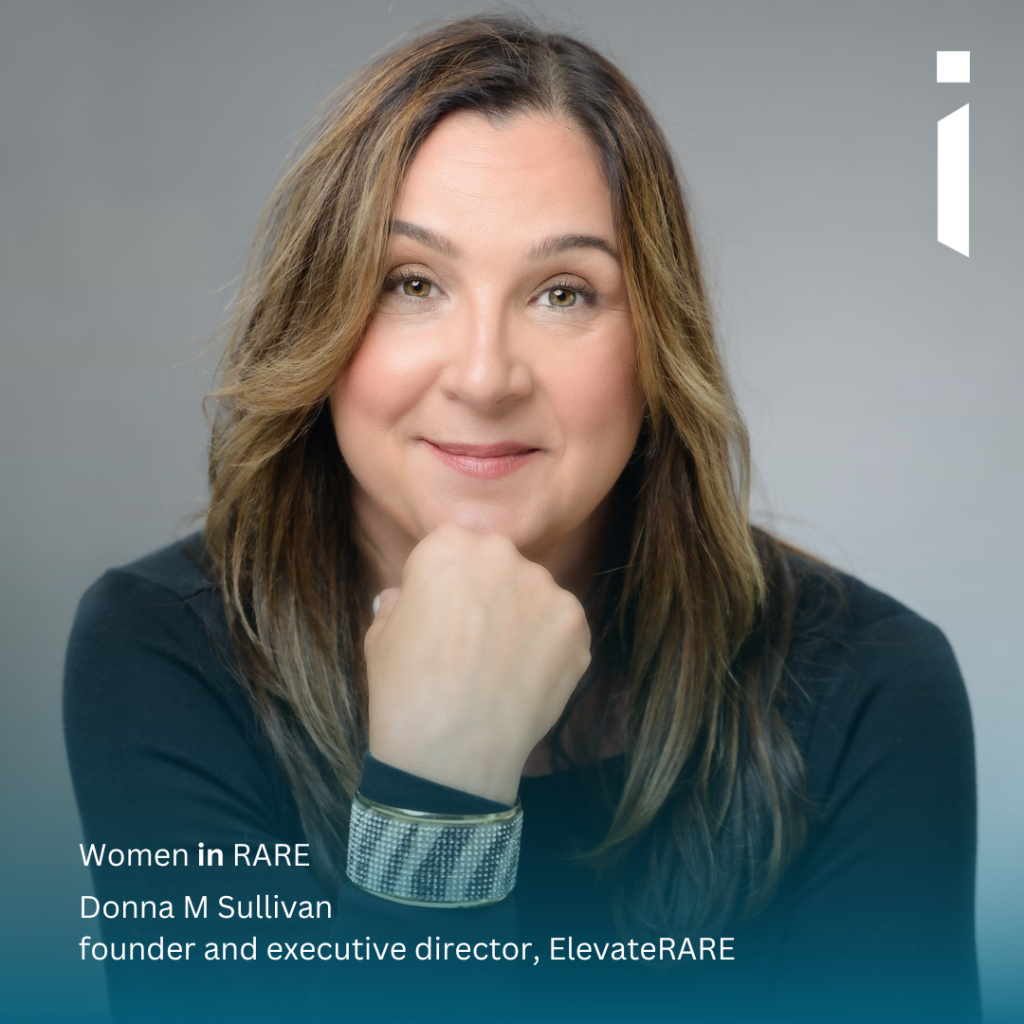
Donna M Sullivan, founder and executive director, ElevateRARE

Estimated reading time: 1 minute
“My motivation to work on projects supporting rare and marginalised patient populations is fuelled by my own family’s experience in healthcare and in response to struggles I have witnessed that patients and providers encounter in our broken healthcare system.”
I started out working as a journalist and then transitioned to a creative agency. When my children’s health issues started, I had to leave the workforce to become a full-time caregiver but used my skillset to volunteer on several non-profit boards supporting kids and families living with complex pain and Ehlers-Danlos syndrome. The issues I was seeing rare disease families encounter and horrified by the care gaps that were harming medically complex kids led me back to my journalism roots. I started a documentary film, called Complicated. It is not easy supporting a family and being a caregiver as a single parent, so my work is mostly freelance and consulting. It has not been easy, but I have been fortunate to be able to utilise my creative skills, marketing/business development and agency experience to work freelance and consult with healthcare clients and do meaningful and purpose driven work.
What motivated you into your chosen career path?
I have always had a love of writing and an appreciation for journalism. I was raised by generous parents who instilled a strong sense of empathy and a keen awareness of the importance of giving back.
I clearly remember my sixth-grade book report that I chose to do on a biography of Barbara Walters much to the surprise of my teacher. I was inspired by the power of journalism to educate, empower action and bring about change. My motivation to work on projects supporting rare and marginalised patient populations is fuelled by my own family’s experience in healthcare and in response to struggles I have witnessed that patients and providers encounter in our broken healthcare system. My interest in starting my own non-profit evolved as I saw unmet needs that are amplified in our film. It was a natural evolution to use my communication skills to create a non-profit to continue this work.
What do you see as some of the opportunities as a woman in your field?
Women have so many faces of experience to offer, but I am a bit unsure how the influx of AI into the creative space is going to impact careers in the future. I believe there will always be a need for human experience and authentic storytelling.
I have been honoured to meet so many incredible women in the rare disease space whose work and careers are in response to personal experiences. That drive and authentic sense of mission is what fuels progress. How many mothers have led research efforts to find cures for their children or founded non-profits to address gaps in the system?
I think there will always be opportunities to utilise storytelling in business, and pharma and medical education. I also think data, biotech and wearables are booming sectors that will always needs creative storytelling to connect with consumers.
What are some of the barriers to success as a woman in your field?
Like many professional mothers whose children are impacted by medical issues, my career was impacted because of the needs of my family. Caregiving is highly under supported and under respected in this world. When I tried to re-enter into corporate life, I was surprised to learn how much the time off impacted my ability to find work. Even though I had kept up my skills and had done some ground-breaking volunteer work within my field, it seemed to still be viewed as non-applicative. I also wondered if my choice to stay home to care for my kids might make potential employees question reliability. Men are often not viewed through that lens.
I think we need more corporate development programmes for woman to address these challenges.
What is one piece of advice you would give your 10-year-old self?
I would tell her to run her own race. Find work that fuels your passion, offers some flexibility to accommodate the changing phases in your life and makes you want to get up in the morning and contribute. With that said, I am also a realist. I would also tell her to find a field that has stability because having financial stability is critically important.
Can you tell us about your current work priorities and focus or a particular project you are working on?
I have been working on some very specific issues that relate to medical awareness and clinical education, medical trauma and patient support.
I am looking forward to the release of our documentary film, Complicated, on Apple TV. We are taking it global with educational screenings and executing our impact plan to try and address several of the clinical gaps and issues highlighted in the film. With the launch of ElevateRARE I am working with an incredible team of advocates and physicians, nurses and researchers creating educational programmes to help train healthcare providers on the unique clinical needs of Ehlers-Danlos patients, as they have predictable needs that can help informed providers understand and hopefully avoid common unexpected outcomes and adverse events. We are collaborating with experts and other non-profits in the space to work on solutions and programmes to help address the unmet needs of rare disease patients in palliative and end of life care as well.
To find out more about the film, Complicated, please visit:openeyepix.org/complicated
Connect with Donna
Women in RARE is a celebration of women working in the RARE space in science, research, industry and advocacy. To access more Women in RARE articles click below.