
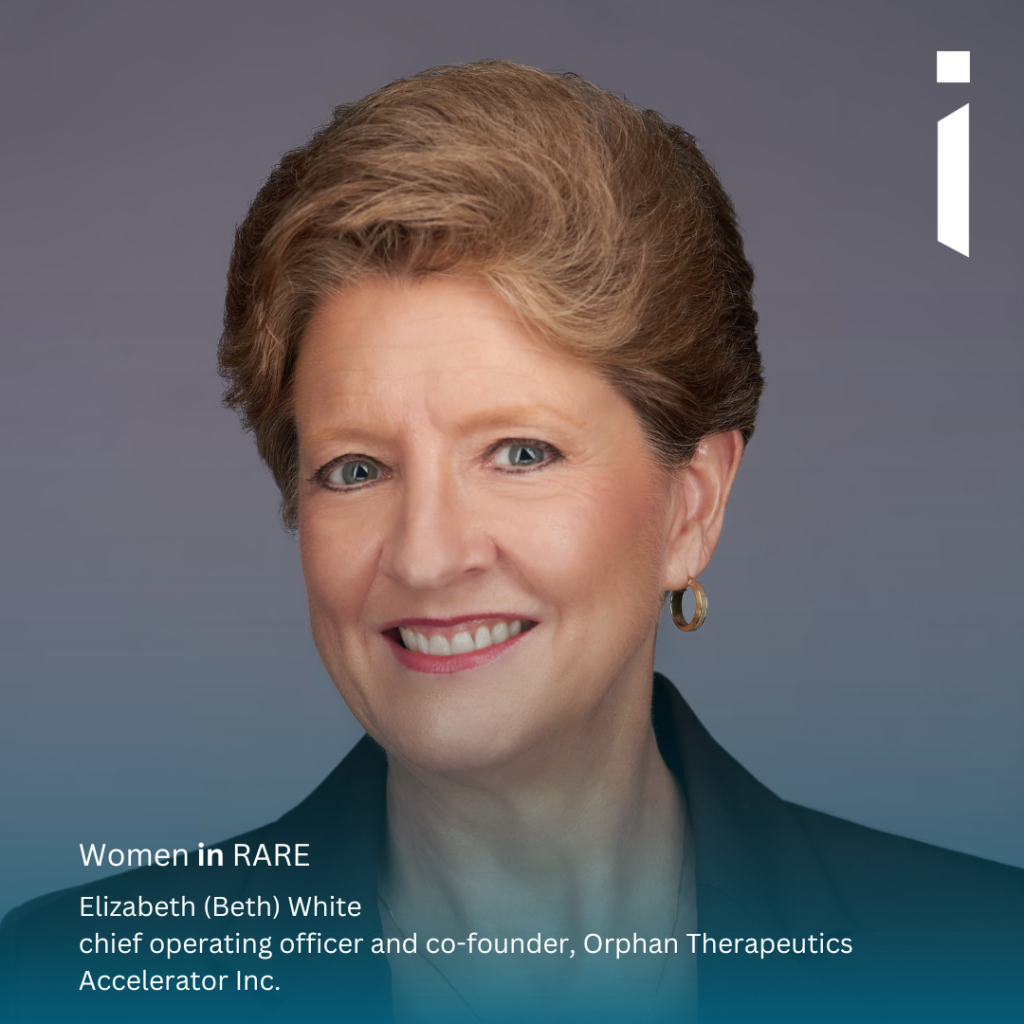
Elizabeth (Beth) White, chief operating officer and co-founder, Orphan Therapeutics Accelerator, Inc.

Estimated reading time: 7 minutes
“I was motivated to find solutions for patients who had none. And more than fifteen years ago, the first time I heard a patient advocate, a mother, describe the devastation of losing a child to a rare disease, I knew that I would dedicate the rest of my career to finding ways to help.”
Trained as a molecular biologist, I am an experienced biopharmaceutical executive with a 35-year career spanning drug development, portfolio prioritisation, strategic planning, business development, operations, corporate communications, commercial planning and global brand management. I am currently chief operating officer and co-founder of the Orphan Therapeutics Accelerator, a unique non-profit biotech focused on ultra-rare disease drug development and access.
Prior to that, I served as chief business officer and SVP of Operations for Renovacor, a public preclinical cardiovascular gene therapy company, where led the business development efforts resulting in Renovacor’s acquisition by Rocket Pharma. Prior to Renovacor, I was chief business and strategy officer for NeuExcell, a preclinical gene therapy company focused on neurologic disorders, which was preceded by 20 years at Wyeth/Pfizer where I most recently led new product planning strategy and contributed to important licensing and acquisition deals as assistant vice president, Commercial Development, for Pfizer’s Rare Disease and Gene Therapy Business.
What motivated you into your chosen career path?
I was interested in science from a young age, especially biology, as I was very intrigued by how things worked. I decided to pursue a Ph.D. in biology with the intention of becoming a college professor, but in the end decided I wanted to take what I learned both in terms of knowledge and ability to solve problems and use it for something much more applied.
I joined the biotech/biopharma industry at a time when it was really coming of age, starting to translate discoveries into innovative, life-changing medicines. Like so many of my colleagues over the years, I was motivated to find solutions for patients who had none. And more than fifteen years ago, the first time I heard a patient advocate, a mother, describe the devastation of losing a child to a rare disease, I knew that I would dedicate the rest of my career to finding ways to help.
What do you see as some of the opportunities as a woman in your field?
Generally speaking, there are so many opportunities in rare disease and genetic medicine development and commercialisation. Depending on your interests and background, you can get involved in drug discovery, preclinical safety, statistics, analytics, regulatory affairs, clinical development, project management, manufacturing, quality control, commercial planning, business development, policy, market access, marketing and sales, finance, investing and so much more. Our understanding of the science behind the development of many different kinds of genetic medicines is exploding and there is so much promise for these treatments to make a real difference in patients’ lives. But there is much work to do to allow the business and commercialisation models to keep up with these promising innovative scientific advancements.
One of the special things about rare disease medicine development and commercialisation is the real importance of bringing in the voice of patients and families, because they know better than anyone what is important to them. And women have a special place in this work because they tend to excel when it comes to patience, caring, dedication, listening, building bridges, collaborating across silos, making connections, building new pathways and putting patients and people first.
Patient advocacy groups, which play a key role in this field, are often led by women, and women leaders in biopharma can often more easily connect with them. Advocates put a lot of emphasis on trust—they need to be able to trust the people they are working with because their family member’s life may depend on it—and often women can bring a sense of trust and believability.
What are some of the barriers to success as a woman in your field?
I know many women who work hard, keep their head down, pay attention to all the details and focus on the deliverables because that’s what it really takes to get the job done. And this is so important! Since women are often very focused on their work (or because they may not feel worthy or confident enough, or because they feel they can’t take additional time away from their families), women often don’t pay enough attention to doing the things that tend to elevate and promote people. Things like networking, taking advantage of public speaking opportunities, taking time for lunch or coffee, getting involved with organisations that will build connections or clearly articulating or highlighting their contribution to a successful effort. And women don’t necessarily make the plans or outline the steps they need to take (including those things outside of getting their job done) to get where they want to go in their career.
I believe it’s especially hard for women to break into areas that are traditionally male dominated (e.g., finance, venture capital, business development). And women are generally too hard on themselves, not believing they are good enough to get that speaking engagement or promotion, when they clearly are good enough!
What is one piece of advice you would give your 10-year-old self?
I think of this as what advice would I give to my almost 10-year-old granddaughter! And that would be to be yourself and follow your heart. What interests you the most and what do you like to do? No matter what anyone else thinks about that, you can feel confident that if you follow your dreams and work hard at it, you can be whatever you want to be (even if it’s something that boys usually do). You are much better than you think—believe it! And you don’t have to be perfect to make a difference.
Can you tell us about your current work priorities and focus or a particular project you are working on?
My career has now come full circle in that I feel I can take advantage of all I’ve experienced and all I’ve learned and apply it to a whole new approach to making rare disease medicines accessible to the patients who need and deserve them. I am currently a co-founder and chief operating officer of the Orphan Therapeutics Accelerator (OTXL), a patient-centred non-profit biotech focused on obtaining and reinitiating development of promising “shelved” clinical-stage treatments for ultra-rare conditions and providing a scalable and sustainable commercialisation path to get these treatments to patients.
In support of our commercialisation efforts, we introduced Orphan Therapies, a wholly owned subsidiary of OTXL, which provides access to approved treatments for very rare conditions where high costs and small patient populations make commercialisation by traditional biotech companies unviable. At the end of 2025, we announced a partnership between Orphan Therapies and Fondazione Telethon, an Italian non-profit organisation, to facilitate US commercial access for WASKYRA™ (etuvetidigene autotemcel), an ex vivo gene therapy for the treatment of Wiskott-Aldrich syndrome. This marks the first commercialisation of a gene therapy, or perhaps any medicine, via a purely non-profit collaboration.
Early in 2026, we also announced a partnership with The American Society of Gene & Cell Therapy (ASGCT), the leading professional organisation for the advancement of cell and gene therapies (CGTs). This joint venture addresses a growing and urgent challenge facing the CGT field: policy and economic shifts in recent years have led biopharma sponsors to halt development of hundreds of CGTs no longer considered commercially viable by traditional industry standards, including many that delivered clear benefits to patients in trials. Our “CGTxchange” leverages the combined capabilities of the organisations in an unprecedented way to engage a broad array of potential partners and funders to efficiently identify, evaluate, finance, develop and provide sustainable, reliable and scalable access to potentially transformative CGTs for ultra-rare diseases.
Connect with Elizabeth
Women in RARE is a celebration of women working in the RARE space in science, research, industry and advocacy. To access more Women in RARE articles click below.