
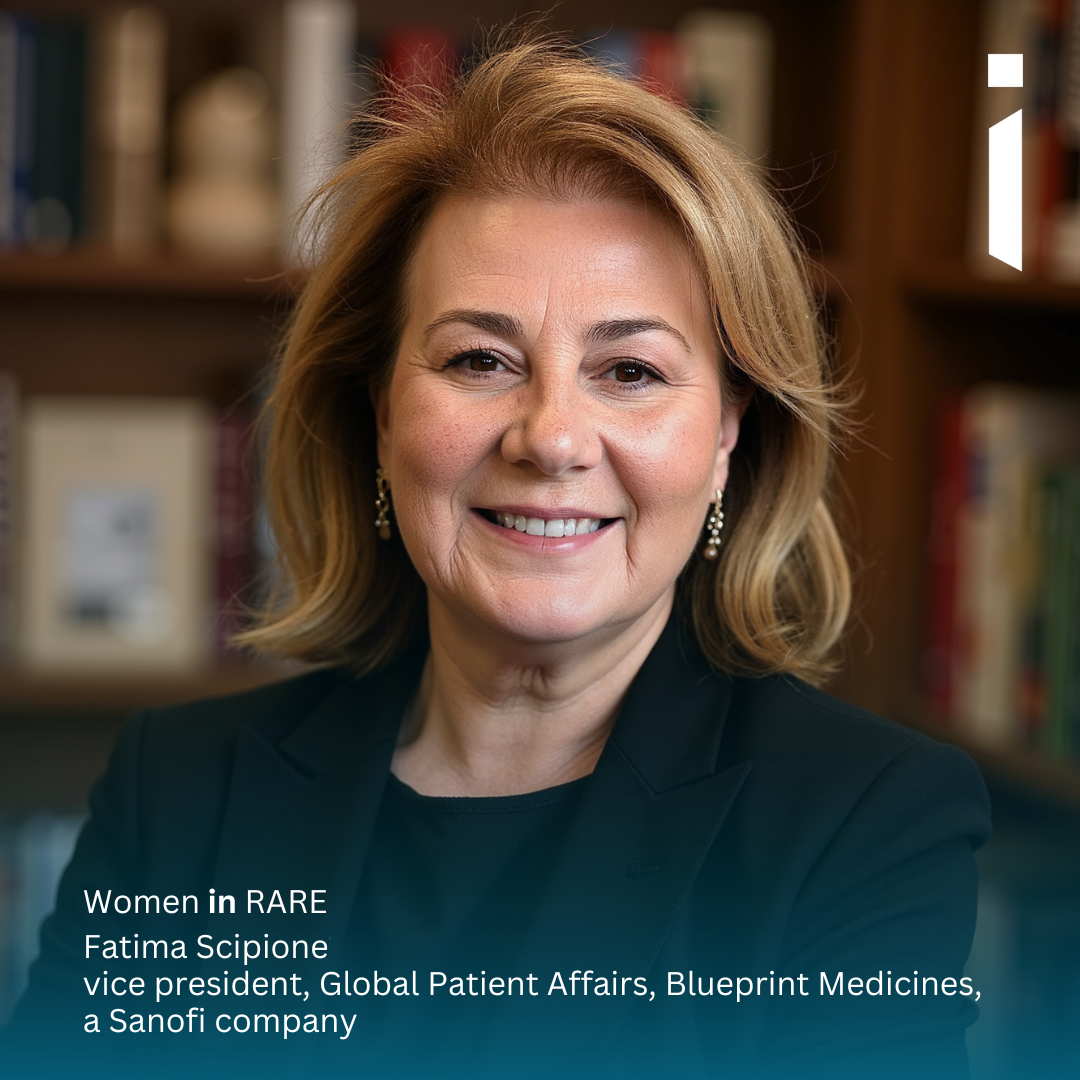
Fatima Scipione, vice president, Global Patient Affairs, Blueprint Medicines, a Sanofi company

Estimated reading time: 7 minutes
“What continues to motivate me is the belief that patient experience is a form of evidence. When it is respected and integrated into how medicines are designed, studied and delivered, it strengthens science, trust and outcomes. Connecting lived experience with innovation in ways that improve care at scale is what gives this work its lasting meaning for me.”
Across more than 25 years in biopharmaceuticals and patient advocacy, I have built and led global teams that connect scientific innovation to the realities of people living with serious and rare disease. I have held senior leadership roles across oncology and rare conditions, guiding patient and professional engagement functions that translate lived experience into research strategy, access decisions and care models that improve outcomes at scale.
I began my career in patient advocacy and moved into executive leadership to ensure patient insight was not simply heard, but structurally embedded into how medicines are developed and delivered. Over time, my work has evolved into designing the teams, partnerships and governance that allow patient experience to shape decisions across organisations.
Today, as vice president of Global Patient Affairs at Blueprint Medicines, I lead a global, high-performing team advancing care for systemic mastocytosis and other mast cell driven diseases through earlier diagnosis, evidence generation and ecosystem-wide collaboration.
What motivated you into your chosen career path?
I began my career in the pharmaceutical industry working in AIDS wasting, where I saw firsthand what disease can do to an individual, a family and a community. That experience stayed with me. It shaped how I think about the responsibility our industry carries and the importance of never losing sight of the people behind the science. In oncology and rare disease, where I have worked, no one chooses their diagnosis. They depend on us to do our work with rigor, urgency and humanity so they can live the lives they aspire to, even in the face of illness.
I was drawn to this work by watching people with serious and rare disease navigate systems that were not designed with them in mind. I met patients who carried extraordinary knowledge about their condition, yet struggled to see that insight reflected in care decisions, research priorities or access to treatment.
What continues to motivate me is the belief that patient experience is a form of evidence. When it is respected and integrated into how medicines are designed, studied and delivered, it strengthens science, trust and outcomes. Connecting lived experience with innovation in ways that improve care at scale is what gives this work its lasting meaning for me.
What do you see as some of the opportunities as a woman in your field?
One of the most important opportunities for women in rare disease and biopharma is the ability to shape healthcare at every level of the ecosystem, from discovery and clinical care to evidence generation, policy and commercialisation. Women today are leading as physicians, scientists, advocates and executives, and that breadth of leadership gives us a powerful ability to influence how medicine is practiced and how innovation reaches patients.
In rare disease, progress depends on more than technical excellence. It requires decisions that reflect how people actually live with illness. Women in this field, whether in the clinic, the lab or the boardroom, are increasingly positioned to integrate scientific rigor with real-world insight, improving trial design, outcome measures and care pathways in ways that strengthen both evidence and trust.
There is also an opportunity to ensure that patient and caregiver experience is no longer treated as secondary data, but as a core driver of research and health system design. Women are leading the development of frameworks, metrics and governance models that make this insight actionable at scale.
Finally, women have the opportunity to build leadership pipelines that reflect the diversity of the communities we serve. By mentoring, sponsoring and advancing others, we are helping to create a healthcare system that is not only more inclusive, but more capable and resilient.
What are some of the barriers to success as a woman in your field?
One of the most persistent barriers for women in healthcare and biopharma is not lack of capability, but how authority is perceived. Women are often expected to demonstrate a higher standard of proof before their expertise is trusted, particularly in scientific, clinical and strategic leadership roles. This means we must repeatedly validate what would be assumed for others.
There is also a visibility gap. Women do much of the work that makes programmes succeed, from cross-functional coordination to stakeholder trust to patient engagement, yet that work is often treated as background rather than enterprise-critical. When influence is measured by who speaks loudest rather than who delivers results, women’s impact can be underestimated.
Another barrier is sponsorship. Mentorship helps women grow, but sponsorship is what moves people into positions of power. Women are still less likely to be sponsored into roles where budgets, strategy and enterprise decisions are controlled, even when their performance warrants it.
Structural realities also matter. Many women carry disproportionate responsibility for caregiving, and organisations have not fully adapted their leadership models to support that without penalty.
Finally, women who lead with conviction and clarity are more likely to be labelled as difficult, while the same behaviour in others is rewarded as decisive. These double standards create friction that slows advancement.
None of these barriers are about talent. They are about access to power, recognition and opportunity. When those are equitable, women do not just succeed. They elevate the entire system.
What is one piece of advice you would give your 10-year-old self?
I would tell her that her sensitivity is not something to outgrow. It is something to trust. The way she notices unfairness, feels deeply and cares about people will become the foundation of her leadership.
I would also tell her not to make herself smaller to fit into the room. Her voice will be needed, even when it feels uncomfortable to use it. There will be moments of doubt, but the work she is meant to do will always feel larger than that fear. Follow that pull. It will lead her exactly where she belongs.
Can you tell us about your current work priorities and focus or a particular project you are working on?
At Blueprint Medicines, I lead a global patient affairs team that is building a rare disease ecosystem designed to bring patients, caregivers, clinicians and industry into true partnership. We work in systemic mastocytosis and other mast cell driven diseases that are complex, under-recognised and often diagnosed far too late. Improving that reality is at the centre of our strategy and everything my team delivers.
One of our key priorities is earlier and more accurate diagnosis. Through initiatives such as Project BEACON, my team is partnering with health systems and clinicians to use real-world data and predictive tools to identify patients sooner and shorten the diagnostic journey.
Another priority is elevating patient experience into research and development. Through global advisory boards, publications and patient-generated evidence, we ensure that clinical programmes, trial design and outcome measures reflect what truly matters to people living with these diseases.
We are also strengthening the care ecosystem itself by equipping providers, supporting caregivers and building trusted education platforms that patients can rely on as they navigate complex decisions.
Our HERO Summit reflects this model. It is a global working forum designed to bring patients, clinicians and advocates together to share insight, build trust and co-design the future of advocacy and care in systemic mastocytosis.
This work connects scientific innovation with lived experience in ways that make progress real, scalable and lasting for rare disease communities.
Connect with Fatima
Women in RARE is a celebration of women working in the RARE space in science, research, industry and advocacy. To access more Women in RARE articles click below.