
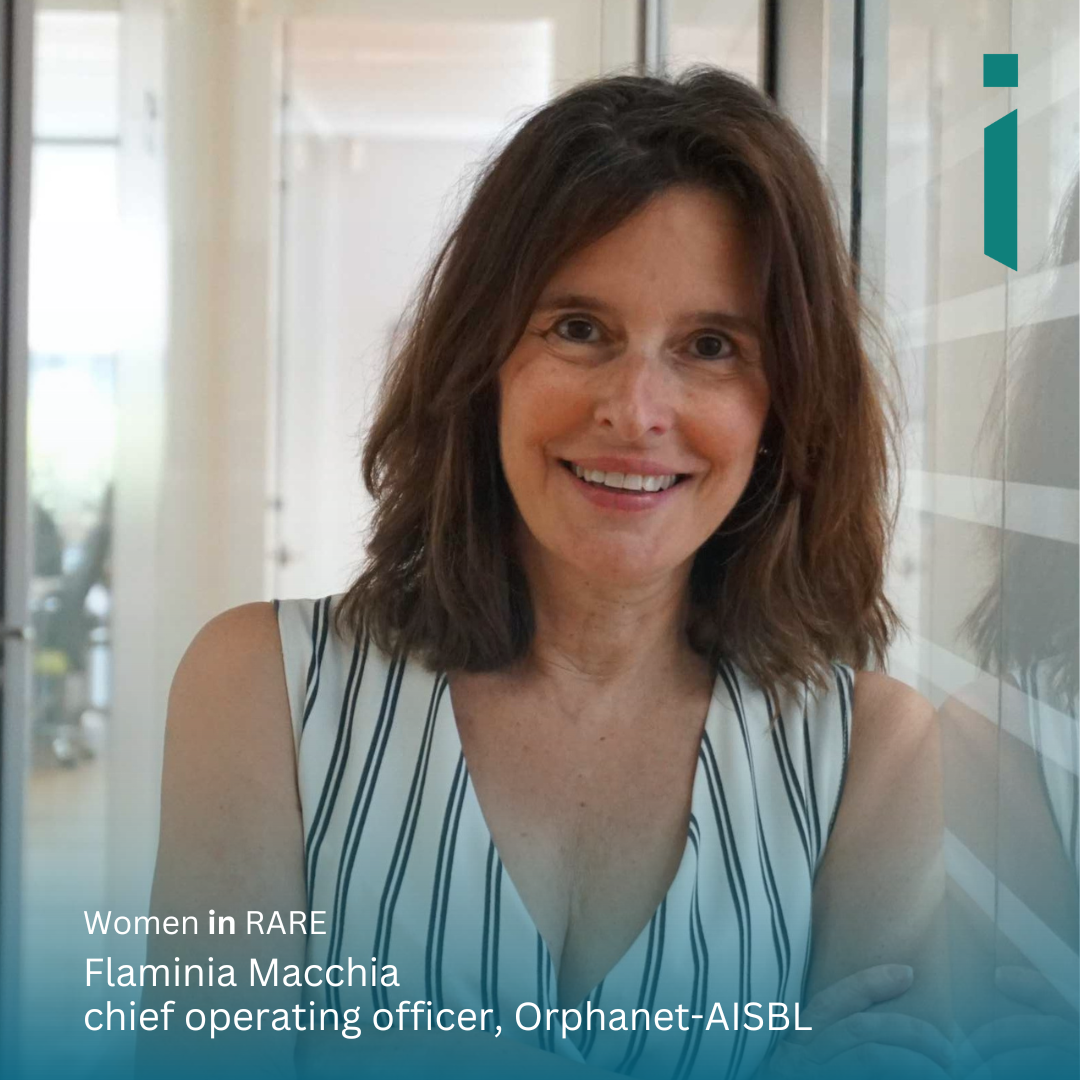
Flaminia Macchia, chief operating officer, Orphanet-AISBL

Estimated reading time: 8 minutes
“After all these years, I still believe that shared knowledge is a powerful tool to reduce inequalities.”
I graduated in political sciences with a Master’s degree in Middle Eastern politics and began my career as a journalist in Jerusalem. Working in a complex political environment shaped my ability to bring diverse stakeholders to the same table, address difficult issues and identify common ground. I later moved into EU policy, first within EU institutions and then as a public affairs consultant in Brussels, working on several EU policy files.
Since 2000, I have been a rare disease advocate, with a strong commitment to improving the lives of people living with rare diseases and their families. I began this journey at EURORDIS, where I served for fifteen years as director for European Public Affairs, influencing relevant EU policies. I later broadened my perspective through roles in the pharmaceutical sector and as executive director of Rare Diseases International, gaining global experience.
Today, I serve as chief operating officer of Orphanet-AISBL, focusing on transforming expert-curated data into actionable knowledge to address persistent gaps in rare disease evidence. Across all roles, I have been guided by the same objective: improving outcomes for patients.
What motivated you into your chosen career path?
My motivation has always come from patients: what they go through on a daily basis, the unacceptable gaps in our healthcare systems, their isolated battles. Early in my career, I saw how delayed diagnosis, lack of expertise, lack of data, lack of research, lack of treatment, meant lack of hope for entire families.
My commitment is also deeply personal. One of my childhood friends died at the age of sixteen from spinocerebellar ataxia dystrophy, and I was closely involved throughout the final years of her illness. Witnessing the family’s despair, progressive isolation and lack of support left a lasting mark on me. From there comes a lifelong determination to help alleviate the burden carried by patients and their families.
Working within patient organisations showed me the power of a collective voice. I also saw the limits of screaming the truth without evidence. My experience in the pharma sector further reinforced how critical high-quality data is for all levels of decision-making.
This combination of personal and professional experience led me to Orphanet-AISBL, where we truly work for the collective knowledge of patients, clinicians, researchers, industry and policymakers. After all these years, I still believe that shared knowledge is a powerful tool to reduce inequalities.
What do you see as some of the opportunities as a woman in your field?
In my opinion the opportunities for women in rare diseases come from the fact that this field requires far more agility and adaptability than a linear or predefined career path. My own journey, from journalism and EU policy to patient representation, industry, global advocacy and evidence generation, reflects an ability to move between roles and perspectives while remaining anchored in my human values and ethical principles.
Freedom of thought is essential to me, and when that space feels constrained, I have chosen to take my expertise elsewhere rather than compromise it.
As a woman working in policy, I have built legitimacy through long-term commitment to rare disease patients, across different roles and institutional settings, combined with technical credibility and trust earned over decades of transparent relations with patient communities. I have also had to learn how to navigate complex institutional structures and witnessed power dynamics that I refuse to lose time and energy over: my purpose is elsewhere.
This agility has allowed me to combine leadership roles, in-depth policy analysis and, more recently, independent policy work. Alongside my role as COO of Orphanet-AISBL, I work as an independent senior policy advisor supporting European patient organisations and alliance-building. Rare diseases offer women in policy the opportunity to influence decisions, shape agendas and governance frameworks and generate the evidence base itself.
That said, and regardless of gender, this field reflects broader realities: I have seen both the best and the worst of leadership, both from men and women.
What are some of the barriers to success as a woman in your field?
One of the main barriers to success as a woman in the rare disease field is the persistent imbalance of power in decision-making. Women are often highly visible in advocacy, coordination and operational roles, while they often remain underrepresented in the spaces where strategic priorities, funding decisions and governance structures are defined. These arenas are still largely male-dominated and opaque.
Another barrier is the systematic undervaluing of qualities often associated with women, such as emotional empathy, collaborative leadership or a conscious refusal to adopt dominant or aggressive behaviours. Choosing a non-dominant leadership style and refusing to compromise one’s values or ethics is too often interpreted as a lack of leadership, even after decades of experience and demonstrated impact.
There is also a cultural expectation that women in rare diseases will be endlessly available and mission-driven at all costs. The emotional weight of working closely with patients and families is significant but the effort and skills it requires —active listening, asking questions out of genuine human interest, mediation and sustaining trust—are rarely recognised as expertise and valued. When women assert boundaries, independence or intellectual autonomy, this is not always interpreted for what it is: professional integrity.
Finally, rare diseases are not immune to power abuse. I have seen how authority, funding or access to platforms can be used to silence dissenting voices or discourage critical thinking. For women who value freedom of thought and ethical consistency, resisting these dynamics can come at a personal or professional cost, but it is necessary to create healthier, more credible systems in the long term.
What is one piece of advice you would give your 10-year-old self?
I would tell my 10-year-old self: “Trust your moral compass and don’t confuse discomfort with being wrong. The ability to ask questions, to feel deeply and to refuse easy compromises will sometimes make the path seem more difficult—but it would be more difficult to compromise essential principles and be less free. Strength comes from hard work and knowledge and does not always sit where authority appears. Importantly, integrity is a form of strength that reveals itself over time.”
I would tell her: “Stay curious, stay independent, choose a work that allows you to remain human and empathic, even when systems abuse their power while rewarding silence and conformity. Work hard but don’t forget to enjoy life.”
Can you tell us about your current work priorities and focus or a particular project you are working on?
I am currently the chief operating officer of the newly established Orphanet AISBL.
Orphanet-AISBL: Transforming rare disease data into actionable knowledge.
Why Orphanet-AISBL exists:
Rare diseases suffer from fragmented, incomplete and poorly interoperable data. This persistent lack of reliable data hinders diagnosis, research, innovation, policy design and patient outcomes. Therefore, rare diseases urgently require informed evidence-based decision-making across healthcare, research, regulation and policy.
The Orphanet-AISBL was created exactly to address this gap by providing tools and services that enhance impact across the rare disease ecosystem.
Who we are:
Orphanet-AISBL is the international non-profit spin-off from Orphanet, which is recognised as the world’s largest rare disease knowledge base, for more than 25 years. Building on Orphanet’s more than five million combined data, the AISBL transforms these expert-curated reference data into actionable knowledge ready to use, for all stakeholders.
Our mission:
The AISBL mission to support stakeholders to take evidence-based decisions and accelerate innovation for patients by developing tailor-made services that address stakeholders’ needs and drive policy, research and innovation.
Building on Orphanet’s unique knowledge base, the Orphanet-AISBL aims to co-design and deliver customised services tailored to the needs of a wide range of stakeholders, including industry, patient organisations, European Reference Networks and public authorities.
Our unique assets include:
• Expert-curated, interoperable rare disease data from more than 35 countries
• Globally recognised ORPHA codes and disease classifications
• Comprehensive coverage across diseases, genes, diagnostics, treatments, clinical trials, epidemiology, expert centres, ERNs, patient organisations, registries, biobanks and guidelines
• Access to a network of rare disease experts and partners
What we do:
We turn rare disease data into actionable knowledge. Orphanet data can be used to answer specific strategic or scientific questions, combined with stakeholders’ own datasets and interpreted through expert analysis to generate meaningful insights.
Our services include:
• Customised datasets and analyses
• Data integration, exploitation and interpretation
• Policy, research and innovation support
• Strategic insights for regulatory, HTA and healthcare decision-making
Who we support:
• Patient organisations and alliances
• European Reference Networks (ERNs)
• Researchers and academic institutions
• Industry and CROs
• Policymakers, regulators and public authorities
Our value proposition
Time: faster access to trusted knowledge
Information: reduced uncertainty and better decisions
Impact: improved alignment between research, policy, innovation and patient needs
How we work
Our services are tailor-made and priced according to the level of customisation, the complexity and expertise required and the format and delivery (datasets, dashboards, reports, insights). Our service catalogue is under development and co-design is encouraged.
Get involved
Let’s build the future of rare disease evidence and decision-making together.
To find out more, please visitwww.orphanet-aisbl.com
Have your say in shaping the services we provide, take the survey below
Connect with Flaminia
Women in RARE is a celebration of women working in the RARE space in science, research, industry and advocacy. To access more Women in RARE articles click below.