
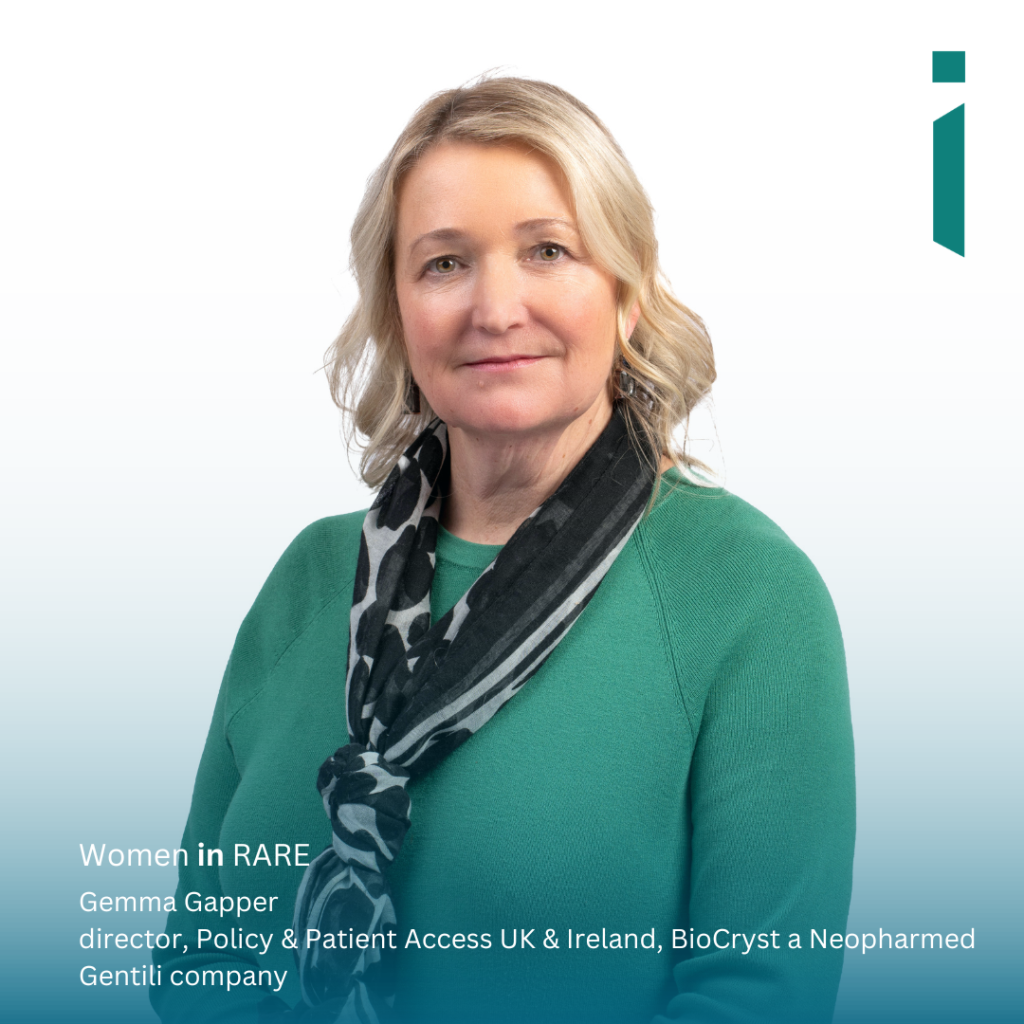
Gemma Gapper, director, Policy & Patient Access UK & Ireland, BioCryst a Neopharmed Gentili company

Estimated reading time: 6 minutes

“Experiencing the lasting impact of the work [with Alzheimer’s disease] sparked my commitment to a career focused on market access, patient access and system improvement. It showed me the power of collaboration and the difference we can make when we help innovative medicines reach the people who benefit from them.”
With a 30‑year career in pharmaceuticals and biotech, I specialise in market access, policy and patient access, with a particular focus on rare and inherited conditions. My work centres on ensuring innovative medicines reach patients by aligning industry, the NHS and the clinicians delivering care. I collaborate closely with patient organisations to understand real‑world challenges, shaping solutions that improve pathways and support people in managing complex conditions.
I partner with clinicians to provide education, tools and clarity around new treatments, while working with NHS payers and policy leaders to demonstrate value and enable sustainable commissioning. Known for my ability to build trust and create alignment across stakeholders, I am committed to leaving a lasting legacy.
What motivated you into your chosen career path?
Early in my career, I witnessed first‑hand the frustration experienced by patients with Alzheimer’s disease as they struggled to obtain a timely diagnosis and access to NICE‑approved treatment. I was fortunate to work in partnership with local service providers to redesign pathways, improve diagnostic access and support better long‑term management of the condition. Seeing how this 360‑degree approach—bringing together clinicians, payers and patient services—directly improved access to treatment for eligible patients was a defining moment for me.
Experiencing the lasting impact of this work sparked my commitment to a career focused on market access, patient access and system improvement. It showed me the power of collaboration and the difference we can make when we help innovative medicines reach the people who benefit from them.
What do you see as some of the opportunities as a woman in your field?
When I reflect on my career, I feel incredibly fortunate that my opportunities have never been defined by gender, but by the relationships I built, the expertise I earned and the impact I delivered. I have been supported, listened to and valued by colleagues, clinicians, payers and patient organisations because of my commitment to improving patient access—not because of my identity as a woman. That in itself is inspiring: it shows what is possible when we create environments where people are recognised first for their contribution and their integrity.
Yet I also see that there are powerful opportunities for women in this field—opportunities rooted in the strengths we so often bring: empathy, collaboration, resilience and the ability to unite diverse perspectives around a shared purpose. In market access and patient access, these qualities are not “nice‑to‑have”—they are essential for creating meaningful change.
The real opportunity for women is the chance to lead by example: to show that influence can come through partnership rather than hierarchy; that courage can look like listening deeply; and that improving the lives of patients is work that benefits from a diversity of voices, experiences and leadership styles.
If my career demonstrates anything, it is that when we bring authenticity, compassion and determination to the table, the system responds. And that gives me great hope for the women who will follow—because this is a field where purpose matters, where expertise is respected and where every individual has the chance to create a legacy that truly changes lives.
What are some of the barriers to success as a woman in your field?
When I reflect on potential barriers for women in our field, my own experience comes to mind. Early in my career, I was fortunate to have three young children under the age of five. At that time, parental leave and flexible working options were far more limited than they are today. My husband—also in the pharmaceutical industry—received no paternity leave, which placed the full weight of early parenthood on my shoulders. Coupled with the expectation to travel abroad for conferences and meetings, I felt compelled to pause or soften my career ambitions during those formative years. It wasn’t a lack of capability or motivation—it was simply the reality of the support structures available at the time.
As I progressed into the more experienced later stages of my career, I have occasionally sensed another subtle barrier: the perception that investing in my development may yield a shorter return because I am closer to retirement than earlier‑career colleagues. While no one has ever stated this explicitly, it can be felt in the way opportunities are distributed, and it highlights an important truth—bias is not always intentional, but it can still shape outcomes.
Despite these challenges, I have been extremely fortunate to build a fulfilling career. But I believe the real barrier for many women remains the same: navigating expectations—professional, societal and personal—through phases of life where support systems may not fully align. Recognising this openly allows us to create a workplace that truly values talent at every stage of life and career.
What is one piece of advice you would give your 10-year-old self?
Life is a journey not a sprint! Take your time to consider a sustainable and rewarding career path and see every challenge as a learning opportunity not a setback.
Can you tell us about your current work priorities and focus or a particular project you are working on?
‘Living Well with HAE’ is a UK patient programme developed with HAE UK, clinical experts and psychologists in the UK, to address the emotional wellbeing and engagement challenges experienced by people living with HAE.
The unmet need
- HAE is unpredictable and emotionally burdensome, with anxiety, stress and disengagement common across the patient journey.
- Many patients feel unsupported beyond clinical treatment, particularly around emotional wellbeing, confidence and day‑to‑day self‑management.
- Disengagement from services is a recognised risk, especially during life transitions.
Overarching project objectives
- Improve emotional wellbeing support for people living with HAE in the UK.
- Identify emotional wellbeing gaps and unmet needs across the patient journey.
- Reach and re‑engage disengaged or low‑contact patients.
- Co‑create practical, patient‑centred resources with HAE UK and clinical experts that are usable in real‑world care settings.
Evidence‑led foundations
- Built on insights from the Power of Partnership report https://www.haeuk.org/news/power-of-partnership/ and real‑world patient experience.
- Co‑created patient resources.
- Development of ‘Living Well with HAE’ patient support leaflets, co‑created with HAE UK and clinical psychology expertise.
- Designed to support conversations between patients, families and healthcare teams.
- Focus on emotional wellbeing, confidence and practical coping strategies.
Expert Advisory Board (key milestone)
Virtual advisory board bringing together immunologists, specialist nurses, psychologists and patient organisation leaders.
Objectives:
- Validate emotional wellbeing gaps and unmet needs.
- Understand drivers of disengagement and opportunities for re‑engagement.
- Identify the most effective formats, channels and touchpoints for patient support.
Translation into action
Advisory board insights inform the next phase of the programme:
- Refined patient resources and signposting tools.
- Practical recommendations for clinics and patient organisations.
- Outputs aligned to awareness moments (e.g. HAE Awareness Day) and wider engagement activity.
Connect with Gemma
Women in RARE is a celebration of women working in the RARE space in science, research, industry and advocacy. To access more Women in RARE articles click below.