
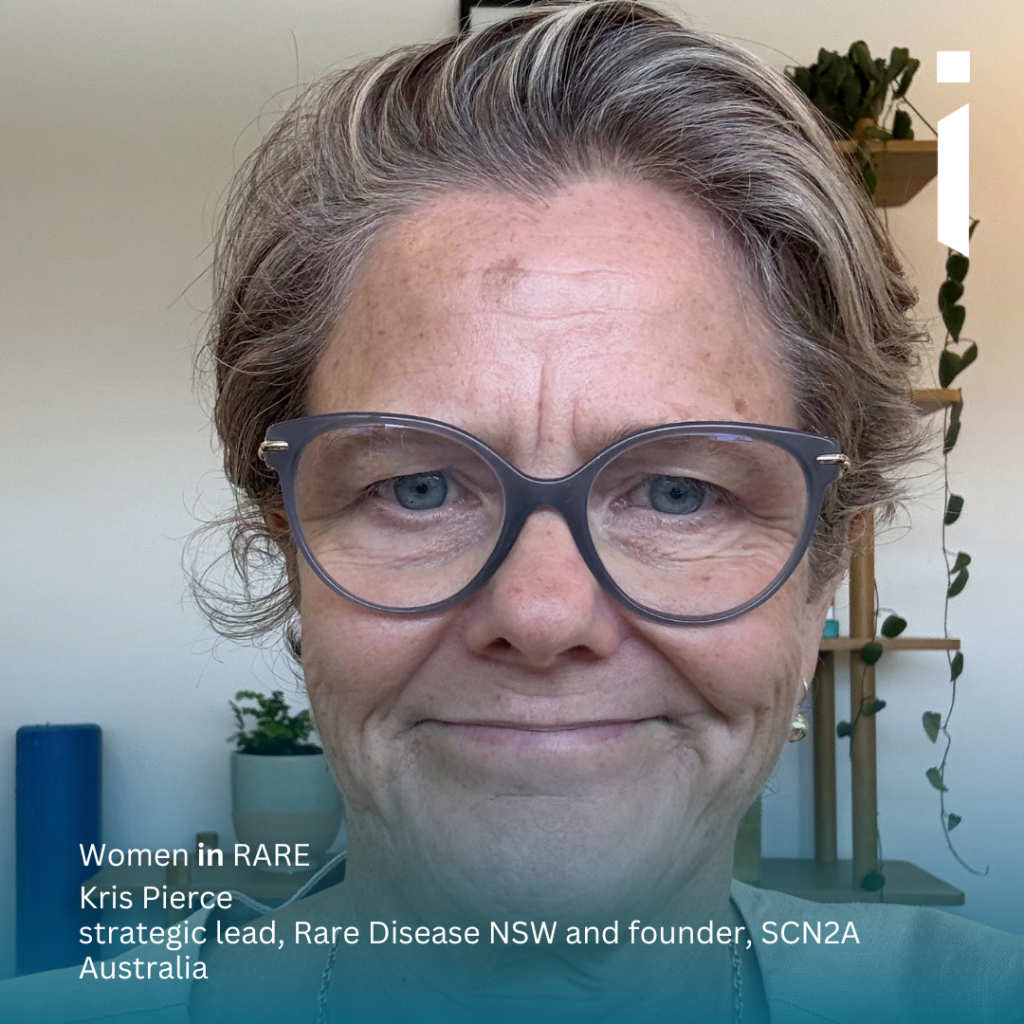
Kris Pierce, strategic lead, Rare Disease NSW and founder, SCN2A Australia

Estimated reading time: 1 minute
“I’m motivated by what’s possible when we get this right. Multi-stakeholder collaboration works. When lived experience is treated as genuine expertise—not a token addition—research becomes more relevant, translation accelerates and families benefit sooner.”
I trained as a nurse at Royal Melbourne Hospital, then completed postgraduate studies in health promotion and wellness. I worked across community health, general practice and clinical trials—including at Beth Israel Deaconess Medical Centre in Boston—building expertise in health systems and research translation.
My career shifted when my son Will was diagnosed with an SCN2A-related disorder. Searching for answers as a parent evolved into advocacy, then leadership. I co-founded SCN2A Australia in 2017 and helped establish the Genetic Epilepsy Team Australia, building networks that now influence research priorities internationally.
Today I lead consumer and community engagement strategy at UNSW, serve as chief investigator on multiple rare disease grants addressing genomic equity and rare disease treatment, and contribute to national bodies including Genomics Australia Advisory Council. My career reflects a deliberate integration of clinical expertise, research leadership and lived experience—combining these to drive meaningful, systemic change.
What motivated you into your chosen career path?
Necessity, frustration and hope.
When Will was diagnosed, I discovered that “rare” meant navigating fragmented systems largely alone. Information was scarce, services were siloed and research felt disconnected from what families actually needed. I channelled my clinical and health promotion background into advocacy—initially just connecting other SCN2A families so none of us felt so isolated.
But I quickly realised meaningful change required more than support. It required influencing research priorities, shaping health policy and building genuine partnerships between families, clinicians and researchers.
I’m motivated by what’s possible when we get this right. Multi-stakeholder collaboration works. When lived experience is treated as genuine expertise—not a token addition—research becomes more relevant, translation accelerates and families benefit sooner.
My path has been about bringing skills together: clinical knowledge, research acumen, strategic thinking and the credibility that comes from living this every day. That combination drives change.
What do you see as some of the opportunities as a woman in your field?
Women are increasingly recognised as leaders and change-makers in rare disease research and health system reform. The field rewards exactly the skills many women bring: building coalitions, navigating complexity, fostering collaboration and thinking systemically about long-term impact.
The shift toward patient-centred research and genuine consumer partnership has created leadership opportunities that didn’t exist a decade ago. Strategic roles in consumer engagement, research translation and health policy now sit at decision-making tables. Women who can integrate diverse perspectives—clinical, research, community, lived experience—are well-positioned to lead.
I see real opportunity in the growing recognition that effective research requires diverse leadership. Funding bodies and institutions increasingly understand that homogeneous teams miss critical insights. Women who bring multidisciplinary expertise and can work across boundaries are assets, not additions.
The collaborative nature of rare disease work also suits women who lead through influence rather than hierarchy. Building networks, connecting stakeholders, facilitating genuine partnerships—these are leadership capabilities in high demand. Success in this field requires relational intelligence and women often excel here.
There’s also opportunity in solidarity. Women in this field actively support emerging leaders. I’ve benefited enormously from this and I contribute to it now.
Finally, the rare disease sector values persistence and long-term strategic thinking—qualities often forged through years of navigating health systems. Women who have built organisations, influenced policy and driven research agendas bring demonstrated leadership that opens doors.
What are some of the barriers to success as a woman in your field?
Despite genuine progress, barriers remain for women seeking leadership in rare disease research and advocacy.
One persistent challenge is the legitimacy gap. Women—particularly those whose expertise includes lived experience—can face subtle questioning of their authority. I’ve been in rooms where my clinical credentials shifted how I was heard. Lived experience should be recognised as expertise in its own right; too often it requires formal validation before contributions are taken seriously.
Visibility and sponsorship remain uneven. Women are well-represented in consumer engagement and advocacy roles but underrepresented on governance boards, as principal investigators and in executive positions. The talent pipeline exists; the pathways to decision-making power need strengthening. Active sponsorship—not just mentorship—makes the difference.
The undervaluation of collaborative leadership is another barrier. Women who lead through facilitation and coalition-building can be overlooked in systems that reward individual achievement. Yet these collaborative approaches often deliver greater impact in complex fields like rare disease.
Compensation inequity persists too. Much foundational advocacy work remains unpaid, despite being essential to the field’s progress. Many women spend years building patient organisations and contributing to research without fair remuneration. The transition from volunteer advocate to paid professional is harder than it should be.
Finally, the combination of professional ambition and caregiving creates real tension. I know this personally. Flexible arrangements are improving but structural support remains inconsistent.
Addressing these barriers requires deliberate action: recognising diverse expertise, sponsoring women into senior roles, valuing collaborative leadership and building systems that enable sustained contribution.
What is one piece of advice you would give your 10-year-old self?
Trust your instinct to connect people.
You’re not the loudest in the room, and that’s fine. Some of the most important work happens quietly—in conversations, in follow-ups, in showing up consistently. You’ll build things by bringing the right people together and then stepping back so they can do their best work.
Don’t wait until you feel like an expert. You’ll learn more by saying yes to things that scare you a little. And when life throws you something completely unexpected, you’ll discover that all those different experiences actually prepared you perfectly. Keep collecting skills. They’ll make sense eventually.
Can you tell us about your current work priorities and focus or a particular project you are working on?
My work centres on a simple premise: as science accelerates toward precision therapies, our health systems need to be ready. Too often they’re not. Families wait years for diagnoses, face impossible barriers to clinical trials and then discover treatments exist but can’t be accessed. I’m focused on changing that.
Access to treatments for rare and ultra-rare diseases drives much of my current work. This means clinical trial readiness, health technology assessment processes that work for small populations and building the infrastructure—registries, natural history data, patient preferences research—that enables therapies to reach families faster. It’s systems work, often invisible, but essential.
I’m equally passionate about psychosocial supports. A diagnosis is just the beginning. Families need wraparound support—mental health, sibling wellbeing, navigation assistance, connection with others who understand. Research that ignores this misses half the picture.
Developmental and epileptic encephalopathies (DEE) remain my heartland. This year I’m working with the International Bureau for Epilepsy to bring together rare epilepsy leaders from around the globe. We’re developing a global rare disease survey to better understand shared challenges and opportunities. In Australia, I’m leading efforts to galvanise the DEE community—building a collective voice, identifying priorities and positioning us for the wave of precision therapies on the horizon.
I’m also a chief investigator on Diagnosis4All, an MRFF-funded project (Medical Research Future fund) tackling genomic equity for priority populations in New South Wales—First Nations communities, culturally diverse families and people in regional and remote areas. These communities face significant barriers to genomic diagnosis and we’re co-designing solutions with them. My role ensures consumer voices shape every stage.
Connect with Kris
Women in RARE is a celebration of women working in the RARE space in science, research, industry and advocacy. To access more Women in RARE articles click below.