
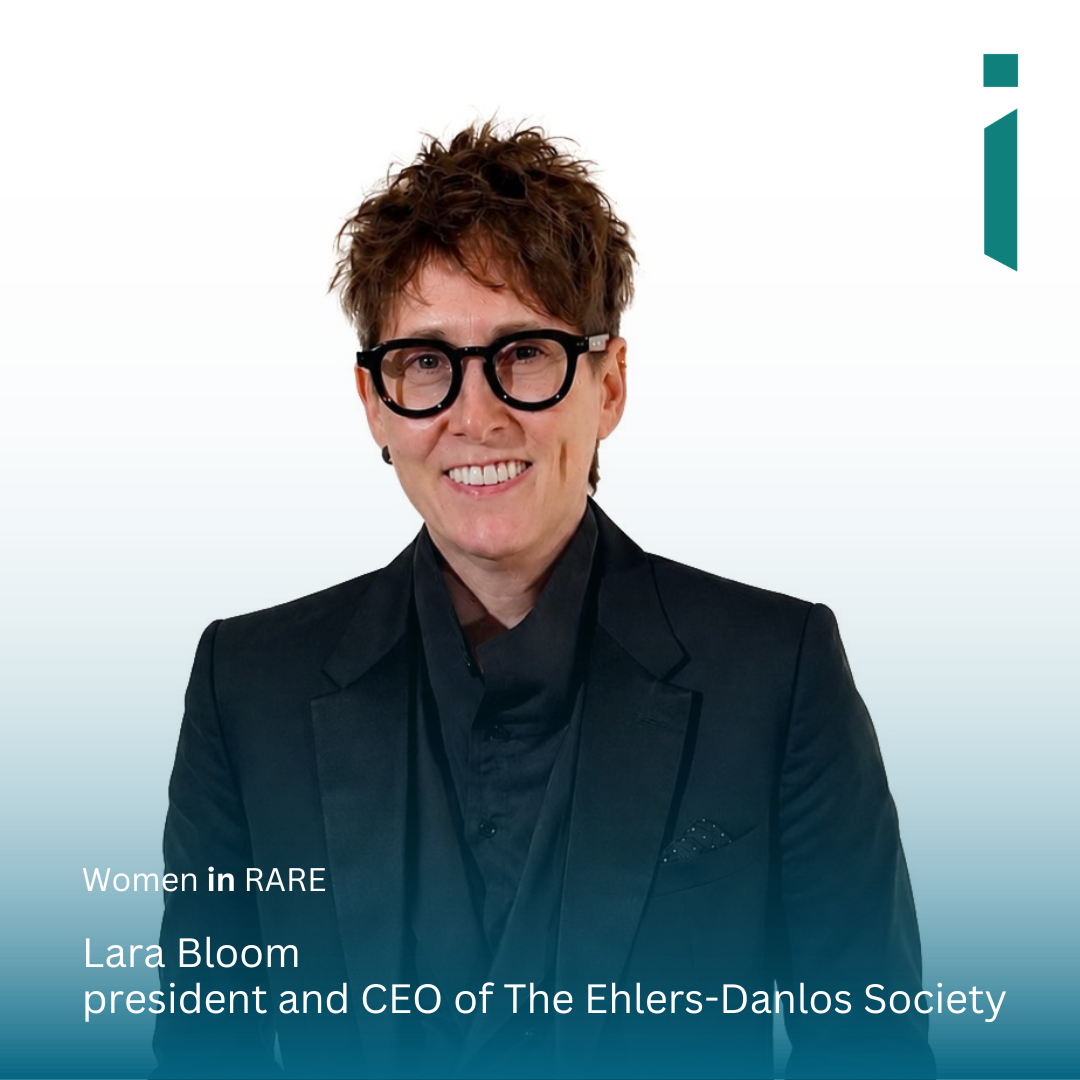
Lara Bloom, president and CEO of The Ehlers-Danlos Society

Estimated reading time: 7 minutes

“What connects every part of my career is a commitment to ensuring lived experience drives meaningful change.”
My career has been shaped by a combination of lived experience, determination and a belief that the people most affected by healthcare decisions must have a meaningful role in shaping them.
I began my professional life in photography, including working at Getty Images, before my own experience of living with Ehlers-Danlos syndrome led me into a new career. I became CEO of EDS UK and, in 2015, left to set up the global organisation – The Ehlers-Danlos Society, where I am now president and CEO.
Over the past decade, I have helped build the organisation into a global force for research, education, awareness and advocacy. Alongside this, I am chair of the International Alliance of Patients’ Organizations, a trustee of Genetic Alliance UK, and an Academic Affiliate Professor of Practice at Penn State College of Medicine.
What connects every part of my career is a commitment to ensuring lived experience drives meaningful change.
What motivated you into your chosen career path?
I didn’t choose this career path in the conventional sense; in many ways, my own experience chose it for me.
I developed symptoms of hypermobile Ehlers-Danlos syndrome at 11 years old, but wasn’t diagnosed until I was 24. Those years of searching for answers taught me what it feels like to be dismissed, misunderstood and left navigating a healthcare system that doesn’t have the answers you need.
When I finally received a diagnosis, I discovered an extraordinary community facing many of the same challenges. I realised that the experiences we had individually could become incredibly powerful collectively.
That became my motivation: to turn frustration into action and lived experience into evidence, research, education and systemic change.
I have always believed we should never underestimate the power of the patient voice. When lived experience is genuinely valued alongside clinical and scientific expertise, it doesn’t just make healthcare more compassionate; it makes the science, policy and ultimately the outcomes better.
What do you see as some of the opportunities as a woman in your field?
Healthcare, rare disease and patient advocacy are undergoing a significant transformation, and I think there is an enormous opportunity for women to help shape what comes next.
Women bring diverse leadership styles, perspectives and experiences to spaces that historically have not always represented them. In my field, that matters enormously. Many rare and chronic conditions disproportionately affect women, yet women’s symptoms and experiences have historically been under-researched, dismissed or misunderstood. Having women in positions of influence, across research, medicine, policy, industry and advocacy, creates an opportunity to challenge those patterns.
I also see an opportunity to redefine what leadership looks like. I don’t believe we have to choose between being empathetic and ambitious, collaborative and decisive, or vulnerable and strong. Some of the most effective leadership I have witnessed combines all of those qualities.
Increasingly, there is also recognition that lived experience is expertise. For women who have navigated healthcare systems themselves, cared for others, or experienced inequity, that perspective can become a powerful professional asset when it is valued appropriately.
Perhaps the greatest opportunity is to make sure that as more women reach positions of influence, we hold the door open for others. Representation cannot simply mean being the woman at the table. It means using that position to change who gets invited into the room, whose expertise is recognised and whose voice influences the decisions being made.
What are some of the barriers to success as a woman in your field?
There has been significant progress, but many of the barriers women face are still deeply embedded in the systems around us.
Women continue to navigate different expectations around leadership. The same qualities that may be celebrated as decisive or ambitious in men can sometimes be interpreted very differently in women. There can be an expectation to be strong but not intimidating, confident but not too outspoken, compassionate but never emotional. Navigating those contradictions takes energy that could be better spent leading.
Healthcare presents another layer. Women’s symptoms and pain have historically been more likely to be dismissed or attributed to psychological causes, and this is particularly relevant in the rare and chronic disease communities I work with. Many women spend years fighting to be believed before they ever receive an accurate diagnosis.
There are also practical barriers. Women continue to carry a disproportionate share of caring responsibilities, while senior leadership roles often operate within structures designed around very different assumptions about family and working life.
I think one of the biggest challenges is ensuring that progress goes beyond representation. It isn’t enough to have more women visible in leadership if the systems beneath them remain unchanged.
For me, success means creating environments where different leadership styles are valued, flexibility isn’t seen as weakness, lived experience carries genuine weight, and the next generation of women doesn’t have to expend the same energy proving that they deserve to be in the room.
What is one piece of advice you would give your 10-year-old self?
I would say: trust yourself.
There will be times when people tell you that what you are feeling isn’t real, that your ambitions are too big, or that you need to make yourself smaller to fit comfortably into the spaces around you. Don’t.
Your sensitivity will become empathy. Your stubbornness will become determination. The experiences that make you feel different will eventually give you a perspective that enables you to help other people feel seen.
You don’t need to have your whole life mapped out. Stay curious, be brave enough to change direction, and never underestimate what can happen when you find your voice and use it.
Can you tell us about your current work priorities and focus or a particular project you are working on?
One of my biggest priorities right now is helping to transform what the future looks like for people living with Ehlers-Danlos syndromes (EDS) and hypermobility spectrum disorders (HSD).
We are at an important point scientifically and clinically. Through The Ehlers-Danlos Society, we have invested significantly in research, including genetics, biomarkers and natural history, while working internationally to improve classification, diagnostic approaches, education and care.
A major focus is the Road to 2026, an international effort bringing together researchers, clinicians and people with lived experience to update the classification and diagnostic framework for EDS and HSD. But establishing diagnostic criteria is only part of the challenge. A diagnosis has limited value if there is nowhere for someone to go afterwards.
That is why another major priority is our work on models of care: looking at how we move knowledge out of specialist centres and into healthcare systems so people can access knowledgeable, coordinated care closer to home. This means thinking about primary care, professional education, policy, reimbursement and the evidence needed to demonstrate the value of earlier diagnosis and appropriate management.
Beyond EDS and HSD, I am increasingly focused on the wider rare disease landscape and how we build stronger global collaboration. Through my roles with the International Alliance of Patients’ Organizations, Genetic Alliance UK and Penn State, I have the opportunity to connect lived experience with research, policy and health-system transformation internationally.
The thread running through all of this is simple: lived experience cannot be something we consult at the end of a process. It needs to be embedded from the beginning. The people living with rare conditions hold knowledge that no dataset, laboratory or textbook can replicate. When we combine that knowledge with scientific and clinical expertise, we have the greatest opportunity to create lasting change.
Connect with Lara
Women in RARE is a celebration of women working in the RARE space in science, research, industry and advocacy. To access more Women in RARE articles click below.