
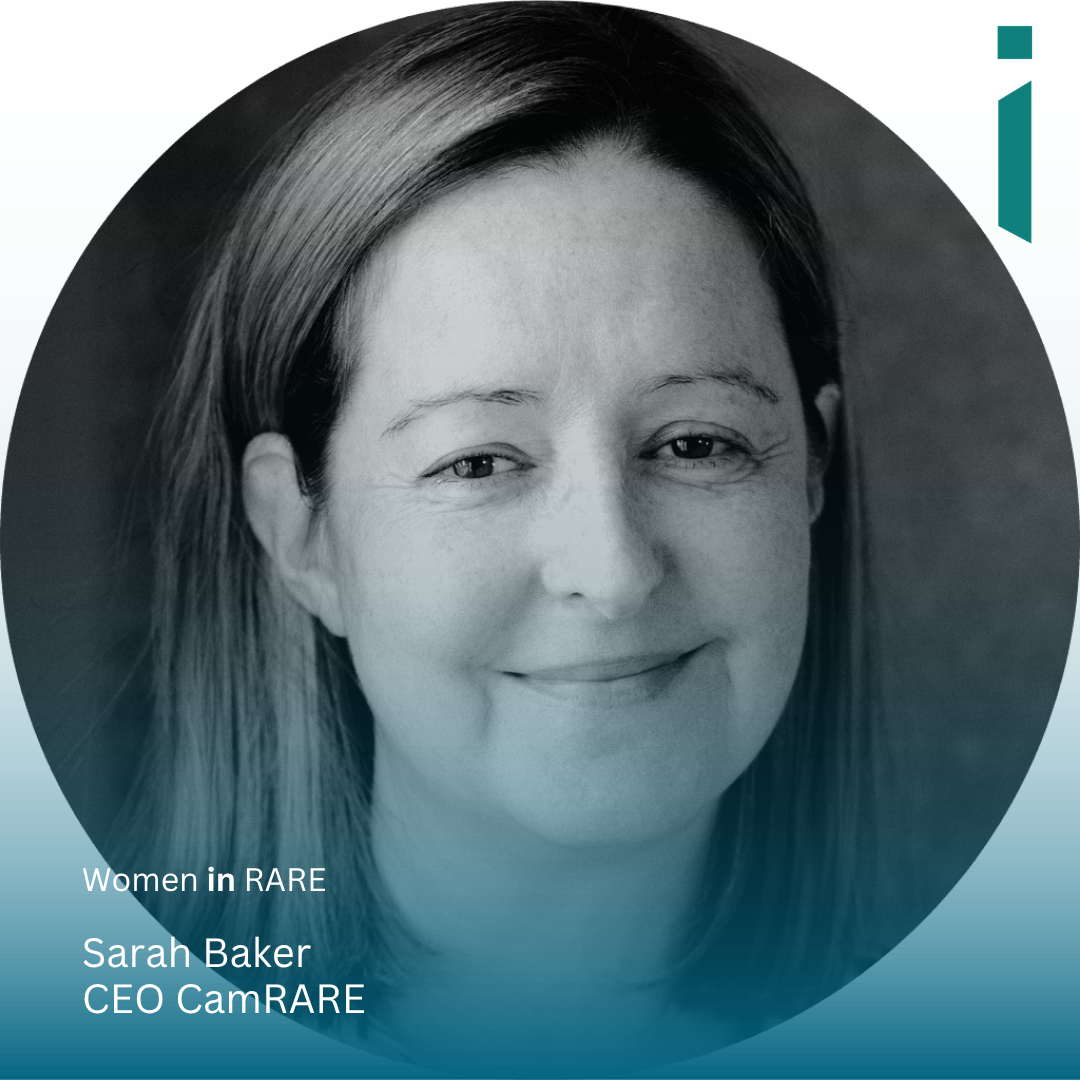
Sarah Baker, CEO CamRARE

Estimated reading time: 8 minutes
“At the heart of my career is a simple belief: inclusion should be something people experience, not simply something organisations talk about.”
My career has always been rooted in inclusion and improving outcomes for individuals whose voices can too easily be overlooked. I began my career as a geography teacher and SENDCo (Special Educational Needs and Disabilities Coordinator) before moving into local authority advisory work and senior leadership roles focused on inclusion, safeguarding and specialist provision.
I went on to become an executive principal and then founding CEO of a multi-academy trust, leading growth across multiple sites and regions while strengthening governance, financial sustainability and services for children and young people with complex needs.
Throughout my career, I have worked alongside families, clinicians, therapists and wider partners. Those experiences reinforced my belief that the best solutions come when people listen to one another and work across boundaries.
In May 2026, I became CEO of CamRARE. It feels like a natural next chapter, bringing together my experience of strategic leadership, inclusion and partnership working with my commitment to community voice.
What motivated you into your chosen career path?
At the heart of my career is a simple belief: inclusion should be something people experience, not simply something organisations talk about. I have always been drawn to roles where there is an opportunity to remove barriers, bring people together and turn good intentions into practical change.
My early career in education and SEND gave me a close understanding of the challenges children, young people and families can face when navigating complex systems. On a personal level, my sister, who has learning difficulties, has also been a constant inspiration to me. Seeing her navigate a world that does not always make space for difference has strengthened my belief that everyone should have the opportunity to be heard, valued and included.
Working alongside health professionals, therapists and families also taught me that lasting change rarely comes from one organisation working in isolation. It comes from listening, sharing expertise and seeing the whole person.
That has remained a constant throughout my career. Moving into the rare disease space therefore felt like a natural progression. At CamRARE, I can bring together strategic leadership, inclusion and partnership working with something I care deeply about: ensuring that people with lived experience have a meaningful voice in shaping the services, research and systems that affect their lives.
What do you see as some of the opportunities as a woman in your field?
For me, one of the greatest opportunities is the chance to help shape what leadership looks and feels like. I have worked across education, disability, health and now rare disease, often in complex environments where leadership is as much about building trust as it is about setting direction.
I believe women have an opportunity to bring their own leadership identity to the table, rather than feeling they have to fit an established model. My approach has always been values-led, collaborative and curious. I see listening, relationship-building and the confidence to ask difficult questions as strengths, not weaknesses.
The rare disease community particularly benefits from leaders who can connect different worlds. Patients and families, researchers, clinicians, charities and industry each bring valuable expertise, but they may see the same challenge very differently. Creating spaces where those perspectives can meet, and where lived experience is valued alongside professional expertise, is incredibly important.
There is also an opportunity to make leadership more visible and accessible to the women coming behind us. My own career has moved from teaching and inclusion roles into executive leadership, Board work, consultancy and now charity leadership. It has not been a straight line, and I hope that demonstrates there is no single route to senior leadership.
For me, success is not simply about women reaching senior positions. It is about using those positions to widen participation, challenge assumptions, amplify voices that are too often overlooked and create opportunities for others to lead.
What are some of the barriers to success as a woman in your field?
I think some barriers are structural, while others are the expectations we place on ourselves. Leadership can create pressure to demonstrate credibility quickly, have all the answers and keep delivering, particularly when moving into a new sector or stepping into a more senior role.
My own career has involved moving between different professional worlds, from education and SEND into charity leadership and rare disease. That experience has taught me to be confident in the skills and experience I bring, while also being humble enough to listen and learn from people with deeper expertise.
Visibility is another important factor. Progression into senior roles can depend on networks, sponsorship and opportunities to contribute beyond your immediate organisation. Those opportunities are not always equally accessible. We need to make sure women have access to the relationships, mentoring, professional development and spaces that can help open the next door.
I have also learned that leadership does not mean doing everything yourself. There can be a pressure, particularly for women, to prove their value through constant delivery. Sustainable leadership is about building strong teams, sharing ownership and being clear about where you can add the most value.
Ultimately, overcoming barriers requires both individual confidence and organisational change: cultures where different leadership styles are valued, challenge is welcomed, and talented women are encouraged not only to take opportunities, but to recognise that they belong in those spaces.
What is one piece of advice you would give your 10-year-old self?
Be curious, be brave and don’t worry if your path does not look like everyone else’s.
Some of the best opportunities in my career have come from being willing to step into something new, take what I have learned with me, and then listen carefully and learn again.
You do not need to have everything mapped out. Hold on to your values, pay attention to the people who help you grow, and look for ways to help others grow too.
Most importantly, never underestimate what can happen when you bring people together. Meaningful change rarely happens alone. Be open to opportunities, even when they take you somewhere unexpected, you never know where they may lead.
Can you tell us about your current work priorities and focus or a particular project you are working on?
As the new CEO of CamRARE, my immediate priority is turning our five-year strategy into focused, sustainable action, while protecting what makes the organisation distinctive: its community-led approach and its ability to connect people across the rare disease landscape.
For me, the exciting opportunity lies in the space between our community and research. CamRARE is disease-agnostic, supporting people with rare or undiagnosed conditions, and we are rooted in Cambridge’s extraordinary research and life-sciences ecosystem. That gives us a valuable role as a connector between lived experience, research, healthcare, charities and industry.
I am particularly passionate about ensuring patient voice is not something added at the end of a research process. People with lived experience should help shape the questions being asked, how research is designed and what meaningful outcomes look like from the outset.
Alongside research, we want to strengthen practical community support, including exploring the development of the Patient Passport which is, “A concise communication tool for use by anyone, with any rare or complex condition, anywhere”. We now want to boost awareness of it, increase recognition of it among frontline health and care professionals and make it the go-to communication tool for rare and complex conditions.
A particular focus for me and the team at the moment is RAREsummit26, CamRARE’s flagship annual event, taking place on 7 October 2026. It is a fantastic opportunity to bring people from across the rare disease ecosystem together, patients and families, advocates, researchers, clinicians, charities, industry, policymakers and innovators, to share knowledge, challenge thinking and, most importantly, make connections that can lead to collaboration and action. The programme reflects that breadth, from policy and advocacy to lived experience, research, care, innovation and patient involvement in research.
I love the idea that RAREsummit is not simply a conference where people come to listen; it is a space where people can meet someone they would not otherwise have encountered, share an idea, find a collaborator or start something that could ultimately make a difference. This year there is an opportunity to join online so as a conference it can bring voices from across the UK, Europe and the world.
None of this is sustainable without strong organisations behind it. My role therefore also includes building strong relationships, diversifying partnerships, strengthening governance and systems, building team capacity and increasing CamRARE’s visibility and influence.
Ultimately, the ambition is simple: to make life with a rare condition easier through connection, collaboration and community, and to turn those connections into lasting change.
Connect with Sarah
Women in RARE is a celebration of women working in the RARE space in science, research, industry and advocacy. To access more Women in RARE articles click below.