
Understanding comes first, decisions follow: trialport brings clarity to the clinical trial environment

Interview with Keith Berelowitz, founder and CEO, trialport
Estimated reading time: 9 minutes
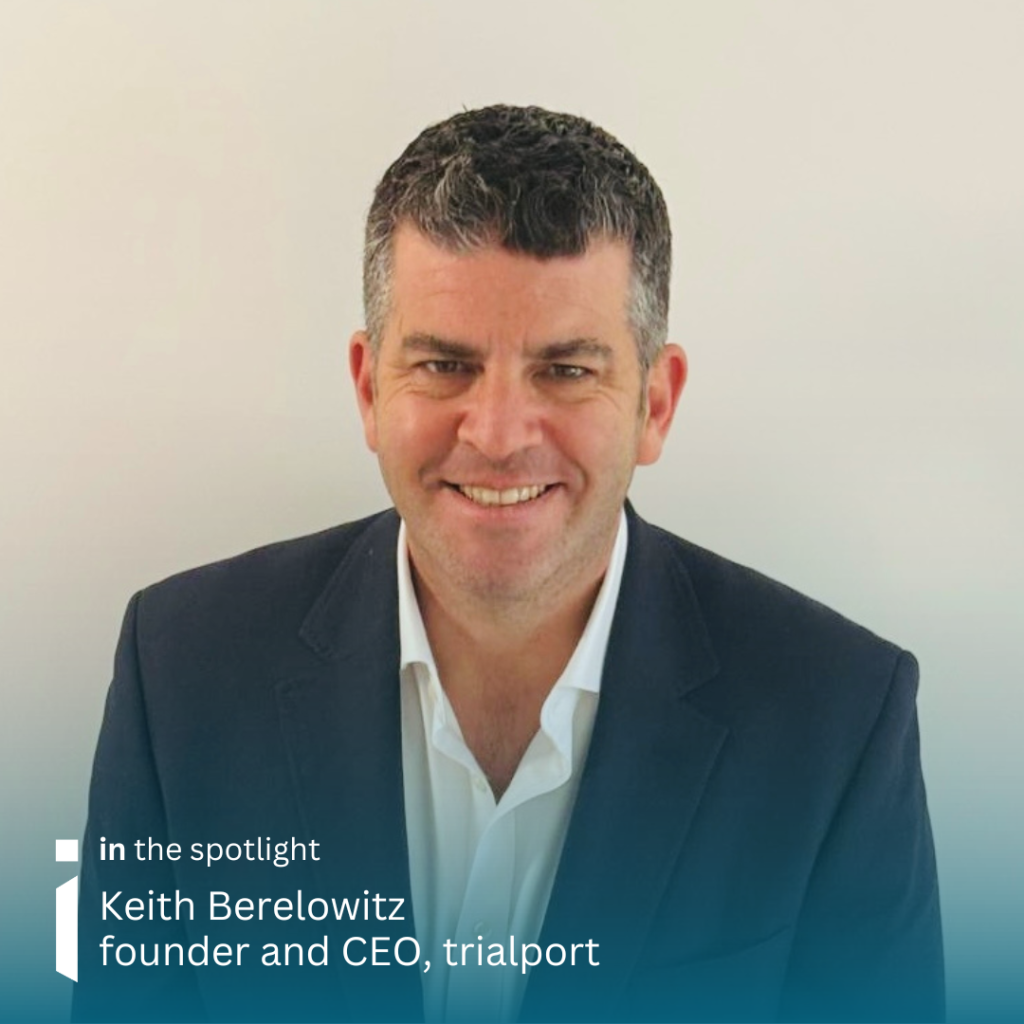
Immersed in clinical trial research for over 25 years, it wasn’t until Keith Berelowitz experienced the space as a patient, that the barriers to recruitment and retention became clear. He founded trialport to help patients navigate the complex world of clinical trials and provide sponsors with authentic patient insights to better understand the barriers and improve communication
Name:
CEO:
No of staff:
Company status: Head office: Sector:
Founded:
trialport
Keith Berelowitz
Eleven
Private
Atlanta, USA
Health tech/digital health
2024

A very personal motivation
From his early days as a bench scientist to director of operations for Richmond Pharmacology, where he worked for 20 years, Keith Berelowitz has gained a wealth of expertise and insight in clinical research throughout his career. He has also chaired the Fulham Research Ethics Committee since 2023.
In 2024 Keith founded trialport, an AI-native decision-quality infrastructure that delivers clinical trial information inside trusted communities and clinical environments. Having worked professionally in the space for over two decades, it was a personal experience that proved to be the catalyst for Keith establishing the platform.
As he explains: “I’ve always helped people enrol in trials. I always thought it was relatively straightforward—we always had good retention and good enrolment. But then I became a patient myself.” This is when Keith’s perspective shifted. Diagnosed with prostate cancer at 47 years old and discouraged by the side effects from existing treatments, Keith decided to explore clinical trials.
“Considering I’ve been in this space for more than 25 years, you would think it would be easy to navigate, and even I was getting confused. I thought if I’m struggling, how does everyone else do this, in a state of anxiety?”
Keith eventually received a diagnosis of prostatitis, but for three months went on a journey with suspected cancer, and discovered how difficult it was to find comprehensive clinical trial information and support. His platform makes it easier for people to navigate and connect with clinical trial sites and is embedded within patient communities. As he notes: “You assume that if you build something, patients will come to it. You need to build it, put it where people living with the conditions are, and then they will engage.”

trialport – bringing clarity and understanding to clinical trials
trialport provides a service to multiple stakeholders in the space.
For patients, trialport provides plain language, bit-sized summaries of clinical trial information so people can understand what the trial is, what’s being asked of them and whether it fits into their real life, not just their medical profile. As Keith outlines, “The way it’s always been done is to assess whether someone is medically fit for a study and lightly touch on what else is going on in their life. With that you get high dropout rates and high screen failure rates. People may go on a journey they don’t necessarily want to because they feel like they’re supposed to.” trialport is positioned as a patient-first, plain-language trial finder and decision aid, designed to support informed choice and life-fit.
For charities and PAGs, trialport provides a built-in hub that can sit on their websites allowing the community to search for, and connect to, trials. When a patient passes through the trialport hub via a charity’s hub and consents to a study, a commercial relationship is formed and the organisation receives a referral fee per patient. This creates a much sought-after revenue stream and reduces traditional piecemeal funding, providing them with agency and dignity that aligns with their role in connecting patients to research.
For clinical trial centres, trialport aims to reduce the time and energy spent processing leads and screening patients, which Keith knows from experience, can be demoralising and costly. trialport uses self-reported tools so patients can gauge both medical fitness and behavioural fit. When a patient chooses to connect, a centre then receives structured information rather than a cold lead, improving the quality of referrals and significantly easing the workload around recruitment and screening.
For biotech and pharma, trialport acts as a patient-centric recruitment and insight platform, with the aim of improving trial performance and reducing costly drop-outs. The trialport live network has ties to over 1,000 communities giving sponsors access to diverse condition-specific communities at scale. The information is translated for patients into 47 languages which can aid the sponsor in achieving diversity and inclusion. Sponsors receive real-time behavioural intelligence, seeing how patients interact with study pages, how long they spend and what they find challenging, allowing for the improvement of materials and messaging in real-time.
For Keith, patient engagement works like concentric circles around the person living with the condition—first clinicians and family, then community and advocacy groups, and then biopharma and clinical research sites. Traditional recruitment has largely skipped those middle “community hubs” to go straight to doctors (despite clinicians directly driving as little as 0.2% of US enrolment1), so trialport is designed to sit inside those hubs and distribute trial information more widely and effectively.
Maintaining a human “guardrail” in a technological era
trialport uses artificial intelligence (AI) to scale core tasks such as converting complex trial information into clear and concise language. It is also used to build and run behavioural tools, calculating readiness scores and analysing how patients move through the platform. Ai draws on self-determination theory, which is awareness, competence and relatability and embeds validated tools such as the decisional conflict scale, adapted specifically for clinical trials. As Keith expands: “These are self-reported tests that ask questions and help people understand how conflicted they feel about joining a study and how likely they are to see it through to completion.” The results are presented as percentages which helps patients make an informed decision and preserves their agency.
While the use of AI is pivotal to the platform, Keith insists there is a human at every stage, checking outputs, monitoring interactions, and most importantly, supporting patients when they reach out.
“We are AI native, and that allows us to scale, but ultimately, there is a human at every single touch point along the way.”
The relationship between technology and human experience is symbiotic: “The way a technologist would build a platform like the one we have is very different to someone who’s worked in the space for a sustained period of time, because there are human nuances that they’re not thinking about. But equally, I couldn’t build this platform without the technologist, and so we are always bouncing off each other.”

Addressing assumptions, building trust and fostering understanding
When recruiting and designing recruitment materials for a study, Keith believes one of the clear oversights of pharma and clinical sites is to make assumptions that, first, people understand clinical trials and, second, naturally want to join. As he explains:
“We’re asking people to do something that is extraordinary to them. For those who work in the space, it’s normal, but not for them. We’re asking them to do something that is going to change their life, hopefully for the better, but in some cases negatively, and to absorb their anxiety and fears. There’s an assumption that everyone will do it because it’s relatable to us.”
Keith believes people are overloaded with information too early which creates cognitive burden instead of supporting understanding. “There’s nothing wrong with piecemealing information. You’re not holding back; you are allowing people time to process.” He adds that sponsors want swift enrolment for a study they have worked on for years and want patients to match their excitement. But awareness and relatability cannot be built overnight.
Keith feels pharma and clinical sites underestimate the trust deficit in the system. There is a systemwide lack of trust that undermines recruitment: clinical sites feel pressure from pharma, community groups feel constrained and patients have a historical distrust of industry. He calls for all stakeholders to draw a line, agree on the desired outcomes and decide how to get there together.
“This is where technology, those with lived experience, and those with domain expertise coming together can help biotech and pharma better understand patients; community groups understand what biotech and pharma are looking for; and clinical research sites understand what the expectation is of people living with a condition who are now considering a clinical trial.”
Global patient voices: a library of humanity
Global Patient Voices is trialport’s growing library of short videos from patients and caregivers around the world, sharing their own personal health journeys. The motivation behind the project is twofold. Firstly, it aims to help patients feel less alone and more informed in their decision making about clinical trials by hearing other people’s experiences. As Keith explains, “People are sharing their health journey because they want to make it better for the next person and the next generation.”
The second role of the project is to help sponsors, researchers and clinical trial sites understand the reality behind the science. By hearing from ‘real people’ it shows the true burden of living with a condition and the emotional reality of participating in a trial. It makes the science personal, which for Keith, is essential. “The more we hear from people, the more we understand. 20% of my week is spent talking to people living with various conditions; not to participate in one of our trials, but to just understand what’s going on in their life, what they think about research and what they think about the current standards of care. At the moment I’m asking people, ‘What does patient engagement mean to you’, and I’m not looking for the stock answer, I want to know what it truly means to people.”
Keith reflects how there is a distinct difference between observation and understanding.
“We do so much observation, but do we actually take the time to understand what we’re looking at?”
He believes in the power of conversations; of truly listening and learning. This is crucial in improving the clinical trial space, offering patients clarity, and understanding issues of burden and barriers to retention. “Understanding comes first, decision follow.”
To learn more please visit:trialport.com
Connect with Keith
References
[1] https://www.ciscrp.org/wp-content/uploads/2019/06/Building-bridges.pdf?utm_source=chatgpt.com
in the spotlight profiles innovative companies working in the RARE space. To access more in the spotlight articles click below.