New research aims to build evidence base for braille food labelling across the UK
Blind and partially sighted people across the UK are being invited to share their experiences of accessing food packaging as part of a new survey designed to strengthen the case for mandatory braille food labelling.
The survey, launched by Sight Scotland, Disability Equality Scotland and partners, will gather evidence on the challenges people face when identifying, storing and using food products. The findings will help inform Food Standards Scotland’s Business and Regulatory Impact Assessment while also supporting discussions with UK Government departments, including DEFRA, on future policy change.
The campaign comes amid growing calls for greater accessibility in food labelling. Research conducted by Disability Equality Scotland in 2023 found that three-quarters of blind and partially sighted people find food labels inaccessible. While technology plays an important role in helping people access information, campaigners stress that braille is not a replacement for technology, nor does it compete with it.
Veronica Whymant, 43, from St Andrews, has lived with visual impairment all her life after being born prematurely, says everyone should be able to make informed decisions about the food they buy and eat without being held back by inaccessible information.
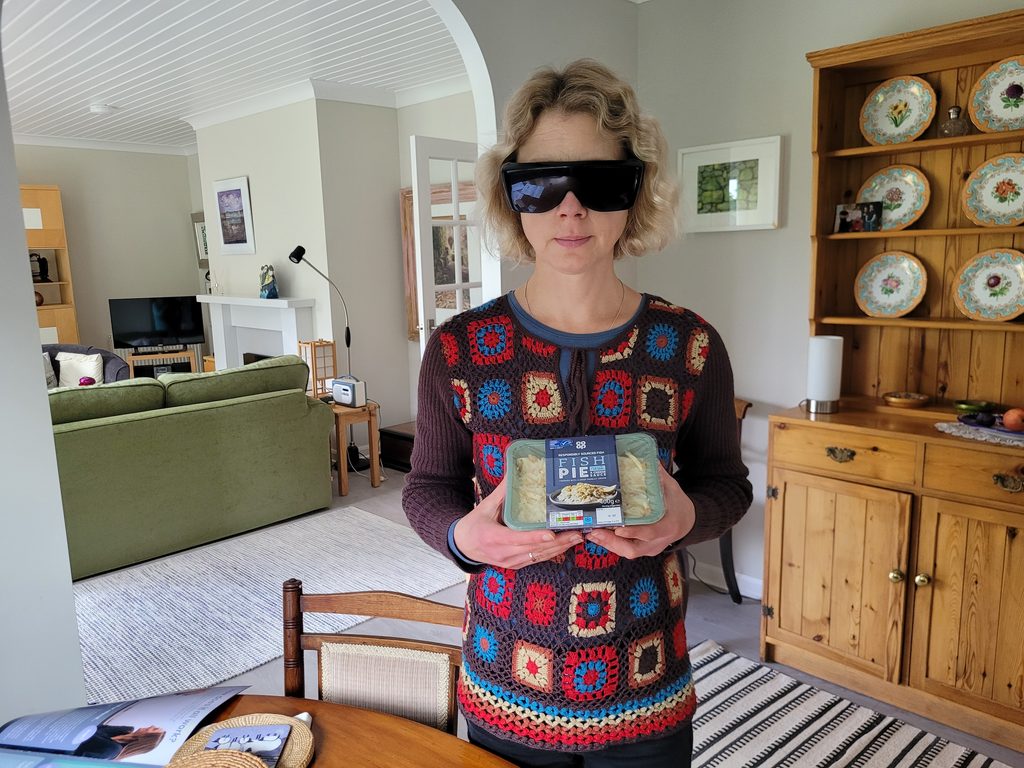
Veronica explains:
“My vision gradually deteriorated through my teens, and I was registered blind in my early twenties. Since then, maintaining my independence has relied on determination, organisation and finding ways to adapt to a world that is largely designed for people who can see.
“Braille labelling on food packaging would be revolutionary. It would give me more independence, less anxiety when shopping and greater confidence when preparing meals. Most importantly, it would allow me to make decisions for myself. That is something many people take for granted, but for people with visual impairment it can be life changing.
“This isn’t about convenience, it’s about dignity, equality and choice. No one should be denied the ability to confidently and independently make decisions about the food they buy and eat simply because information isn’t accessible. Every day, people like me are forced to rely on others to identify basic food items, check ingredients or confirm expiry dates.
“At home I’m an extremely organised person and I carefully catalogue everything in my cupboards and freezer, so I know where everything is. That helps me avoid mistakes, but it also shows how much extra effort visually impaired people have to put into everyday tasks. Having clear braille labels would provide reassurance and confidence and remove so much uncertainty from daily life.”
Veronica adds: “People often assume technology has solved every problem for someone who is blind or partially sighted, but it can be expensive and depends on devices, software and internet access. Braille allows you to access information directly, privately and independently, whether it’s on medicine, food packaging, public signs or museum displays.”
Lucy Mulvagh, Chief Executive Officer at Disability Equality Scotland, comments:
“We are launching this survey because evidence matters, and right now there is a real gap in what we know. The survey is open to all blind and partially sighted people, whether or not they use braille.
“We know that many blind and partially sighted people find food labels inaccessible, but we still need to understand the impact this has on everyday life. What happens when someone cannot identify food in their own kitchen? How do people currently cope? What are the costs in terms of safety, time and independence?
“To make the case for change, we need to show that this is not just a Scottish issue, but one that affects people across Britain and the wider UK. By collecting experiences from across the UK, this survey will provide the evidence needed to support policy change and make food safer and more accessible for blind and partially sighted people.”
The survey is available at: https://bit.ly/3T1ZQwHTo. The survey is open until 31 October.
For more information, please visit sightscotland.org.uk.
About Disability Equality Scotland
Disability Equality Scotland is a national membership-led charity working to make life more accessible, equal and inclusive for disabled people in Scotland. We promote access in its widest sense, including access to the built and natural environment and access to the same opportunities as are enjoyed by others in our communities thus promoting a life of dignity, respect, choice and independence. Disability Equality Scotland is also the umbrella body for all Access Panels in Scotland, which are groups of disabled volunteers who work together to improve physical access and wider social inclusion in their local communities across Scotland.
About Sight Scotland
Sight Scotland, formerly known as Royal Blind, is Scotland’s largest visual impairment organisation. We have been dedicated to meeting the challenges of visual impairment for more than 230 years. Our range of services support people with visual impairment and span all stages of sight loss, including learning services, support in the community, residential care, enterprise and funding for research. Sight Scotland runs the Royal Blind School in Edinburgh and the Scottish Braille Press.
For more information, visit sightscotland.org.uk
About Sight Scotland Veterans
Sight Scotland Veterans, formerly known as Scottish War Blinded, is the sister charity of Sight Scotland. Sight Scotland Veterans provides free support to armed forces veterans affected by sight loss in Scotland to help them regain confidence, restore their independence and make new connections.
For more information visit sightscotlandveterans.org.uk