Childhood friends, lifelong mission
Written by Nicole Belles, chief product officer, GeneSprout
Childhood should be a season of endless possibility, curiosity and wonder. But for some families, the childhood years are a long, anxious search for answers that start when a child’s health suddenly feels off track. Dr Sarah Gladstone knows that search personally.
Sarah is a paediatrician and head of Condition Navigation at GeneSprout and the Genetic Access Initiative, but she is also the parent of a child living with an ultra-rare disease. Like many parents navigating the rare disease journey, she experienced the fear, uncertainty and emotional exhaustion that occurs when answers do not come quickly enough.
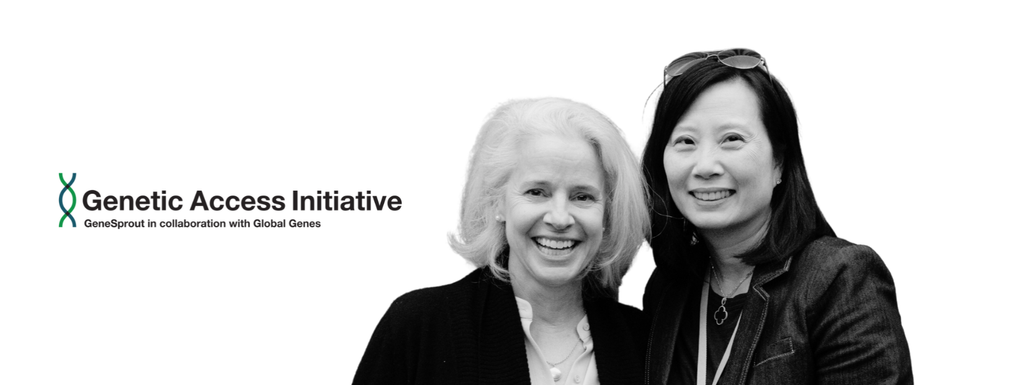
Her close friend and colleague, Dr Ann Wu, has spent her career trying to shorten the diagnostic journey of unnecessary tests and countless specialist visits for families in search of a diagnosis. While individual genetic diseases are rare, they are collectively common and impact 5–10% of children.1 It is thought that 80% of rare diseases have a genetic cause.
To address this urgent diagnostic need, Ann first founded GeneSprout to provide genetic screening to eliminate the paediatric diagnostic odyssey, which can last between 5 and 30 years for some families.2 Soon after, she created the Genetic Access Initiative, a non-profit partnership with Global Genes which accepts tax-deductible donations, because the cost of screening remains a significant barrier for far too many families. The Genetic Access Initiative addresses this challenge by breaking down financial barriers and expanding access to paediatric genetic sequencing for families who might otherwise be unable to afford it, thus advancing health equity and improving outcomes for children everywhere.
A shared history in paediatric medicine
Ann and Sarah’s relationship began in childhood, when they grew up in the same town, attending school together, long before they would dedicate their lives to paediatric medicine. Years later, they reunited to complete their paediatric residency training together at Boston Children’s Hospital. It was there that they worked with families navigating unexplained symptoms and partnered with them on the long road to obtain answers.
Ann’s clinical and research experiences shaped the mission behind GeneSprout and the Genetic Access Initiative: to give every child their healthiest start through clear, actionable genetic insight.
She brings a remarkable scientific pedigree to that mission. A graduate of Massachusetts Institute of Technology and Harvard Medical School, she spent more than two decades as a paediatrician, researcher and genomics leader at Harvard Medical School. Her work in genomic medicine and paediatric research produced hundreds of scientific publications and helped advance understanding of how genetics can identify disease risk earlier in childhood.
Ann and Sarah believe that every parent should have access to the kind of genetic information that can help identify serious conditions early, before symptoms appear or the condition progresses. Their focus is on the early detection of actionable conditions that manifest in childhood, conditions that parents will want to know about because they are treatable. As Sarah says, “knowing, even when it’s hard, is always better than not knowing.” Despite the technology being available now, too many families still spend years going from specialist to specialist before receiving answers. Guided by empathy and compassion, the Genetic Access Initiative was created to help close the gaps in genetic screening access and knowledge for families.
Bridging the gap in genetic screening
The Genetic Access Initiative provides a paediatric precision health solution that includes early childhood genetic screening combined with physician-led support to help families navigate their child’s genetic findings. The goals of the programme are to provide an accessible pathway for families to identify risks earlier, connect families to answers faster and help children receive the right care as early as possible. For parents of children with rare diseases, early genetic answers can be transformative.
An early diagnosis often means caregivers no longer have to become “accidental medical experts,” coordinating appointments, relentlessly googling conditions and struggling to be heard inside an overwhelmed healthcare system. Mothers, in particular, frequently become the care managers for their children, carrying emotional and logistical burdens. Sarah understands that burden both as a mother and a physician.
This dual parental and clinical perspective gives the Genetic Access Initiative its humanity; paediatric and genetic experts walk the path with families and guide them to ensure their child’s genetic journey is rewarding and hopeful. Sometimes this means identifying a serious risk early enough to intervene and end the exhausting cycle of uncertainty. More often, it is giving parents peace of mind that their child is likely to have a healthy childhood. For some families, it can mean changing a child’s life.
The promise of genomic medicine can feel theoretical. But it becomes real and meaningful when we focus on how it can help children access precision medicine sooner, help paediatricians make informed decisions earlier, and provide families with expert guidance and support. The Genetic Access Initiative mission is urgent because early detection is critical for avoiding the lifelong consequences of preventable or mitigable conditions.
In a healthcare system that can often feel impersonal, the Genetic Access Initiative serves as a reminder that medicine is about people caring for people. Ann and Sarah came together to ensure that every child has access to genetic screening along with actionable and compassionate guidance. The genetic knowledge families gain from the Genetic Access Initiative gives them a profoundly promising roadmap for the future.
About the author
Nicole Belles is the chief product officer at GeneSprout. She is a healthcare executive and product leader with more than 20 years of experience supporting healthcare payer strategies and improving outcomes across the healthcare industry.
References
[1] Ostrer, H. When Rare Is Common—Rethinking Pediatric Genetic Care. JAMA. Published online March 25, 2026. doi: 10.1001/jama.2026.2072
[2] Wu, A., McMahon, P, Lu, C. Ending the Diagnostic Odyssey—Is Whole-Genome Sequencing the Answer? JAMA Pediatrics (2020). Volume 174, Number 9