Life with PSC: the visible and invisible toll
SPONSORED CONTENT
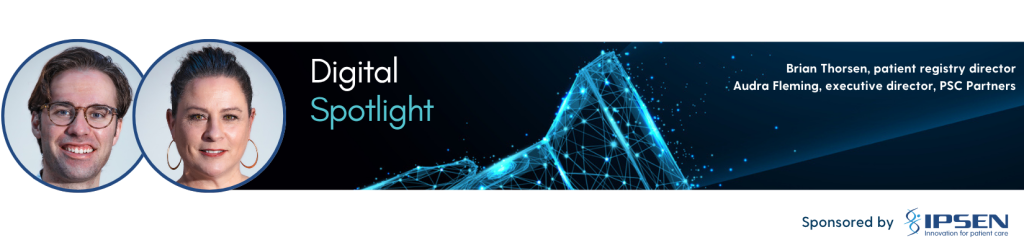
When statistician Brian Thorsen was told he had “five to ten years,” it set him on a path that would transform his life. Now, Brian, patient registry director at PSC Partners and executive director, Audra Fleming, unpack the visible and invisible toll of primary sclerosing cholangitis—from crushing fatigue and chronic itch to career loss and caregiver grief
Written by Nicola Miller, RARE Revolution
Interview with Brian Thorsen, patient registry director, and Audra Fleming, executive director, PSC Partners
When Brian Thorsen picked up the phone in 2020, a few weeks after being diagnosed with inflammatory bowel disease (IBD), he wrote down one phrase from his doctor and never forgot it:
“Five to ten years”. His life expectancy. A figure that Brian now knows not to be true.
The diagnosis was primary sclerosing cholangitis (PSC)—a rare, chronic liver disease that scars the bile ducts and carries an increased risk of liver failure and bile duct cancer (cholangiocarcinoma). For Brian, then in his early twenties and freshly out of university, the news was life-altering in ways he didn’t yet comprehend.
Brian’s path into advocacy started with isolation. “At first, you feel like you’re alone, but you’re not.” It took Brian two years to connect with the charity PSC Partners via signposting from his therapist. Today, Brian is the director of the patient registry at PSC Partners where he is helping Audra Fleming, executive director of PSC Partners, to reshape how the burden of PSC is understood—medically, psychologically and socially—for both patients and caregivers.
Brian discovered early on how poorly understood the condition can be—even in healthcare: “I’ve been in a hospital where it’s 3am and my doctor is Googling PSC.”
That experience forced Brian to develop skills that are now central to his work: learning the science, advocating for himself and, later, using his background as a statistician to build research tools that actually reflect patient reality.
“I am the person I am now because of the skills I’ve had to learn along the way.” But that does not diminish the impact of PSC on Brian, and others who live with the disease.
“invisible” erosion
Talk to any individual affected by PSC and two words quickly emerge: fatigue and itch. They appear in medical charts as “symptoms”—but in real life, they are persistent forces that shape identity, relationships and mental and emotional health, as Brian explains. “The symptom burden and the impact of the disease in our daily life often doesn’t correlate with disease stage. My labs have mostly been looking good, but I’ve had severe fatigue, where I’ve struggled to walk up the stairs.” Audra adds, “One of the most impactful things I heard a patient say was how they literally, have a fork on their nightstand because the itch is so extreme, and they have to wear clothing so that they don’t tear their skin. It’s the only way they find some kind of relief.”
Fatigue is also poorly understood in medical settings, with many professionals still equating it to “tiredness”. But fatigue is so much more than the tiredness we all experience from time to time. It is a level of tiredness that brings with it a qualitative shift in existence. As Brian puts it, patients are often told: “Everybody has fatigue, everybody’s busy, and so on.” But the PSC-specific fatigue, experienced daily by most people living with PSC, is of another order—enough that PSC Partners has helped develop and validate new patient-reported tools to measure it, along with brain fog and liver pain, not just for trials but for everyday clinical care.
Similarly, for many with PSC, brain fog is more than simple forgetfulness; it is a heavy cognitive drag that blurs concentration, slows thinking and erodes confidence, sometimes making it hard to simply form sentences, —even when blood tests may suggest the disease is “stable.”
For many people with PSC, co-existing inflammatory bowel disease (IBD) adds a second, relentless layer of burden—bringing flares, pain, urgent bowel symptoms and extra cancer surveillance that can disrupt work, family life and social plans even on days when their liver disease seems “quiet,” turning long-term management into a constant juggling act between gut and liver.
This daily erosion—of energy, function and sometimes dignity—feeds directly into anxiety and depression. Brian is clear that this isn’t just “understandable sadness”; it’s often a blend of grief, clinical depression and the neurological effects of chronic illness: “There is grief associated with that diagnosis for both individuals and caregivers.”
The caregiver’s shadow
PSC’s affects ripple through relationships, as Brian explains. “It changes the relationship and creates the caregiver role”, particularly impactful between partners. “There’s a loss of the person that you’re giving care for.” Caregivers watch their loved ones endure intractable itch, exhaustion and unrelenting uncertainty, and often take on additional responsibilities while often juggling their own jobs, childcare and mental health. PSC Partners has responded by creating dedicated Zoom rooms and peer groups: separate spaces for caregivers, teens, those living with loss and others.
“The caregiver and their well-being are just as important,” Audra emphasises. “They have their own grief and their own challenges associated with PSC. It really takes a village.”
Individuals, too, feel responsible for their caregivers: “From a patient side, it’s: how do I support my caregiver? When I’m not noticing something, when do they call me out on it.” Brian adds, “The caregiver can be an important reality check.” But this places a significant burden on loved ones and ultimately can impact the intimate relationship in ways that are difficult to accept and need sensitive support and mindfulness to circumnavigate.
The diagnostic trauma
There is a particular psychological trauma in being told you have a chronic, progressive disease with no specific treatment and no cure. “You don’t know what the path is going to look like which can be anxiety inducing,” Brian says, adding, “but that is also the good news that you don’t know what the path is going to look like.”
That ambiguity cuts both ways. It opens a narrow window for hope but also creates a constant background hum of dread. And PSC’s variability amplifies that, where some have decades of relatively preserved health while others face rapid progression, cholangiocarcinoma or repeated infections. Around 40% may go on to need a liver transplant—meaning 60% never do. The variability fuels uncertainty.
For years, many live in a state that Brian calls “learning to be well even when you’re sick”—building a life around something that could, at any point, demand everything.
Managing the “wait”
Without a disease-modifying drug, management becomes watchful waiting: tracking labs and imaging, monitoring symptoms and trying to interpret what they mean.
That “wait” influences every major life decision:
- career – Brian left a career in education due to the physical demands of the job. Now he works part-time and builds in flexibility around his symptoms.
- family planning – couples have to consider fertility, pregnancy risks, , financial stability and the looming possibility of transplant.
- finances – off-label medications, time off work and travel to specialist centres all add hidden layers of burden.
- leisure – fatigue and pain can restrict participation in social events and leisure pursuits. Brian, an avid musician is no longer able to play his standup bass the way he used to, a loss which he laments.
Brian points patients toward practical tools like the Job Accommodation Network, which guides on workplace adaptations—from anti-fatigue mats to flexible hours and remote options. He is equally pragmatic about home life: “Even simple things, like just keeping paper plates on hand for those nights when it’s too hard to do the dishes.”
These are not small details; they are survival strategies for everyday life with PSC.

When it comes to advanced disease, a transplant is sometimes the next line of defence. However, the nature of PSC means that instruments designed to assess eligibility and suitability are not entirely fit for purpose. The MELD score, used to allocate organs, primarily reflects end-stage liver dysfunction and can underestimate risk and suffering in PSC.
“A sick PSC patient may actually have a low MELD score,” Brian notes, however, might still be at high risk of mortality due to infections (acute cholangitis). In practice, that can mean patients must argue that they are “ill enough” for a life-saving transplant, despite “normal” numbers. Exception points exist (for early cholangiocarcinoma or recurrent acute cholangitis) but require navigating a complex system at a point in someone’s life when energies are low but their need to self-advocate is at its highest.
Both Brian and Audra point to a central truth: when transplant becomes something that can be planned rather than waited for in fear, it reduces—but does not remove—the psychological trauma of a “no cure” disease. The increase of living donors also raises new ethical and emotional questions for families, especially potential donors, which PSC advocates are only beginning to grapple with.
Even post-transplant the path ahead is unclear: is this a new lease or a new map?
Transplant is often framed as a “cure”, but the PSC community knows it is more accurately a trade-off: exchanging one set of threats (liver failure, cholangiocarcinoma risk) for another (lifelong immunosuppression, rejection, increased cancer surveillance). Even more pressing is the risk of recurrent PSC after transplant, which can happen for 30-40% of patients. Life after transplant is therefore both relief and reorientation as patients rebuild strength while adjusting to new drug regimens and new risks and caregivers shift from constant crisis mode to a more complex, but still active, support role.
Audra emphasises that mental health support remains crucial after transplant: “I don’t understand why it’s not part of the treatment. It’s so obvious.”
PSC Partners work hard to keep these voices at the table—feeding lived experience back, ensuring that those who have “crossed the bridge” can help guide those still waiting at its edge. These voices are crucial in managing expectations on what to expect both during the process and in terms of implications for long-term health post-transplant.
In 2026, hope lives in small but meaningful shifts: the first successful phase 3 trials, the WIND-PSC study building “regulatory-ready” data, and projects that finally name and measure what matters most to patients—fatigue, itch, brain fog, liver pain and cancer risk.
Equally, hope is found in community. At PSC Partner’s conferences, people describe the relief of sitting in a room where they can talk frankly about itch, transplant and fear without having to explain themselves. That sense of “I am not alone” is, in itself, therapeutic.
For industry and healthcare professionals, supporting this hope means broadening what good care looks like. Brian and Audra see keys toward this:
- embedding mental health support from diagnosis, not as an afterthought
- recognising caregivers as part of the clinical picture and checking in on their wellbeing
- taking symptoms like fatigue and itch seriously, measuring and documenting them, even when labs look “good”
- communicating clearly about trials, prognosis and uncertainty, in plain language
- partnering with patient organisations early, to ensure research and services reflect real lives
In a world where so much of PSC’s burden remains invisible to the eye and the lab report, the real breakthrough may be a future in which every patient and caregiver is fully seen—mind, body and life—by the systems there to support and care for them. And where all aspects of the lived experience are reflected in clinical and therapeutic progress.
Articles within this digital spotlight are for information only and do not form the basis of medical advice. Individuals should always seek the guidance of their medical team before making changes to their treatment.
This digital spotlight has been made possible with financial sponsorship by Ipsen. They have had no editorial control over the copy, and all opinions are those of the contributor.
RARE Revolution Publishing® retains all copyright.