Patient power: advocates driving research and policy reform
SPONSORED CONTENT
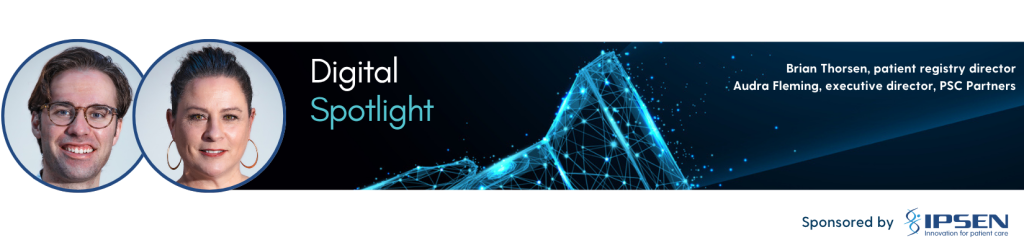
Audra Fleming, executive director of PSC Partners, and Brian Thorsen, director of the PSC Partners Patient Registry and a patient himself, share how advocacy is evolving from storytelling to system-shifting, and how patients really are the power behind meaningful and timely change
Written by Nicola Miller, RARE Revolution
Interview with Brian Thorsen, patient registry director, and Audra Fleming, executive director, PSC Partners
For Audra Fleming, who joined PSC Partners as executive director in 2024, she was struck by the might of this small charity. “When I met Ricky Safer, CEO and founder, I was in awe of what she had achieved,” Audra recalls. “I was excited to come on board and help take us to that next level.”
Today, PSC Partners is doing exactly that—building infrastructure where there was once only isolation: international research collaborations, a regulatory-ready natural history study, an extensive patient registry and a model of advocacy that insists patients are not just subjects, but co-architects of the science and systems that shape their lives.
Founded over 22 years ago, PSC Partners started with three urgent needs: education for patients and clinicians, community, so people no longer faced a frightening diagnosis alone and awareness raising. “Most of the doctors didn’t even know what PSC was, or how to treat it,” Audra says.
As the community grew, so did the mandate. Advocacy alone wasn’t enough. They recognised that to really move the needle they were going to need to get into the driving seat of research.
Today, PSC Partners has become a hub and its work includes:
- hosting annual and regional conferences that unite the whole ecosystem.
- maintaining a patient registry now numbering thousands
- sponsoring major projects like the Symptom Assessment Project and WIND-PSC natural history study
- advocating on policy and standards of care
- providing targeted support spaces for patients, caregivers, teens and the bereaved
- funding grants and sponsoring their own research
“We’re the place where people come—not only patients now, but clinicians and researchers,” Audra says. “The patient’s voice is what drives anything we’re doing.”
Brian Thorsen is clear about how the role of advocates has changed: “I’ll be a little blunt and say I don’t think you have a choice but to get involved in research,” he says. “PSC is a rare disease. Patients are spread all over. I don’t think we would be where we are in drug development without PSC Partners taking that leap.” For Brian patient partnerships are non-negotiable:
“It’s an obligation to have patients represented, not just because it’s morally correct, but because it’s better research.”
At PSC Partners, the “patient voice” is structured into decision-making through:
- deep interviews and listening sessions to define priorities
- large surveys like Our Voices to capture what matters most
- community voting on scientific proposals in their International Collaborative Research Network
- equal weighting of scientific and community committee reviews in the annual Research Grants programme
- co-development of patient-reported outcome (PRO) tools for fatigue, brain fog, and liver pain
- bidirectional communication where trial findings and study results are returned to the community in accessible language, accessible formats
PSC Partners’ approach to patient led priority-setting is also reshaping the research agenda. Through the International Collaborative Research Network (ICRN), they invited the community to rank and comment on research proposals—including complex biomarker and pathophysiology projects. Patients didn’t shy away from the science. Brian notes. “230 patients and community members provided detailed feedback and voted on scientifically dense research proposals.”
This community ranking model, which underpins landmark projects like BIOMAP-PSC, helps define what gets funded. Projects must not only be scientifically strong but clearly address patient-defined needs—for example, slowing disease progression, understanding PSC–IBD interactions, and improving cholangiocarcinoma detection. Researchers are pushed to clearly articulate patient relevance, leading to better designed and more impactful studies, and advocates gain scientific literacy, strengthening their ability to engage with industry and regulators.
PSC Partners recognises that excellent science must also be equitable science. For rare diseases, the stakes are particularly high—small samples magnify any bias in who is—and is not—represented. PSC Partners doesn’t pretend one patient’s experience is enough: “PSC is such a variable disease,” Brian says. “We’re not ‘patient-led’ just because we have one patient perspective. Diversity of voice and experience is needed.”
Today, research funders and regulators increasingly require evidence of meaningful patient engagement. PSC Partners response was to build structures in which the community itself shapes their work at every stage. Making the patient voice structural, not just symbolic.
The PSC Partners Patient Registry is an online platform where people with PSC—and qualified caregivers—share medical histories and complete focused surveys. It has become a live research engine that generates clean, analysable data, now informing trial design and endpoint development and helps identify who is out there, where, and with which burdens. “Patients have really rich, detailed stories to say,” Brian explains. “From a statistical side, it’s very clean data. We use that to help drive new programmes forward.”
The WIND–PSC study1 goes even deeper. It’s a prospective, international, patient-sponsored natural history study, designed to mirror a trial without a drug arm. Patients are followed over five years with regular symptom assessments, labs, and FibroScan measurements. “The goal is to prospectively enroll patients and track their disease progress as if they were in a clinical trial, but they’re not receiving a treatment,” Brian says.
This design offers industry and regulators a regulatory-ready cohort with rich longitudinal data1. This allows for the possibility of a future “synthetic placebo”, reducing the need for large placebo arms and provides a flexible platform for comparative and exploratory studies. “Everyone we’re hearing from is supportive says Audra, confirming, “The data we’re collecting over this five-year period is going to be invaluable.”
WIND-PSC enrollment, woven into standard care for over 600 patients (and counting) across 18 international sites, is producing a more representative cohort than many PSC trials further supporting diversity of voices.

One of PSC Partners’ key contributions is translating between laboratory science and patient-centred outcomes (PROs). The Symptom Assessment Project illustrates this. With no robust blood or imaging-based surrogate for PSC progression, the team focused on other aspects of what regulators explicitly value: “improving how patients feel or function”.
Through intensive community input, they developed three new PRO tools for fatigue, brain fog, and liver pain—symptoms that are highly prevalent but chronically under-documented.
“These are now tools that patients can use to communicate with their providers,” Brian explains. “Often providers aren’t asking about symptoms, or patients mention them and they aren’t logged in their chart. They can now use these tools and attach them as a note.”
This doesn’t just support better clinic visits; it lays groundwork for future trial endpoints centred on what actually burdens people.
As a statistician, Brian lives the tension between rigour and urgency: “That is the fundamental thing,” he says.
“Patients know their symptoms better than their doctors do. The challenge is converting that into something statistically ready—and being able to detect not just statistically significant but clinically and personally significant changes. Tools built specifically for the unique PSC symptom experience will better measure and show these changes.”

PSC Partners has also learned to work upstream in policy and system reform.
A major win was securing a dedicated ICD-10 code for PSC (K83.01): “Previously, we did not have an ICD-10 code,” Brian explains. “This meant payers didn’t know the impact and we didn’t know who was actually being seen, in accurate numbers.” The code now removes this misalignment.
Transplant policy is another focus. PSC patients can be disadvantaged by the MELD score, leading to efforts to secure and refine exception points for complications like early cholangiocarcinoma and recurrent acute cholangitis. Change can also start at hospital level. Brian tells of a patient whose annual MRIs used “thick slices”—too low resolution for PSC: “She really led this conversation,” he recalls. “The radiology board reviewed it and changed it to thin slices. Little things like that can make a big difference at a personal and policy level.”
For Audra, comparisons with cancer highlight how far rare liver diseases still have to go:
“When my parents were diagnosed with cancer, at the first appointment they were handed details of clinical trials and support groups,” she says. “This doesn’t happen as standard in PSC.”
To shift that, PSC Partners work hard to get a seat at the table for important conversations. This includes sitting on FDA and specialist panels. They are also building coalitions with cholangiocarcinoma, IBD, and liver organisations to achieve a larger collective share of voice when bringing data plus real-world narratives to policymakers who lack sophisticated disease knowledge.
When looking at policy, Audra would also like to see mental health and wellbeing benefit from policy protection. Much of PSC’s burden is invisible: fatigue, brain fog, itch, uncertainty. The mental health impact is profound—for patients and caregivers. “There’s grief associated with a diagnosis,” Brian says. Audra believes mental health must be treated as core care, not an afterthought:
“I don’t think mental health has been touched on enough,” she says. “I would love to see that when someone’s diagnosed with PSC, mental health is part of treatment from the very beginning.” A change that will take policy reform to see this integrated into clinical care as standard.
Collaboration in rare disease is about shared ownership of problems and solutions.
Examples include:
- joint funding and design of the CCA blood test project with PSC Support UK
- bringing international IBD and PSC specialists into their annual conference to discuss integrated care
- encouraging industry to co-design trials with the community, including remote visits and lower-burden protocols
- cross-disease learning from communities facing similar symptoms or burdens, such as chronic fatigue syndrome and long COVID, particularly for brain fog and profound fatigue
“For the individual advocate or fledging organisation who feels small in the face of a complex medical system, remember: your experience is data,” Brian says. “When you share it, especially with others behind you, you’re not just telling a story—you’re changing the system’s assumptions.”
Advocacy is no longer an external add-on to the scientific process. It is the connective tissue holding together patients, caregivers, clinicians, researchers, industry and regulators in a shared project: turning visible and invisible burdens into visible and measurable change. And change is coming.
“One of the biggest responses we got from our 2025 conference,” Audra says, “was people saying, ‘This is really the first time I’ve walked away feeling like something is coming.’ That hope comes from seeing how their participation—stories, surveys, trials, everything—adds up to real momentum.”

Beyond today’s trials and symptom tools, PSC research is pushing into new frontiers.
One such area is the gut microbiome. With around 70–80% of people with PSC also living with inflammatory bowel disease, the gut–liver axis is under intense scrutiny. “We’re looking at microbiota and faecal transplant2,” Brian explains. “The gut microbiome is a really new frontier, and we see it is markedly different in PSC. We’re still some way away from being able to make clear causal remarks, but there are definitely significant associations being seen.”
For patients, this raises the prospect of non-invasive, biology-based interventions that might alter disease course, cancer risk, or inflammation—without relying solely on invasive transplants.
At the same time, researchers are experimenting even further upstream, at the level of the bile ducts themselves. “We had a presenter at the conference talk on a mouse model where they’re completely able to regenerate new bile ducts,” Brian notes.
“Thinking outside the box like that, the science is constantly advancing. While there may be setbacks in some areas, there are always new areas where we can move forward.”
Taken together, these strands point toward a future where PSC care depends less on watching and waiting, and more on targeted interventions that aim to change the disease before damage is done. And PSC Partners and their international partners in advocacy are ensuring that this progress is patient powered all the way!
To learn more about the work of PSC Partners, please visit: https://pscpartners.org/


References
[1] https://pscpartners.org/research/wind-psc/
[2] https://pubmed.ncbi.nlm.nih.gov/39762111/
Articles within this digital spotlight are for information only and do not form the basis of medical advice. Individuals should always seek the guidance of their medical team before making changes to their treatment.
This digital spotlight has been made possible with financial sponsorship by Ipsen. They have had no editorial control over the copy, and all opinions are those of the contributor.
RARE Revolution Publishing® retains all copyright.